The existence of circumbinary planets — exoplanets that orbit binary stars — has only been firmly established over the past 15 years. Observations from NASA’s Kepler Space Telescope and Transiting Exoplanet Survey Satellite (TESS) have led to the detection of 14 such planets using the transit method. Now, a novel technique applied to the TESS data has revealed 27 new circumbinary candidates, hinting that such exotic systems may be more common than once believed.

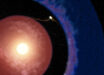
An artist’s impression of a circumbinary exoplanet and its two parent stars. Image credit: Sci.News.
The new planet candidates range from objects that could be as small as the mass of Neptune to 10x as large as the mass of Jupiter.
The closest is about 650 light-years away from Earth, and the furthest about 18,000 light-years away.
“The candidates are scattered across both our southern and northern skies,” said University of New South Wales astronomer Ben Montet, co-author of the study.
“This means that any time of the year, no matter when you’re looking, at least one of these star systems is out there visible for you to look towards — as long as you have a telescope.”
“We found 27 planet candidates out of 1,590 binary star systems, which is an almost 2% rate of binary systems that could potentially host planets.”
“That implies there could potentially be thousands, or tens of thousands, of possible planets to be found with data from the Vera C. Rubin Observatory’s new 10-year sky survey, the Legacy Survey of Space and Time.”
“So it’s a really exciting first step — and it also shows that there’s going to be a lot of work to do over the next few years.”
The team’s new planet-finding method, called apsidal precession, has been used to characterize binary stars before, but not in a large-scale search for exoplanets.
It involves monitoring how the binary stars’ orbit of one other — made visible by their stellar eclipses — change over long periods of time.
If there’s a variation in their eclipse schedule that can’t be explained by general relativity or stellar interactions, it means a third body could be influencing the stars’ orbits — and that body could be a planet.
“Most of our current knowledge on planets is biased, based on how we’ve looked for them,” said lead author Margo Thornton, a Ph.D. candidate at the University of New South Wales.
“We’ve mostly found the easiest ones to detect.”
“This new method could help us uncover a large population of hidden planets, especially those that don’t line up perfectly from our line of sight.”
“It could help reveal what the true population of planets in our Universe might look like.”
“I’m excited about the potential for how many planets we could find with this method,” Dr. Montet said.
“I wasn’t expecting to find 27 already at this point from the pilot study.”
“Now we get to start the really fun project of figuring out which ones are real planets.”
The team’s results appear in the Monthly Notices of the Royal Astronomical Society.
_____
Margo Thornton et al. 2026. Detection of 27 candidate circumbinary planets through apsidal precession of eclipsing binaries observed by TESS. MNRAS 548 (3): stag515; doi: 10.1093/mnras/stag515