The way humans laugh — in rapid, rhythmically timed bursts — is not uniquely ours. New research by the University of Warwick and the University of Portsmouth shows that all great apes, from orangutans to gorillas to chimpanzees, share the same fundamental timing structure in their laughter, suggesting that the common ancestor of all living great apes was already laughing in a recognizable way at least 15 million years ago.
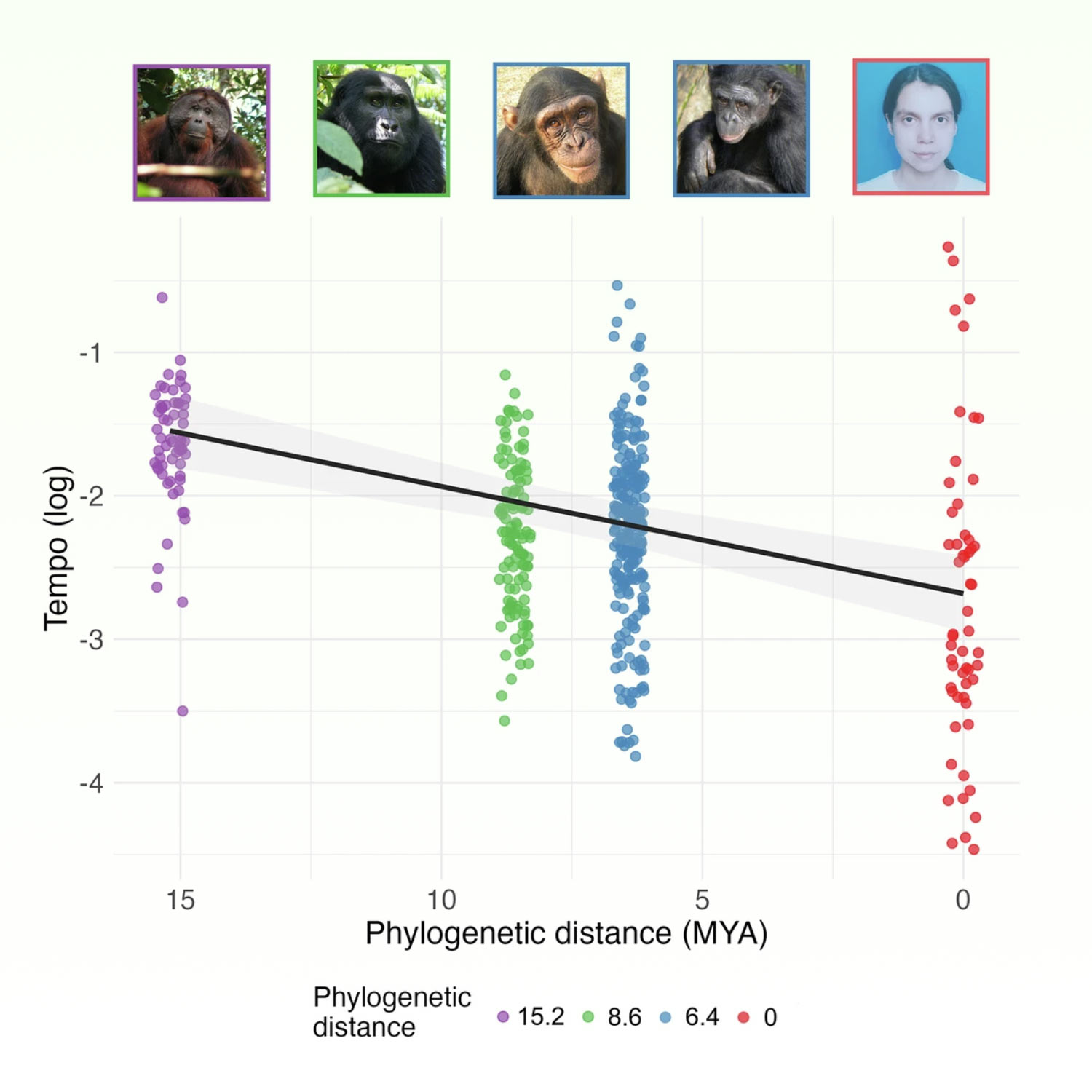
Variation in laughter tempo across five great ape species (orangutans, gorillas, bonobos, chimpanzees, and humans): each dot represents an individual observation; color indicates phylogenetic distance (in million years ago); each square contains an image of the corresponding species, with a matching dot color for intuitive reference. Image credit: De Gregorio et al., 10.1038/s42003-026-10499-z.
“Sound does not fossilize, making it difficult to trace the vocal origins of song, speech, and language,” said University of Warwick researcher Chiara De Gregorio and colleagues.
“Comparative studies of the behavior of (non-human) great apes — our closest living relatives — provide the only extant model of extinct vocal capacities and adaptive functions among human ancestors.”
“While all major branches of the hominid family have evolved distinct call repertoires shaped by their species-specific socio-ecologies, one vocalization has been conserved across species and age-sex classes: laughter.”
In the study, the researchers recorded laughter from 17 individuals across all five great ape species in both tickling and social play situations.
The study involved four orangutans, two gorillas, three bonobos, four chimpanzees, and four humans, including children between six months and seven years old.
Their analysis revealed that laughter across all species is isochronous — that is, the bursts occur at regular, evenly spaced intervals — a property also observed in music and speech rhythm.
According to the scientists, this basic rhythmic structure was already present in a shared common ancestor 15 million years ago and has remained remarkably conserved with all living great apes still show the same underlying pattern.
But they also found meaningful differences along the evolutionary tree: as species grow closer to humans on the family tree, their laughter becomes faster, more variable in timing, and more sensitive to social context.
Humans stood out as the only species to adjust their laughter tempo depending on whether they were being tickled or engaged in free play.
The authors also noted that in human laughter, variable timing is perceived as more emotionally warm and socially positive than rigid, robotic-sounding laughter, suggesting that rhythmic flexibility carries real social meaning.
“It is impossible to assess the precursor forms of language directly from our extinct ancestors,” said Dr. Adriano Lameria, also from the University of Warwick.
“Laughter, being evolutionarily older and having remained shared between all living great apes, provides a rare evolutionary window into the vocal transformations that unfolded across hominid evolution until the first humans appeared on scene.”
“Contrary to the classic notion that the first humans suddenly acquired vocal control capacities remarkably different from their predecessors, laughter evolution tells us that humans lay on a continuum, a prolongation of vocal control capacities that were already being cumulatively honed in for 15 million years.”
The findings were published June 25, 2026 in the journal Communications Biology.
_____
C. De Gregorio et al. 2026. Rhythm and timing in laughter reveal that human vocal plasticity falls on a hominid continuum. Commun Biol 9, 824; doi: 10.1038/s42003-026-10499-z