Scientists in Australia have revealed that what was long thought to be a single widespread planigale species is actually four distinct ones, including an entirely new species found only in the rocky slopes in Kakadu National Park.
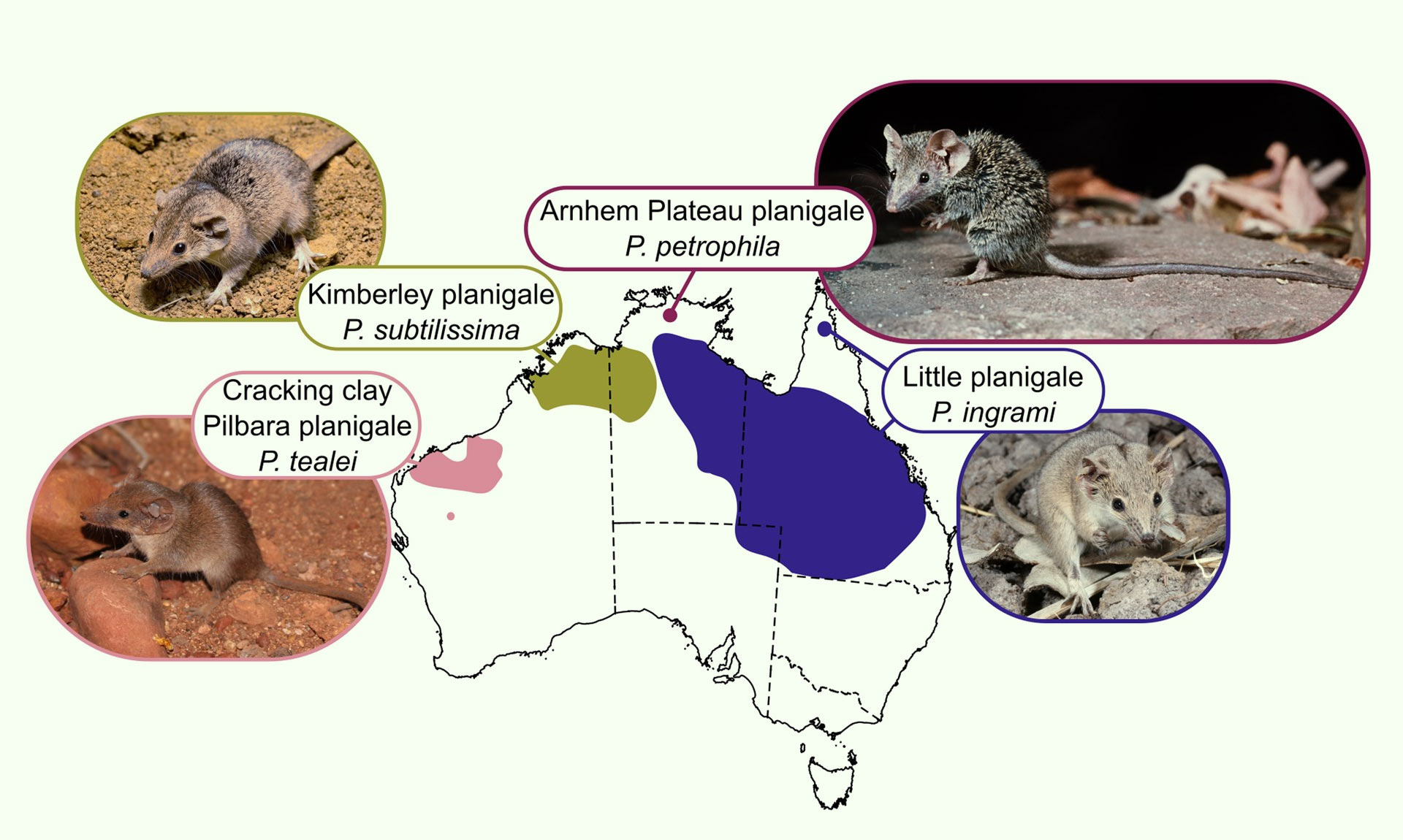
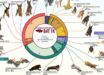
Revised distributions of the four planigale species formerly attributed to Planigale ingrami. Image credit: Umbrello et al., doi: 10.1093/zoolinnean/zlag082.
Planigales are tiny, mostly insectivorous marsupials with flattened skulls that allow them to squeeze into habitat crevices.
They occur in a range of terrestrial environments across Australia and New Guinea, with nine species now recognized.
One of them, Planigale ingrami, is the smallest marsupial species in the world, with adults reaching an average body weight of only 4.2 g (minimum 2.6 g) and with a head-body length of 5.7 cm.
In a new study, Dr. Linette Umbrello, a researcher at the Western Australian Museum and the Queensland University of Technology, and colleagues used genetic analysis and museum specimens to untangle what they call the Planigale ingrami species complex, which includes Planigale ingrami, the recently described Planigale tealei, and two cryptic lineages.
They combined DNA from over 220 individual animals with detailed measurements of skulls and body proportions drawn from collections held in natural history museums across Australia.
“In this study, we used samples from museums across Australia as an invaluable resource that allowed us to recognize species we would never detect in the wild today,” Dr. Umbrello said.
“We conducted comprehensive genetic sampling and morphological (body shape and size) analyses on planigale specimens from museum collections around Australia.
“We then combined these two sets of data in a process called integrative taxonomy to work out whether there were distinct species that had previously been classified as one species.”
The researchers identified three unique lineages within the Planigale ingrami complex.
“We brought back the name Planigale subtilissima, for planigales found in the Kimberley in Western Australia, which had been lumped in with Planigale ingrami but are actually a separate species,” Dr. Umbrello said.
“We also found that the subspecies Planigale ingrami brunnea was just part of Planigale ingrami, so we merged it back into its former classification.”
“And we discovered a completely new species, Planigale petrophila.”
Planigale petrophila (common name is the Arnhem Plateau planigale) stands out from its relatives in several ways.
While most planigales are associated with cracking clay soils in lowland areas, this one appears to favor rocky escarpments.
It is notably larger than its closest relatives and has the longest tail recorded for any planigale, stretching longer than its own body.
“Planigale petrophila is a medium-sized species of planigale, with an extremely flattened and long skull and a very long tail,” the scientists said.
“It differs from all other Australian planigale species in having the greatest tail length recorded for any congener (8.05-9.19 cm), although some large male Planigale novaeguineae (New Guinean) specimens reach 8 cm.”
Planigale petrophila is known from only three specimens, all collected within roughly 12 km of each other in Kakadu National Park, the most recent of which was caught in 2004. No individual has been documented since.
The authors call for an urgent conservation assessment, noting that native mammal populations in Kakadu have already experienced severe and well-documented declines.
“Planigale petrophila is apparently rare among Australian planigales because, so far, only three specimens have ever been found, and it is known only from a small area of the sandstone plateau and rocky slopes in Kakadu National Park in western Arnhem Land,” Dr. Umbrello said.
“Planigale maculata has also been recorded in Kakadu National Park and is the only species that overlaps with the known distribution of Planigale petrophila, although it has not been found on the sandstone plateau but rather in the lowlands and drainage basins that surround it.”
“Planigale petrophila is unique in having a much longer tail than all other planigale species and is larger in all body and skull proportions to its closest genetic relatives.”
“The scarcity of Planigale petrophila indicated it could be threatened,” added Dr. Andrew Baker, a researcher at the Queensland University of Technology and Queensland Museum.
“Given the small geographic area where Planigale petrophila has been found, and the alarming declines in other mammal species from northern Australia, we recommend an urgent full conservation assessment of the species in the Territory.”
“This species is known from only three specimens found within 12 km, and it has not been encountered or re-collected since 2004.”
“Correct classification and taxonomy are critical in conservation to ensure that management decisions and actions are applied appropriately.”
“This information is important when determining an appropriate conservation status for this new mammal species, especially in the context of declines suffered by other native mammals in Kakadu and Australia more broadly.”
The team’s results appear in the Zoological Journal of the Linnean Society.
_____
Linette S. Umbrello et al. 2026. Untangling the long-tailed planigale (Dasyuridae: Planigale ingrami) species complex: four species revealed using integrative taxonomy. Zoological Journal of the Linnean Society 207 (2): zlag082; doi: 10.1093/zoolinnean/zlag082