Paleoanthropologists have identified a trove of Denisovan fossils from a cave in China’s Yunnan province, extending the known range of the elusive human...
Researchers have identified more than 1,200 locations in the human genome associated with personality traits, offering the most detailed look yet at the...
An enduring debate in paleoanthropology asks what kind of foot the last common ancestor (LCA) of humans and chimpanzees had: one built like a modern ape’s...
Dr. Ian Towle, a researcher with the Biomedicine Discovery Institute at Monash University, proposes folding nearly 5 million years of hominin fossils into...
A new analysis of three skull fragments unearthed at the Gran Dolina cave site in Spain indicates that Homo antecessor had bone thickness closer to that...
Neanderthals vanished roughly 42,000 years ago, but a piece of their biology appears to be quietly at work in some people today, according to a new study...
A team of researchers from the University of Sydney and the University of Glasgow argues that dietary sugars, not animal foods, may have played the decisive...
New research led by the University of California, Berkeley reveals that beyond Neanderthals and Denisovans, humans interbred with two mysterious ‘ghost’...
A fossilized skull fragment of Homo sp. unearthed in central Spain offers paleoanthropologists a fresh window into the story of ancient humans who lived...
Ararat-1, a modest limestone cave that lies at an elevation of 1,034 m on the eastern flanks of the Ararat Depression in central Armenia, has yielded a...
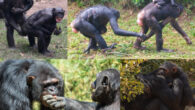
In a new study of chimpanzees (Pan troglodytes) and bonobos (Pan paniscus), scientists found that embraces, touches and other reassuring gestures before...
When paleoanthropologists announced the discovery of Homo floresiensis on the Indonesian island of Flores in 2003, the tiny, small-brained species quickly...
For the first time, researchers have extracted ancient human DNA directly from the walls of a cave. Although their results do not conclusively link ancient...
Scientists have generated genetic data from 27 Neanderthals who lived in Belgium and France less than approximately 52,500 years ago, painting a richer...
Domestic cats (Felis catus) develop the same patterns of brain shrinkage and neurological decline as aging humans, and scientists think that makes them...
New research from the University of Oxford and the University of Reading suggests bipedalism and expanding brain size helped drive the overwhelming dominance...