Paleoanthropology News

Jun 8, 2026 by News Staff

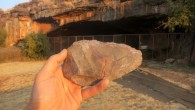
Geochemical analysis of 780,000-year-old stone tools from Israel suggests Acheulean (or Acheulian) hominins repeatedly sought specific basalt sources, revealing sophisticated planning and deep knowledge of their landscape. The basalt slabs at the Acheulean site of Gesher Benot Ya‘aqov in Israel were used for biface production, and most of their knapping took place away from the site. Image credit: Chuang Zhao. “The acquisition of suitable raw...

May 22, 2026 by News Staff

New research from the University of Oxford and the University of Reading suggests bipedalism and expanding brain size helped drive the overwhelming dominance...

May 15, 2026 by Sergio Prostak

Scientists have extracted and analyzed proteins from the tooth enamel of six Homo erectus individuals who lived in China roughly 400,000 years ago, offering...

Apr 22, 2026 by News Staff

New research led by Max-Planck Institute of Geoanthropology and University of Cambridge scientists suggests malaria did more than sicken ancient populations,...

Apr 21, 2026 by Enrico de Lazaro

Mitochondrial DNA (mtDNA) from eight fossils found in Stajnia Cave in Poland reveals a tight-knit group of Neanderthals who lived about 100,000 years ago,...

Apr 8, 2026 by Enrico de Lazaro

New evidence from Germany suggests Neanderthals captured European pond turtles (Emys orbicularis) around 125,000 years ago, likely valuing their shells...

Mar 30, 2026 by News Staff

Both the Tasmanian tiger (Thylacinus cynocephalus) and the Tasmanian devil (Sarcophilus harrisii) are believed to have become extinct on the Australian...

Mar 26, 2026 by News Staff

Scientists have extracted and analyzed DNA from 216 canid remains, including 181 from Paleolithic and Mesolithic Europe. The oldest data that they recovered...

Mar 19, 2026 by News Staff

Examining 31 ancient societies across Europe, Asia, and the Americas, researchers found that democratic systems were more widespread than once believed...

Mar 19, 2026 by News Staff

A cache of 142 beads and pendants from five Natufian (15,000 to 11,650 years before the present) sites in Israel reveals that clay was first used not for...

Mar 18, 2026 by News Staff

New experiments show that tar made from birch bark — long known as a tool adhesive — can inhibit harmful bacteria such as Staphylococcus aureus,...

Mar 16, 2026 by Enrico de Lazaro

Chemical clues preserved in the teeth of straight-tusked elephants (Palaeoloxodon antiquus) from the 125,000-year-old site of Neumark-Nord in Germany suggest...

Mar 5, 2026 by Sergio Prostak

A 7.2-million-year-old thigh bone unearthed at the fossil site of Azmaka in southern Bulgaria displays a mosaic of features suggesting a unique combination...

Mar 5, 2026 by News Staff

An international team of archaeologists has examined a total of 85 pottery sherds with substantial amounts of foodcrusts from 13 archaeological sites across...

Mar 3, 2026 by Enrico de Lazaro

Beyond their value for classification and evolutionary relationships, changes in the size and shape of the hominin face through time can reflect important...

Mar 2, 2026 by News Staff

Prehistoric humans and Neanderthals didn’t just interbreed, they did so with a consistent sex bias, as male Neanderthals and female modern humans mated...

Feb 26, 2026 by Enrico de Lazaro

The ancestors of today’s malaria-spreading mosquitoes in the Anopheles leucosphyrus (Leucosphyrus) group may have shifted to feeding on humans around...

Feb 25, 2026 by Sergio Prostak

Early humans living in Europe some 40,000 years ago developed a conventional system of geometric signs — deliberate, repeatable markings that went...

Feb 23, 2026 by Enrico de Lazaro

New research recalibrates the age of the Jordan Valley’s Ubeidiya Formation to nearly two million years, putting it on par with the famous site of Dmanisi...

Feb 18, 2026 by Enrico de Lazaro

New dating of fossil skulls from the Early Pleistocene site of Yunxian in China suggests that early members of Homo erectus lived in eastern Asia nearly...