A nearly complete skull unearthed decades ago in Arizona has given paleontologists their clearest look yet at Adelphailurus kansensis, an enigmatic felid species that inhabited North America more than 5 million years ago and occupied an early branch of the saber-toothed cat family tree.
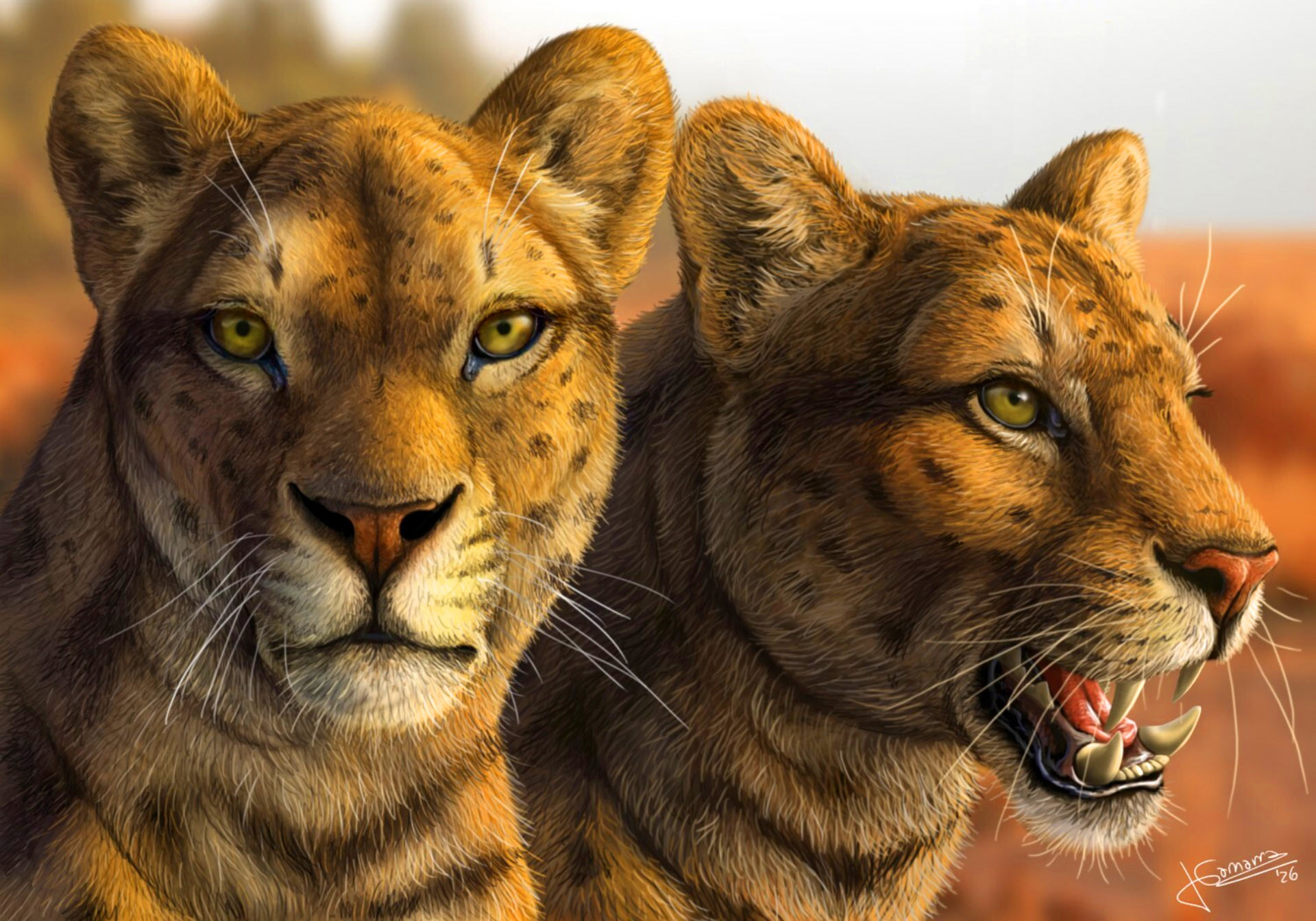
Life appearance of Adelphailurus kansensis based on the newly described material. Image credit: Jesús Gamarra.
Adelphailurus kansensis is an early-diverging machairodontine felid that prowled North America about 7 to 5 million years ago.
The species was first described in 1934 from a fragmentary jaw discovered in Kansas.
Since then, additional fossils had been attributed to Adelphailurus kansensis, but its anatomy remained poorly understood because no complete skull had been studied.
“The machairodontine felid Adelphailurus kansensis was a puma-sized felid, originally described from the Late Hemphillian (latest Miocene) deposits of the Edson Quarry, Kansas,” said University of California, Berkeley paleontologists Narimane Chatar and Z. Jack Tseng.
“The holotype consists of left and right maxillae with a nearly complete dentition.”
“Since then, additional material has been referred to this species.”
“In 1983, paleontologists identified postcranial remains from the Wikieup local fauna (Mohave County, Arizona), housed at the American Museum of Natural History, but did not describe the full set of fossil remains from the locality, which includes a virtually complete cranium with associated canines and mandibular fragments.”
In a new study, Dr. Chatar and Dr. Tseng examined this material from the American Museum of Natural History.
The specimen includes a nearly complete skull, associated jaw fragments and isolated upper canine teeth.
According to their analysis, the skull belonged to a cat about the size of a cougar, but one that was beginning to develop some of the hallmarks of later saber-toothed predators.
Its upper canines were flattened and serrated, though far less exaggerated than those of famous saber-toothed species such as Smilodon.
“The shorter upper canines of the ancestral species of saber-toothed animals, including Adelphailurus kansensis, support our theory that once these hyper carnivores started to evolve longer fangs, they were unable to get rid of them,” the researchers said.
They found that the animal’s narrow snout resembled that of Metailurus, an early saber-toothed cat known from Eurasia, while its rounded skull profile was more similar to species of Yoshi, another primitive saber-toothed genus.
Yet Adelphailurus kansensis differed from both in having unusually thin cheekbones and several distinctive dental characteristics.
“We’ve never found any lineage that started developing long upper canines and then stopped and went back to a less specialized state; once a group starts, they (the fangs) go crazy and then they go extinct,” Dr. Chatar said.
“Saber-toothed carnivores are an example of something called the macroevolutionary ratchet, where basically, you start developing some super specialized morphology and you get very efficient at doing one single thing, but when the environment changes to make that thing harder — harder to find prey and hunt, for example — then you’re just more likely to go extinct.”
The analysis also sheds light on a longstanding taxonomic problem.
Several fossils now attributed to Adelphailurus kansensis had originally been assigned to Pseudaelurus, a catchall category for primitive felid fossils.
“Pseudaelurus has been referred to as a wastebasket genus for average-sized Miocene felids,” the scientists said.
The team’s findigns also contribute to a larger debate over the origins and early diversification of saber-toothed cats.
During the Late Miocene, carnivores moved between Eurasia and North America via the Bering Land Bridge.
The authors suggest that Adelphailurus kansensis may represent a separate migration of primitive saber-toothed cats into North America, distinct from earlier feline dispersals.
“Although the North American fossil record does not yet permit a full resolution of the number and timing of dispersal events, our reexamination of Adelphailurus kansensis cranial material highlights its mosaic morphology somewhat in between Yoshi and Metailurus, consistent with its placement near the base of machairodontine diversification,” they concluded.
The team’s paper was published in the Journal of Vertebrate Paleontology.
_____
Narimane Chatar & Z. Jack Tseng. New material of Adelphailurus kansensis sheds light on the cranial anatomy of an early-diverging machairodontine felid. Journal of Vertebrate Paleontology, published online June 19, 2026; doi: 10.1080/02724634.2026.2667939