New research from the University of Bristol suggests that pterosaurs — the first vertebrates to achieve powered flight — probably displayed a much wider array of wing shapes and flying styles than fossil-based reconstructions have depicted.
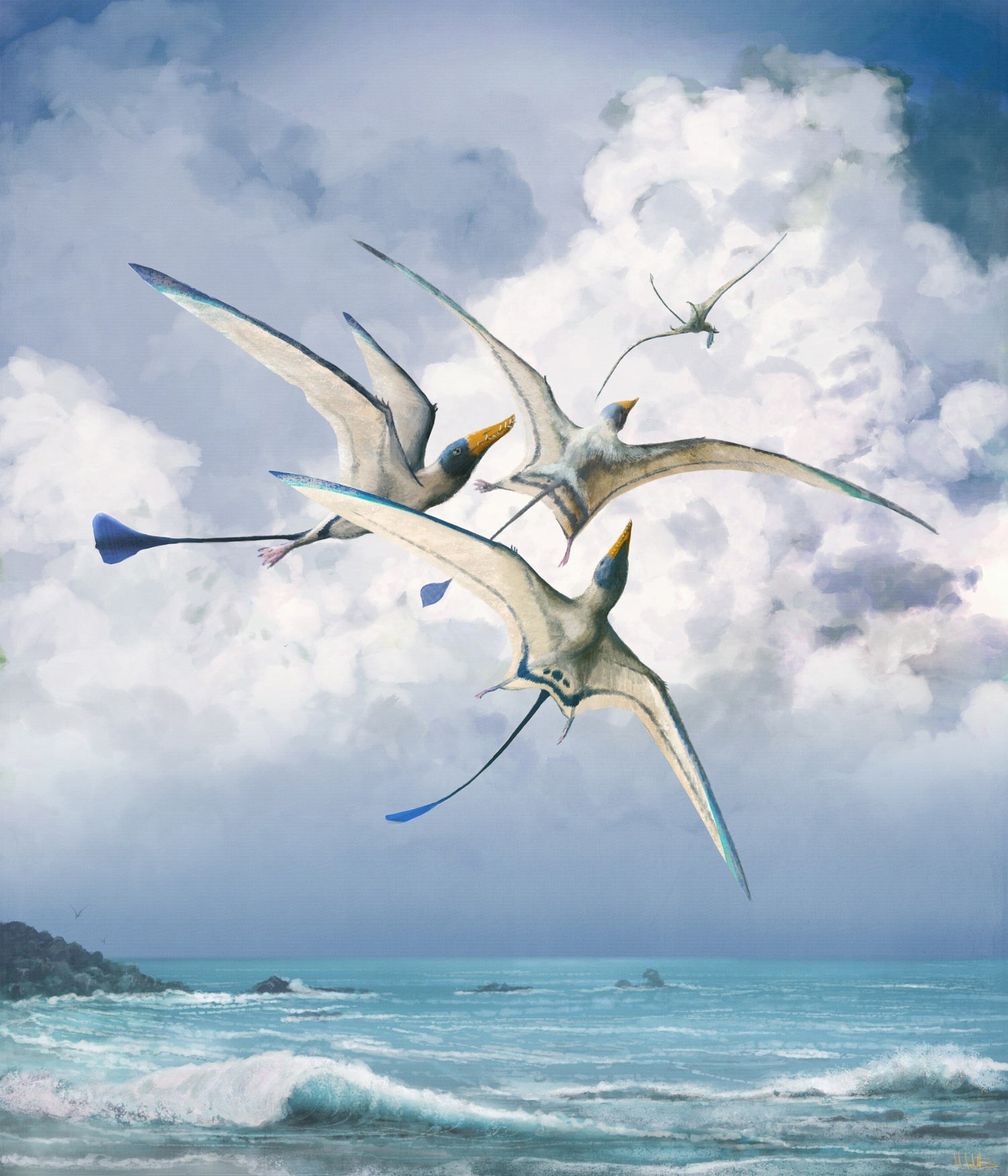
Walters et al. compared theoretical pterosaur wings with published reconstructions over a series of shape and function tests to understand whether the current scientific understanding of pterosaur wing shape is likely to accurately represent the diversity of pterosaur wing shapes and whether issues in depicting pterosaurs stem from the style or substance of life reconstructions; their results revealed that reconstructions do not perform as expected and thus do not accurately represent the flight abilities of pterosaurs. Image credit: Mark P. Witton.
Pterosaurs thrived from about 210 to 65 million years ago, when they were wiped out by the asteroid that also doomed all non-avian dinosaurs.
These reptiles are significant because they independently evolved flight and, through the course of their evolutionary history, established new extremes in the maximum size for flying vertebrates.
Nevertheless, the precise shape of pterosaur wings remains poorly understood.
“Wing shape is integrally related to flight performance and function in living animals,” said lead author Dr. Benton Walters and colleagues.
“Analyzing this relationship in pterosaurs is complicated by the fragmentary nature of the fossil record and because the flight dimensions of wing membranes do not preserve.”
“In the absence of fully extended pterosaur wing fossils, scientific reconstruction of the pterosaur bauplan presents the clearest alternative for analysis.”
“However, these wing shapes are subject to multiple conflicting scientific opinions and the artistic styles of the researchers and illustrators reconstructing them.”
In the new research, the authors analyzed 79 wing reconstructions spanning eight pterosaur genera, including iconic species like Pteranodon and Quetzalcoatlus.
Using a method called theoretical morphospace, they created a map of all the possible shapes or forms the wings could have.
They were then able to test the function of wing reconstructions, to answer how well shaped they were for flight.
They found that the illustrations clustered too closely together in shape and aerodynamic performance, regardless of the size, age, or proposed ecological niche of the animal depicted.
A tiny insect-hawker and a giant ocean soarer — creatures that in life would have had dramatically different wings — end up looking nearly the same on paper.
According to the team, the problem is a persistent lack of scientific consensus on where exactly the wing membrane attached to the pterosaur’s body.
“In living flying animals, such as birds and bats, different lifestyles are associated with distinct wing shapes and flight abilities,” Dr. Walters said.
“The lack of comparable diversity in pterosaur reconstructions suggests that the reconstructions are missing important variation.”
“Reconstructions of pterosaur wings are commonly made using measurements of the bones which support the wing, and information about the soft tissues gleaned from a handful of exceptional fossils, but there is still a lot that cannot be definitively stated from these alone.”
“For a group of animals that existed for over 100-million years and includes both palm-sized and plane-sized animals, you would expect diversity in shape.”
“But wing shape was similar regardless of the pterosaur they depicted.”
“This research provides a helpful guide to show where the scientific understanding of pterosaur wings is lacking and will be used as a benchmark to test new and improved reconstructions of pterosaurs as our understanding of these amazing creatures improves.”
A paper describing this research was published June 23 in the journal Palaeobiology.
_____
Benton Walters et al. Exploring the limits of wing design in pterosaurs. Paleobiology, published online June 23, 2026; doi: 10.1017/pab.2026.10103