Fossils from the Jose Creek Formation in New Mexico reveal that angiosperms (flowering plants) had built dense, fruit-bearing forests nearly 75 million years ago — nearly 9 million years before the end-Cretaceous mass extinction that killed the dinosaurs — challenging a long-held evolutionary narrative about how they came to dominate the planet.
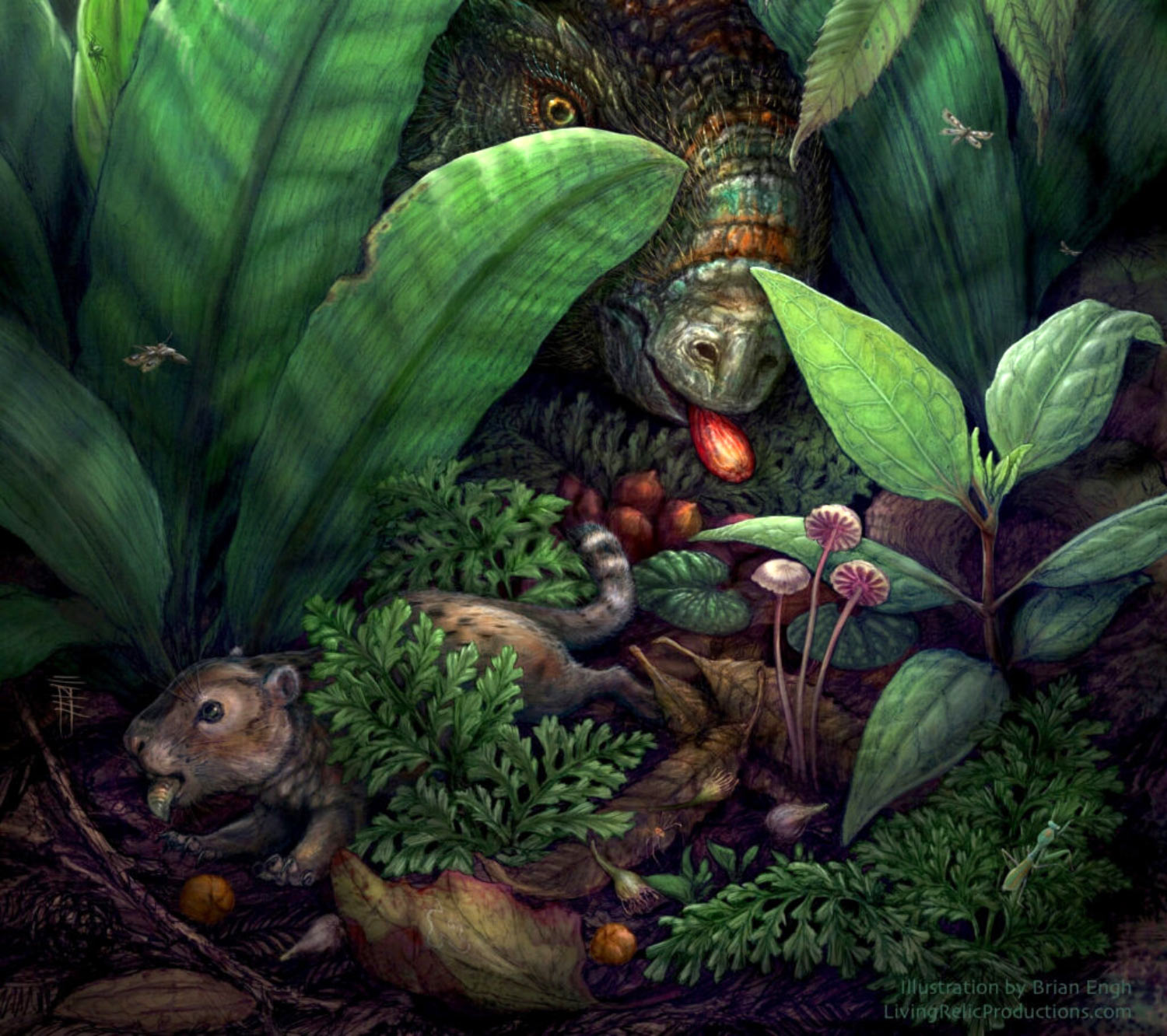
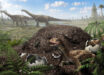
Reconstruction of the forest floor of the 74.6 million-year-old Dori’s Tuff flora, featuring hypothetical angiosperm-disperser interactions. The plants depicted, including the foliage, fruits, seeds and flowers, were illustrated in life position based on the fossil plants found at the site and their inferred growth habits. The mammalian and dinosaur seed dispersers depicted were based on the known fauna from the broader region during the Late Campanian age of the Cretaceous period. Image credit: Brian Engh, livingrelicproductions.com.
“Our results show that, at least in some hot and humid environments during the Late Cretaceous, well before the extinction boundary by 10 million years, angiosperms were already investing more resources into individual diaspores (dispersal units) and forming dense forests,” said University of California, Berkeley doctoral student Jaemin Lee.
Flowering plants arose about 135 million years ago in the Early Cretaceous and were initially small, weedy and inconspicuous, producing small seeds that dispersed unassisted or with a bit of wind.
The story goes that by the Late Cretaceous they had already diversified their size, leaves and flowers, but in the shadow of the dinosaurs, the way they dispersed their seeds did not change.
Contradicting that scenario, the Late Cretaceous fossilized forest from Dori’s tuff deposits of the Jose Creek Formation in New Mexico includes large-trunked flowering trees, such as laurel relatives and palms, and a great diversity of other flowering plants, growing alongside more ancient lineages of ferns and redwoods.
Unlike other Cretaceous floras where angiosperm diaspore size, on average, were comparable to a poppy seed, the average diaspore size in this fossil forest is comparable to a large blueberry, showing over a hundredfold increase in volume.
“This may not sound that big, but the large fruits we eat today are the result of centuries of selective breeding,” Lee said.
“Wild watermelons, for example, were only 5 cm (2 inches) wide.”
“The New Mexico site is unique in capturing an ancient environment at a single moment in time, when an ashfall buried an inland forest,” added University of California, Berkeley’s Professor Cindy Looy.
“Most fossil plant sites consist of material that ended up in lake, river or coastal sediments, which are conducive to fossilization but often represent a mashup of material from different times and habitats.”
“This ash came down within days, because ash doesn’t stay in the air very long. It’s really a snapshot in time.”
“At the base of the solidified ash layer you can still find ground cover plants.”
“And then a little bit higher up you just see leaves in all kinds of orientations because they were brought down by the ash.”
“You can think of it as like a botanical Pompeii, where ashfall deposits preserve everything in position and we can reconstruct the forest structure” Lee added.
“These diaspores are preserved together with various leaves and flowers, brought from the canopy down to the forest floor, by the ashfall.”
“This forest is the earliest known angiosperm-dominated forest with much larger diaspores and one of the most diverse Cretaceous leaf flora ever described.”
“The instantaneous preservation of everything, just with the minimal transport from the forest canopy to the bottom — really enabled the reconstruction of landscape in high detail.”
“It’s bringing more light into the complexity of ecological interactions in groups that we no longer have.”
The findings were published June 25 in the journal Science.
_____
Jaemin Lee et al. 2026. Diversification of angiosperm reproductive strategies predated the end-Cretaceous extinction. Science 392 (6805): 1380-1383; doi: 10.1126/science.adw9457