Fossils trapped in amber aren’t just beautiful, they may preserve real ecological interactions, including possible parasitism or commensal relationships between ants and mites, as revealed by a new, cutting-edge morphological study of six specimens of Baltic, Dominican and Burmese amber.
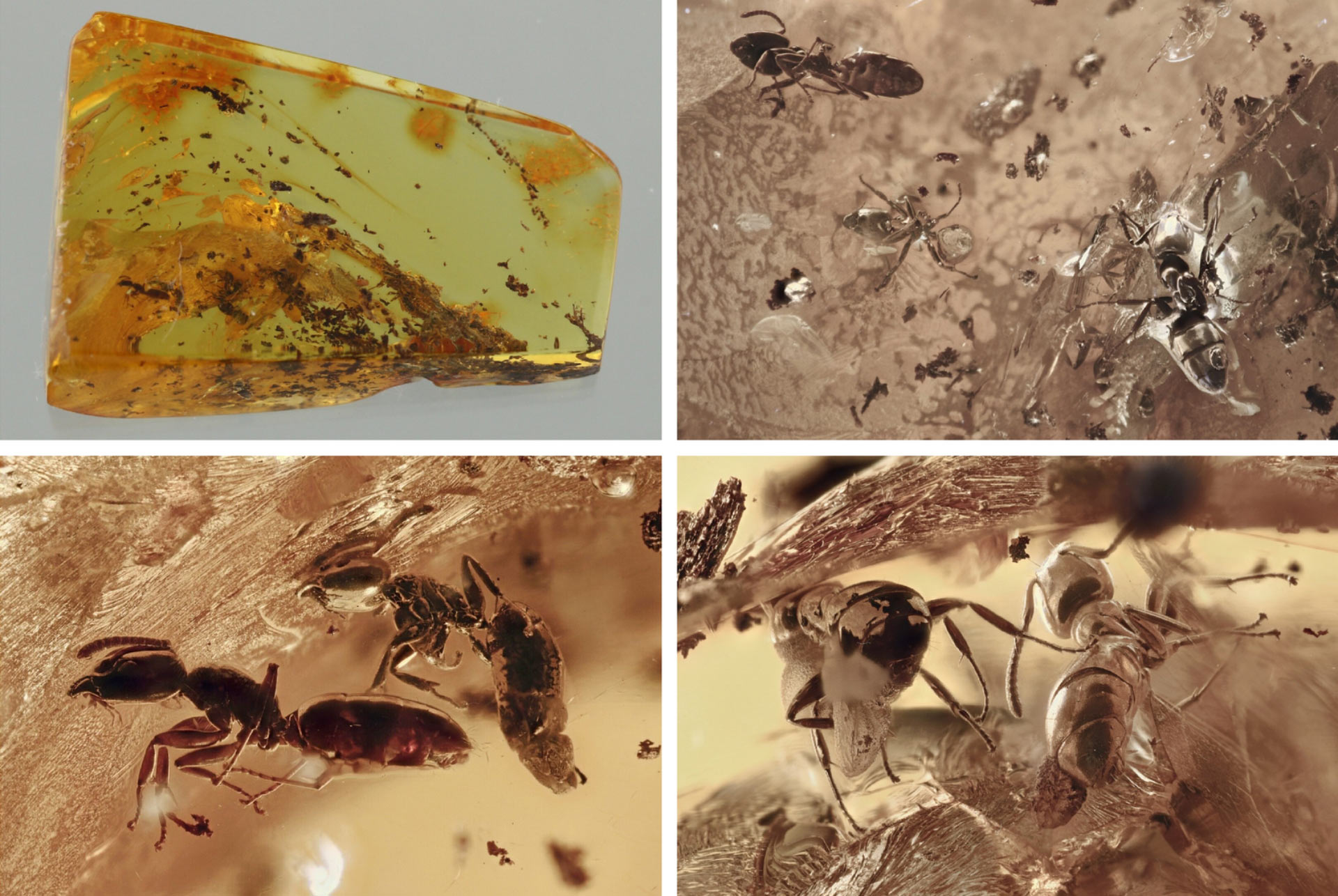
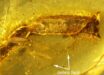
Fossil ant colony preserved in a piece of Baltic amber from Lithuania. Image credit: José de la Fuente & Agustín Estrada-Peña, doi: 10.3389/fevo.2026.1724595.
“Amber inclusions are representative of possible interactions between different organisms shaping the environment,” said Dr. Jose de la Fuente, a paleontologist at the Institute for Game and Wildlife Research.
“The identification and morphological characterization of fossil ants in amber with other inclusions of insects provides a snapshot of life on Earth millions of years ago.”
In the new study, Dr. de la Fuente and colleagues analyzed four pieces of Cretaceous amber (99 million years old), one piece of Eocene amber (from approximately 56-34 million years ago), and one piece of Oligocene amber (from approximately 34-23 million years ago).
The specimens included ancient ants and other organisms, a rare phenomenon called syninclusion.
“The earliest ants, which were first found in the Upper Cretaceous, are known as stem ants and didn’t leave modern descendants; all ants alive today evolved from crown ants,” the paleontologists said.
“Both species are found in the six pieces of amber we studied, as well as hell ants, which evolved from stem ants.”
The researchers used powerful microscopes to examine the specimens, identify the different species found inside, and measure the distance between ants and other species.
In three of the six pieces of amber, they found ants in close proximity to mites.
In the first piece, they found a crown ant, wasp, and two mites so close to the ant that they may have been traveling on it.
The second piece contained a stem ant and a spider, while the third specimen contained a hell ant, a snail, a millipede, and some unidentifiable insects.
The fourth specimen contained a stem ant and a mite, about 4 mm apart.
The fifth piece also contained three different ant species close to a mite and some termites, as well as poorly-preserved mosquitoes and a winged insect.
In the sixth specimen, the scientists found a stem ant alongside a probable parasitic wasp and a spider. The ant seems to have been feeding on something.
It is resting against another insect inclusion, which could be a worm or a larva, but as there’s no indication that the two were interacting, the scientists think this was a coincidence.
“The closest ant syninclusions are more likely to reflect behavior and interactions between these organisms,” Dr. de la Fuente said.
“The proposed ant-mite interactions in the fourth specimen may reflect two possible scenarios.”
“First, a commensal specialized temporal relationship where mites attach to ants for free ride dispersal to new habitats.”
“Second, a parasitism when mites feed on the ant host during transport.”
Although pieces of amber that contain ants are rare, and pieces of amber that contain multiple species are rarer, there is some published evidence that points to interactions between mites and ants, sometimes mutually beneficial.
Future research could help clarify this by using micro-CT scanning to look for attachment structures on mites which would have allowed them to clamber onboard ants for travel purposes.
“To improve the analysis of interactions between different organisms in fossil amber inclusions, future research should use advanced imaging techniques,” Dr. de la Fuente said.
“Nevertheless, these results provide evidence of insect behavior and ecological habits.”
The team’s paper appears today in the journal Frontiers in Ecology and Evolution.
_____
José de la Fuente & Agustín Estrada-Peña. 2026. Description of fossil amber with ant syninclusions. Front. Ecol. Evol 14; doi: 10.3389/fevo.2026.1724595