A small fossil collected on an Antarctic island more than four decades ago is a tail vertebra of a titanosaurian sauropod dinosaur that roamed Antarctica roughly 83 million years ago, according to a new paper in the journal Acta Palaeontologica Polonica. The discovery represents only the second sauropod body fossil known from Antarctica, although it was the first dinosaur bone to be collected from the continent.
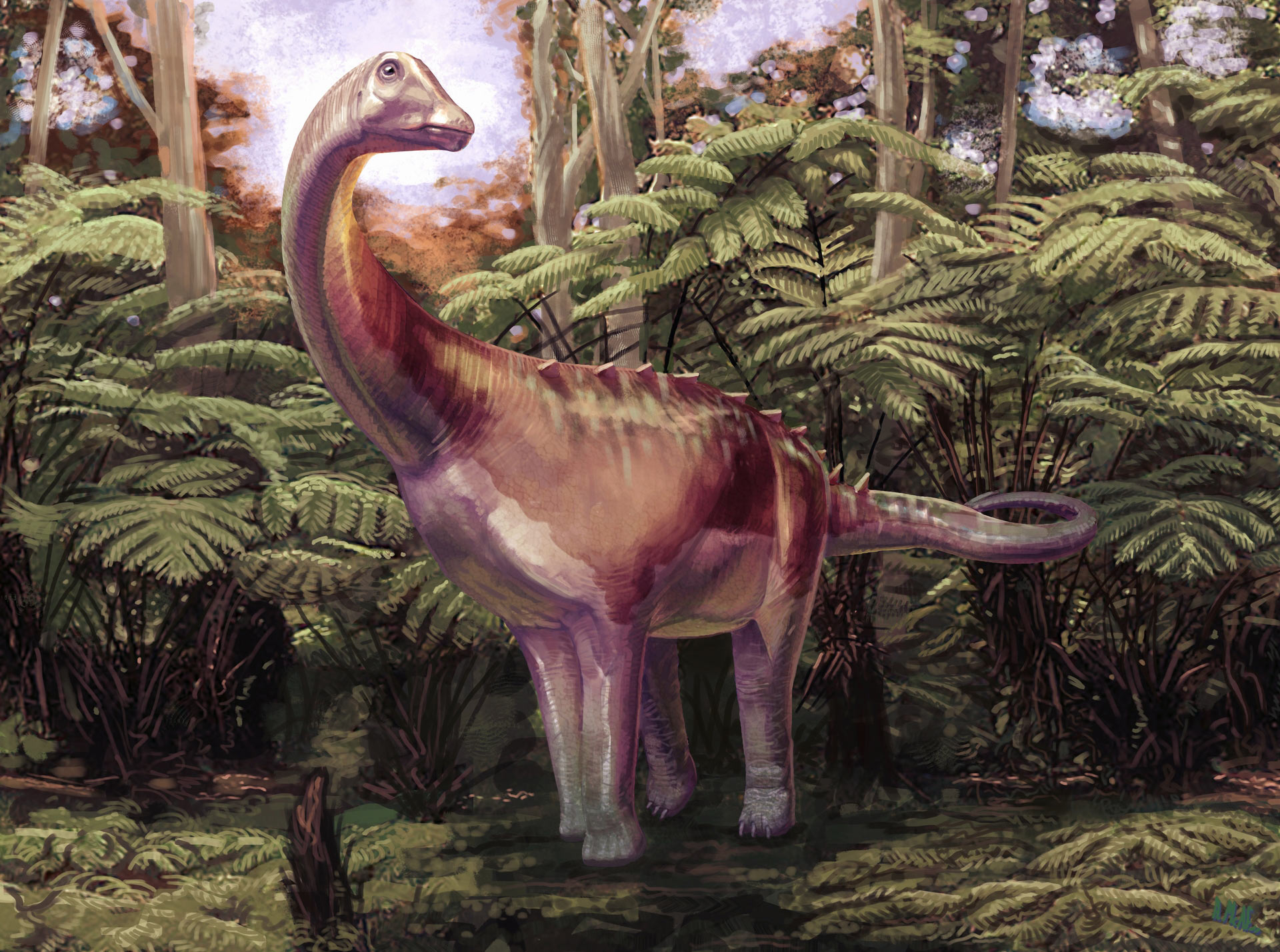
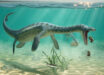
Life reconstruction of the Antarctic titanosaur. Image credit: Andrew McAfee, Carnegie Museum of Natural History.
The Antarctic dinosaur vertebra came from the Santa Marta Formation on James Ross Island, off the tip of the Antarctic Peninsula.
Cataloged as BAS D.8621.25, the specimen dates to the Campanian age of the Late Cretaceous epoch, roughly 83 million years ago.
The fossil was actually dug up on December 9, 1985, by British Antarctic Survey geologist Michael Thomson and German paleontologist Reinhard Förster. But its true identity went unrecognized until now.
“At first glance this appears to be an unremarkable fossil, but it holds an important place in the history of Antarctic exploration as the first dinosaur fossil found on the continent,” said Professor Paul Barrett, a paleontologist at the Natural History Museum, London.
“At the time this animal lived, we know Antarctica would have covered in lush temperate forest providing ample food for large herbivores.”
“There are likely many more dinosaurs to be discovered on the continent. As climate change causes ice to retreat we may indeed find further evidence of this past biodiversity.”
In a new study, Professor Barrett and colleagues identified BAS D.8621.25 as a member of Titanosauria, a group of long-necked, long-tailed sauropod dinosaurs that included some of the largest land animals ever to exist.
The specimen was from either a juvenile or possibly a dwarf species with it estimated to be only 6-7 m in length.
“When I first spotted this bone in our collections a few years ago, I suspected it was a dinosaur,” said Dr. Mark Evans, a paleontologist and manager of the geological collections and labs at British Antarctic Survey.
“After looking at it properly, I thought it was probably a titanosaur tail vertebra.”
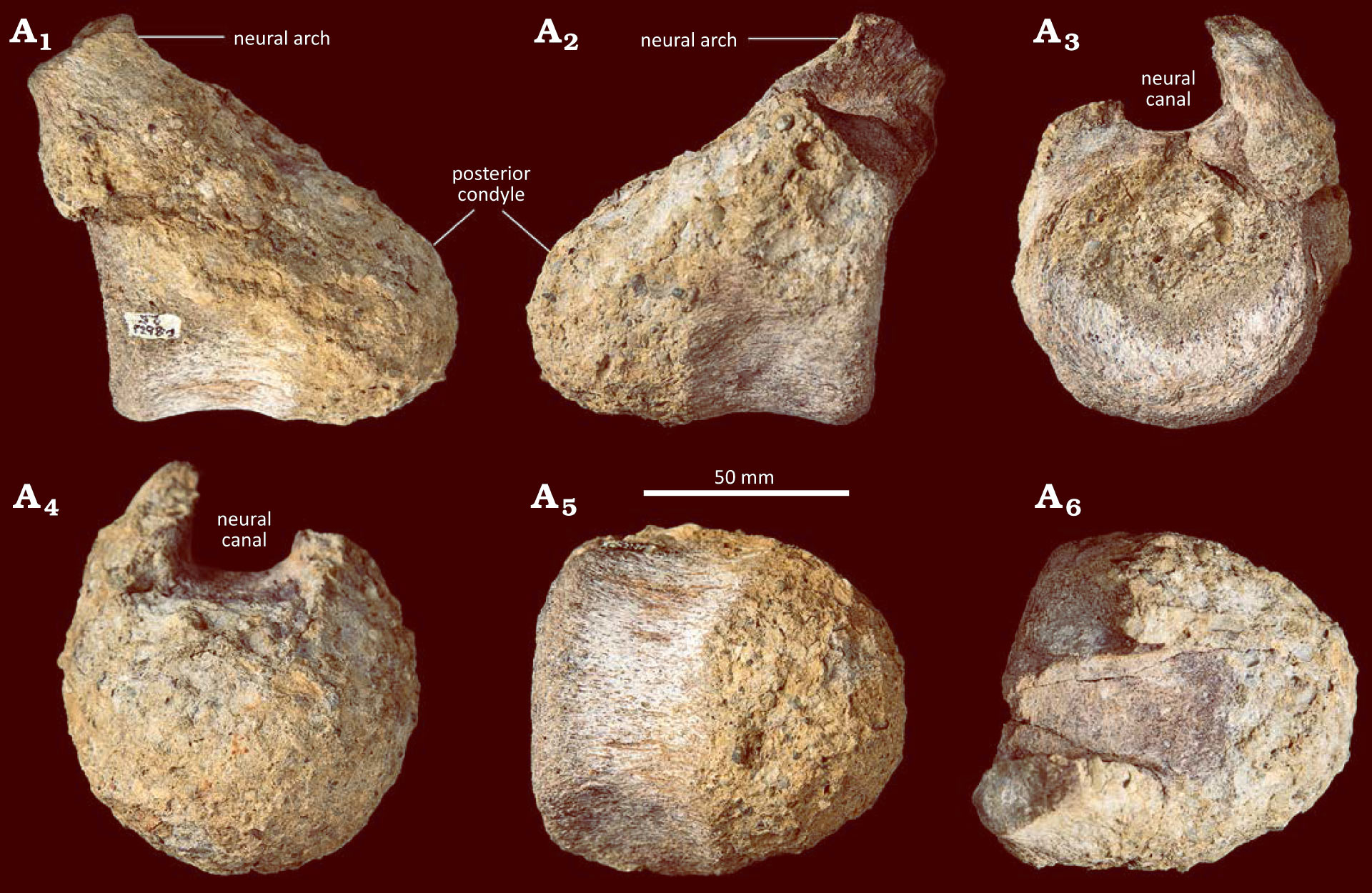
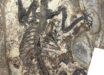
The BAS D.8621.25 specimen from the Santa Marta Formation of James Ross Island, Antarctica. Image credit: Barrett et al., doi: 10.4202/app.01315.2025.
BAS D.8621.25 is not only the first dinosaur bone ever collected in Antarctica — predating the famous armored dinosaur Antarctopelta oliveroi, found in 1986 and long credited as the continent’s first discovery — but also just the second sauropod body fossil ever found there.
The discovery suggests that Antarctica was home to more than one lineage of long-necked sauropods during the Cretaceous, reinforcing the continent’s role as a land bridge connecting South America, Australia, and New Zealand before Gondwana broke apart.
“This bone sat in a collection drawer for decades until new research revealed it for what it was: rare evidence that long-necked sauropod dinosaurs once lived in Antarctica,” said Dr. Matthew Lamanna, a paleontologist at Carnegie Museum of Natural History.
“It’s a powerful reminder of exactly why museums collect, care for, and steward objects like these — new methods and expertise continue to emerge, enabling scientists to unlock discoveries from specimens that have been waiting in plain sight,” added University College London Ph.D. student Samantha Beeston.
“Antarctica seems an enigmatic world away for most of us, and a find like this is very exciting for scientists working on piecing together how our world has changed over time.”
“During the Cretaceous when this animal lived, Antarctica formed part of the supercontinent of Gondwana, and this new find shows that its close relatives traveled between South America and Australia via Antarctica.”
“New technology such as CT scanning is being utilized by scientists to see inside bones, and our use of CT data in this research helped us to describe previously unidentifiable information so that we can better understand the anatomy of the fossil.”
_____
Paul M. Barrett et al. 2026. A titanosaurian sauropod dinosaur from the Upper Cretaceous of Antarctica. Acta Palaeontologica Polonica 71 (2): 349-362; doi: 10.4202/app.01315.2025