Paleontologists have described a new genus and species of ancient gecko found in two pieces of amber from the 99-million-year-old (mid-Cretaceous) amber deposits in Kachin province, Myanmar. One of the specimens shows a swelling at the base of the tail, comparable to the hemipenal bulge in male lizards, suggesting the presence of paired copulatory organs.
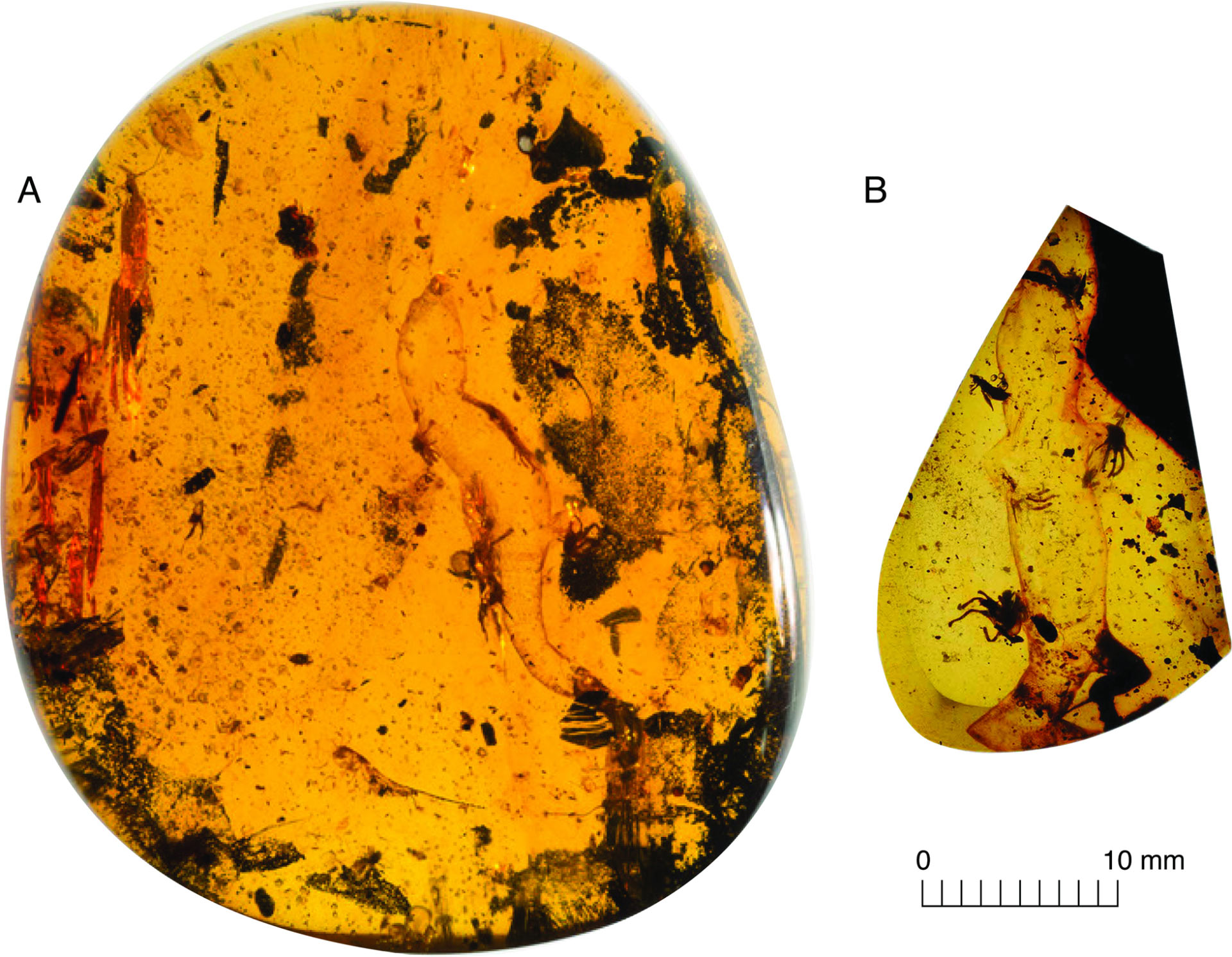
The holotype (A) and paratype (B) specimens of Carinasquama rusmithii in ventral view. Image credit: Daza et al., doi: 10.3897/sjp.145.188227.
Named Carinasquama rusmithii, the amber gecko lived in the tropical forests of what is now Myanmar around 99 million years ago.
The species measured between 1.6 and 2.2 cm in snout-to-vent length, comparable in size to some of the smallest living geckos.
What sets the find apart is not the animal’s size but a swelling at the base of one specimen’s tail.
Sam Houston State University paleontologist Juan Daza and his colleagues interpret this as a hemipenal bulge, the external sign of paired copulatory organs, or hemipenes, that many male squamates — the group that includes lizards and snakes — carry retracted inside their tails.
Because such soft-tissue structures almost never survive fossilization in rock, they describe this as among the oldest lizard fossils that can be confidently identified as male.
“Paleontologists use skeletal features to determine the sex of specimens, but this can be complicated due to the incompleteness of fossil remains,” the researchers explained.
“In fossil assemblages, sexual dimorphism may be present in the form of ornamentation or may occasionally be detected through multivariate analyses.”
“Sex can sometimes be estimated when embryos or eggs are found within a female specimen or associated with the specimen, although other sex-specific traits are rarely preserved in fossils.”
“Squamates exhibit hemipenal bulges that are externally observable in males.”
“These structures typically do not leave traces in hard rock fossils, but may be preserved in amber.”
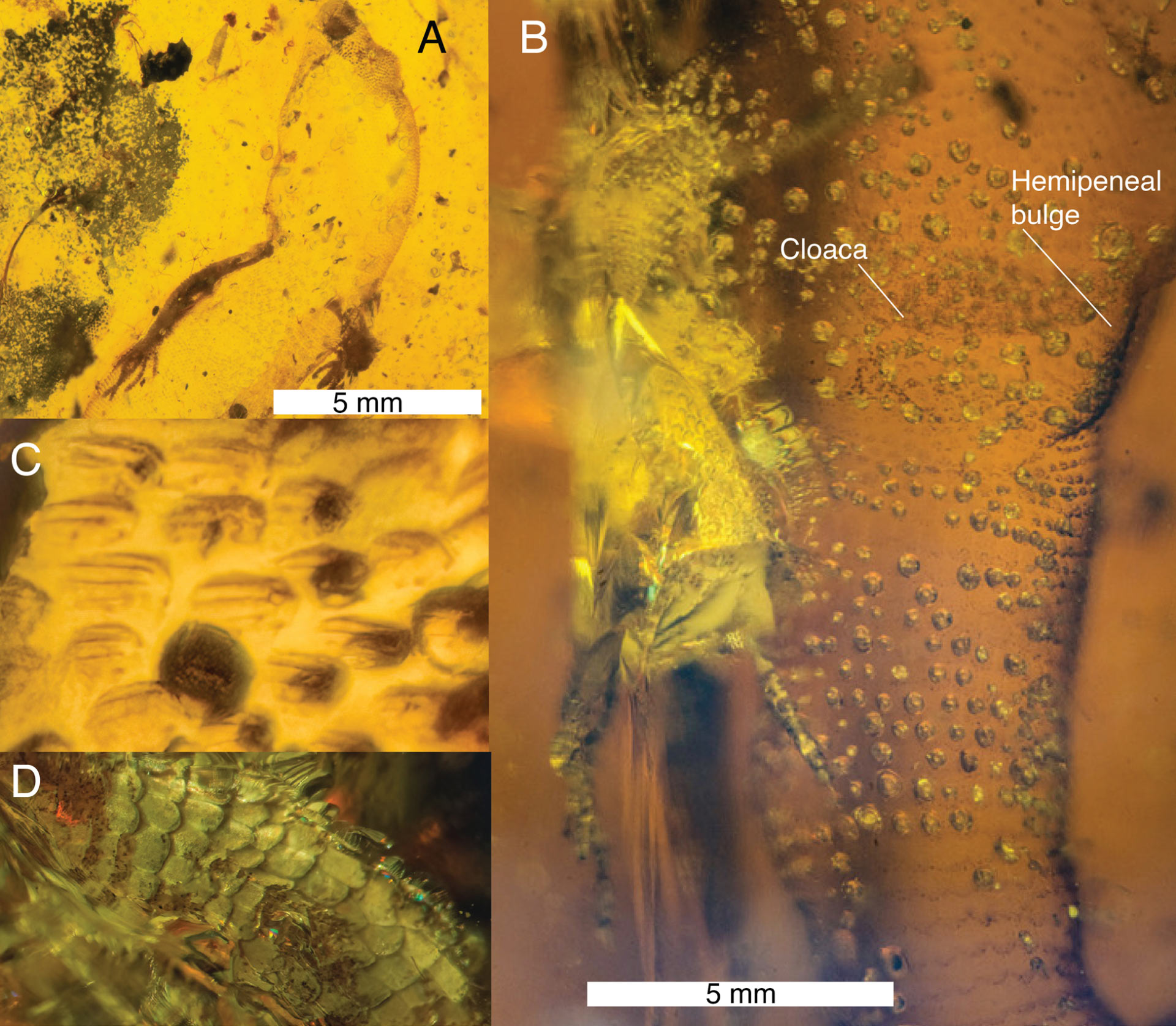
Carinasquama rusmithii, showing details of the integument: (A) dorsal view of the specimen, showing the head and back scales; (B) ventral view, at the level of the cloaca, showing the hemipenal bulge; (C) details of the multi-carinated scales; (D) ventral view of the tail with imbricated scales. Image credit: Daza et al., doi: 10.3897/sjp.145.188227.
To reconstruct their skeletons in three dimensions, the scientists scanned the two specimens of Carinasquama rusmithii using micro-CT technology.
Their preservation is largely a hollowed void where the body once was, but the surrounding integument — scales, skin texture, even the outline of the cloaca — survived in fine detail.
“Carinasquama rusmithii shares with extant gekkotans the lack of frontal scale, lack of frontoparietal scale, cephalic scales small, granular and homogeneous, fused eyelids, scale size relatively consistent across body and interstitial skin visible between scales,” the authors said.
The precise place of Carinasquama rusmithii in the gecko family tree remains uncertain, but they provisionally place it within the broader group Pan-Gekkota.
“The amber lizards are identified as a member of Pan-Gekkota and include one of the oldest fossil lizards that can be unequivocally identified as male,” the researchers said.
“This hemipenal bulge in one of the fossils documents the presence of hemipenes in the Squamata, during the mid-Cretaceous, although their origin was probably much earlier likely with the origin of the group.”
The team’s paper appears online in the Swiss Journal of Palaeontology.
_____
J.D. Daza et al. 2026. Evidence of male anatomy in a mid-Cretaceous Burmese miniaturised amber gecko. Swiss Journal of Palaeontology 145: 785-799; doi: 10.3897/sjp.145.188227