Paleontologists in China have discovered what they say is the earliest confirmed pieces of amber ever found, a fossilized resin roughly 385 million years old (Middle Devonian epoch) that predates the previous record-holder by about 65 million years. The discovery also suggests that resin production evolved in plants well before seed plants existed.
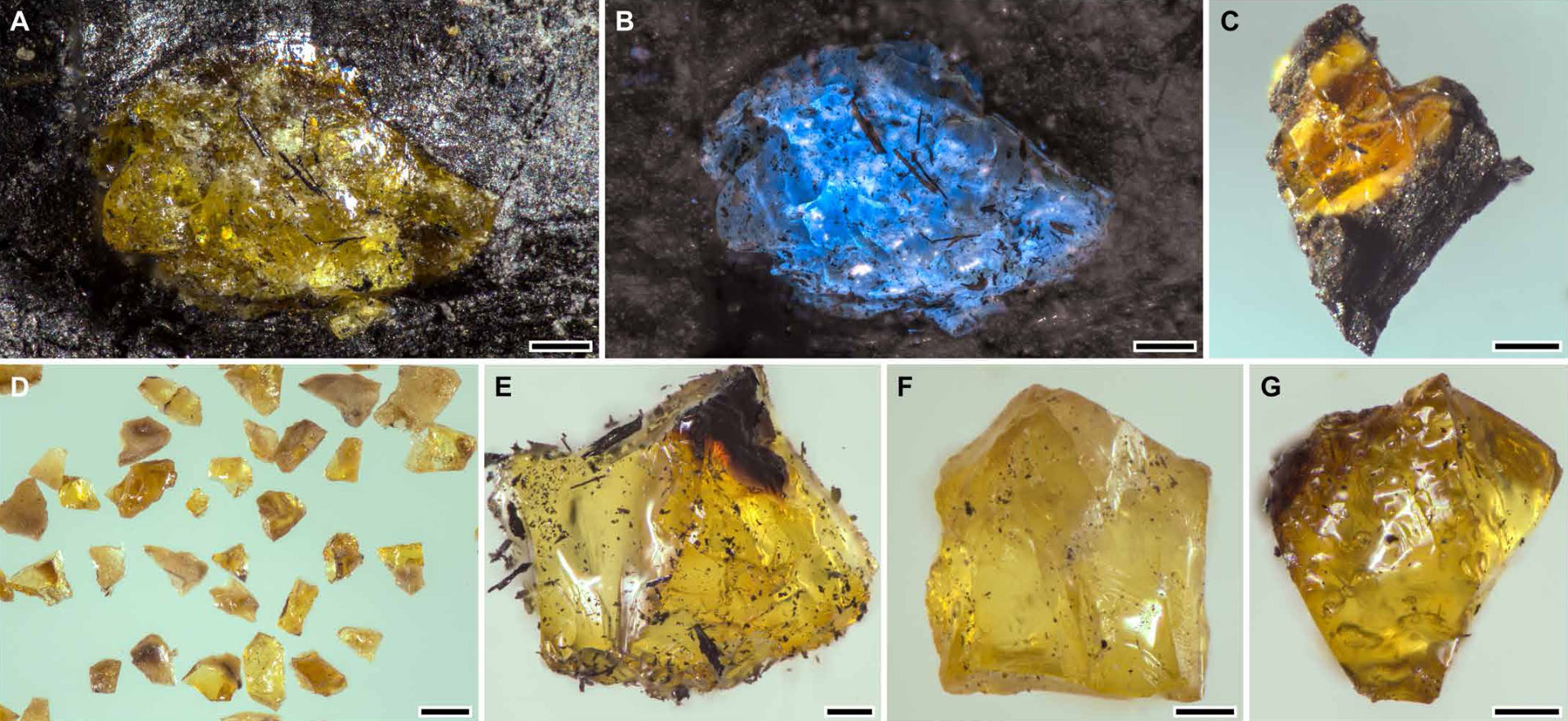
Photographs of the Middle Devonian Hujiersite amber. Scale bars – 0.2 mm in (A-D) and 0.1 mm in (E-G). Image credit: Lu et al., doi: 10.1126/sciadv.aeh1266.
“Amber, specifically fossilized resin, is thought to be one of the ancient exudates of seed plants,” said Dr. Cihang Luo, a researcher with the Nanjing Institute of Geology and Palaeontology at the Chinese Academy of Sciences and the Senckenberg Research Institute and Natural History Museum, and colleagues.
“Seed plants usually secrete resin through specialized secretory tissues of plant surfaces or, on a larger scale, via their internal secretory systems associated with bark and wood.”
“These resins, which are complex mixtures of primarily terpenoid and/or phenolic compounds, help plants recover from various biotic and abiotic injuries, including those from pests, microbial pathogens, and wildfires.”
“Secreted resin hardens and transforms into amber during diagenetic and catagenetic processes, under elevated temperatures and pressures.”
“The viscous resin sometimes traps organisms, which are subsequently preserved as fossil inclusions within amber, providing critical information on the evolution of terrestrial ecosystems.”
In their research, Dr. Luo and co-authors analyzed about 10 kg of coal collected from a coal seam in the Hujiersite Formation near Hoxtolgay in China’s Xinjiang region.
Using ultraviolet light, they located small clusters of amber embedded within the coal and ultimately extracted 241 tiny pieces — most measuring just 0.1 to 0.5 mm across — by hand under a microscope.
Most of the amber is translucent to opaque and ranges from pale yellow to dark brown.
Some pieces contain bubbles, and the fossils fluoresce bright blue under ultraviolet light.
The amber-bearing layer in the Hujiersite Formation is Middle Devonian, approximately 385 million years old.
Until now, the oldest definitively verified amber came from the Late Carboniferous, about 320 million years ago.
“Although amber is a unique repository of environmental, diagenetic, and biological data, its occurrence is not continuous through Earth history,” the researchers said.
“Before the Permian period, there are only two definite records of amber — both from the Carboniferous period — with one from the Late Carboniferous of the United States (320 million years ago), which may have been produced by cordaitalean gymnosperms (Cordaitales), an extinct seed plant lineage closely related to conifers, and another from the latest Carboniferous of Canada (300 million years ago), probably produced by pteridosperms (seed ferns).”
Using Fourier transform infrared spectroscopy and gas chromatography coupled with mass spectrometry, the scientists found that the Hujiersite amber’s chemical makeup closely resembles resin produced by modern and fossil conifers rather than resin from flowering plants.
That is notable because seed plants had not yet evolved when this resin formed.
Instead, the authors suggest the resin was most likely produced by progymnosperms, an extinct group of seedless plants that gave rise to seed plants, or by tree-like lycopsids, an ancient lineage of vascular plants.
Fossils of both plant groups have been found in the Hujiersite Formation. Because no plant tissue was preserved with the amber, the exact source cannot be confirmed.
The findings indicate that the biochemical machinery needed to produce complex terpenoid-based resin — a trait long associated exclusively with seed plants — had already evolved in at least some non-seed plants by the Middle Devonian.
The researchers propose that early resin likely served to seal wounds and fend off fungal infection rather than to deter insect feeding, since substantial evidence of insects attacking plant tissue does not appear in the fossil record until later, in the Carboniferous period.
They also note that ancient wildfires, which were common by this time, may have driven the evolution of a wound-sealing resin.
“Our chemically verified Hujiersite amber represents the earliest confirmed amber record thus far,” they said.
“It shares comparable chemical components with coniferous ambers, providing insights into the early evolution of terpenoid resin biosynthesis in vascular plants.”
“Given its Middle Devonian age, the Hujiersite amber most plausibly derives from non-seed plants.”
“Previously, all known fossil resin has been derived from seed plants (spermatophytes), a monophyletic lineage that includes pteridosperms (seed ferns), gymnosperms, and angiosperms.”
“Seed plants first emerged and radiated extensively in the Late Devonian (Famennian, 372 to 359 million years ago), later than the age of Middle Devonian Hujiersite amber.”
“Therefore, it is unlikely that spermatophytes are the source plants although the chemical properties of Hujiersite amber and gymnospermous resin are similar.”
“If this inference is correct, Hujiersite amber would represent the earliest known fossil resin produced by non-seed plants.”
The team’s paper was published online July 15 in the journal Science Advances.
_____
Cihang Lu et al. 2026. The earliest amber from the Middle Devonian of China. Science Advances 12 (29); doi: 10.1126/sciadv.aeh1266