Fossils from some of the oldest-known animals on Earth, dating from 574 million years ago (Ediacaran period), suggest that cloning, not competition, dominated the Ediacaran seas, slowing evolution until environmental stress helped drive the rise of sexual reproduction and a burst of biodiversity.
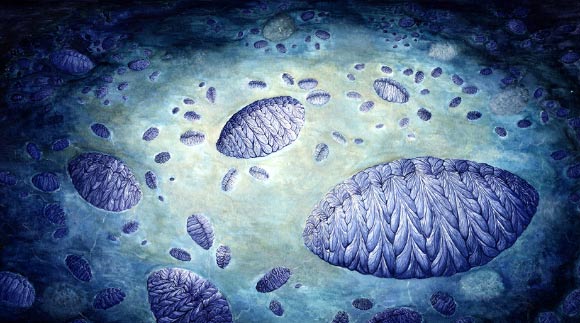
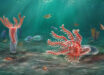
Artist’s reconstruction of the Fractofusus community: the bottom right features a large Fractofusus around which there are 5 to 8 medium specimens clustered; each of the medium specimens also has small specimens clustered around them; the small specimens therefore form an independent double cluster pattern, namely clusters of clusters. Image credit: C.G. Kenchington.
After billions of years of microbial life, during the Ediacaran period, between 635 and 539 million years ago, life exploded in size and the first animals appeared.
Some of these earliest animals, such as Fractofusus, could grow as tall as 2 m (6.6 feet), although most were much smaller.
These animals looked more like ferns than any animal we would recognize today: they do not appear to have mouths, organs or means of movement, so they are thought to have absorbed nutrients from the water around them.
And like most Ediacaran life forms, they disappeared from the fossil record at the beginning of the Cambrian period 540 million years ago, making it difficult for scientists to link them to any modern life forms.
Researchers have previously determined that these early animals reproduced asexually, by sending out clones via stolons or runners, like modern strawberry plants. In the rich waters of the Ediacaran, they thrived.
“Life was pretty nice during the Ediacaran, so the need for sex was rather limited,” said Dr. Emily Mitchell, a researcher at the University of Cambridge.
“There was relatively little competition, so there was no real pressure to change anything.”
Dr. Mitchell and her colleague, University of Cambridge’s Professor Andrea Manica, used a combination of laser scanning, spatial analysis and artificial intelligence to study Ediacaran fossils from Mistaken Point in Newfoundland, Canada.
They first showed that asexual, stolon-based reproduction limited competition, then built a computer model to simulate how early animal communities might behave under different reproductive strategies.
They ran the model thousands of times while a simple neural network helped narrow down which simulations best matched the diversity patterns seen in the fossil record.
This approach, known as Approximate Bayesian Computation, allowed the researchers to work backwards from the real data to estimate how far organisms spread and how strongly they competed for resources.
Using this method, they showed that limited dispersal linked to asexual, runner-based reproduction could explain why early animal communities had relatively few species, and why a later shift toward wider dispersal and sexual reproduction coincided with a sudden burst of evolutionary diversity.
Competition and stress have been prime drivers of evolution for billions of years, but in the deep waters of the Ediacaran, asexual reproduction meant that competition was limited.
“If you’re connected to your neighbor by these runners, then you’re sharing nutrients and you don’t need to compete with them,” Professor Manica said.
However, as life in the Ediacaran slowly spread from the deep ocean to shallower waters, early animals faced more pressures: tides, storms, changing temperatures and nutrient levels all would have made life more precarious, leading to increased competition for resources.
“If you’re suddenly in an environment where you’re essentially getting killed a couple of times per year, then that changes everything,” Dr. Mitchell said.
“Stress essentially leads to sexual reproduction, and when that happens, we can see a massive increase in dispersal distances as animals attempt to colonize new areas due to an increase in competition.”
“As these early animals adapted to both a new mode of reproduction and new habitats, there was a corresponding increase in diversification, leading to the Ediacaran ‘second wave’ of animal evolution, a process that accelerated further in the Cambrian, once animals became mobile.”
The study was published this week in the journal Nature Ecology and Evolution.
_____
E.G. Mitchell & A. Manica. The influence of reproductive mode on resource competition and diversity patterns in Ediacaran early animal communities. Nat Ecol Evol, published online June 9, 2026; doi: 10.1038/s41559-026-03094-2