Using NSF’s Very Large Array (VLA), astronomers made the first radio detection of polarized light and Faraday rotation from a gamma-ray burst afterglow, offering an unprecedented glimpse of the magnetic fields surrounding one of the Universe’s most powerful explosions.
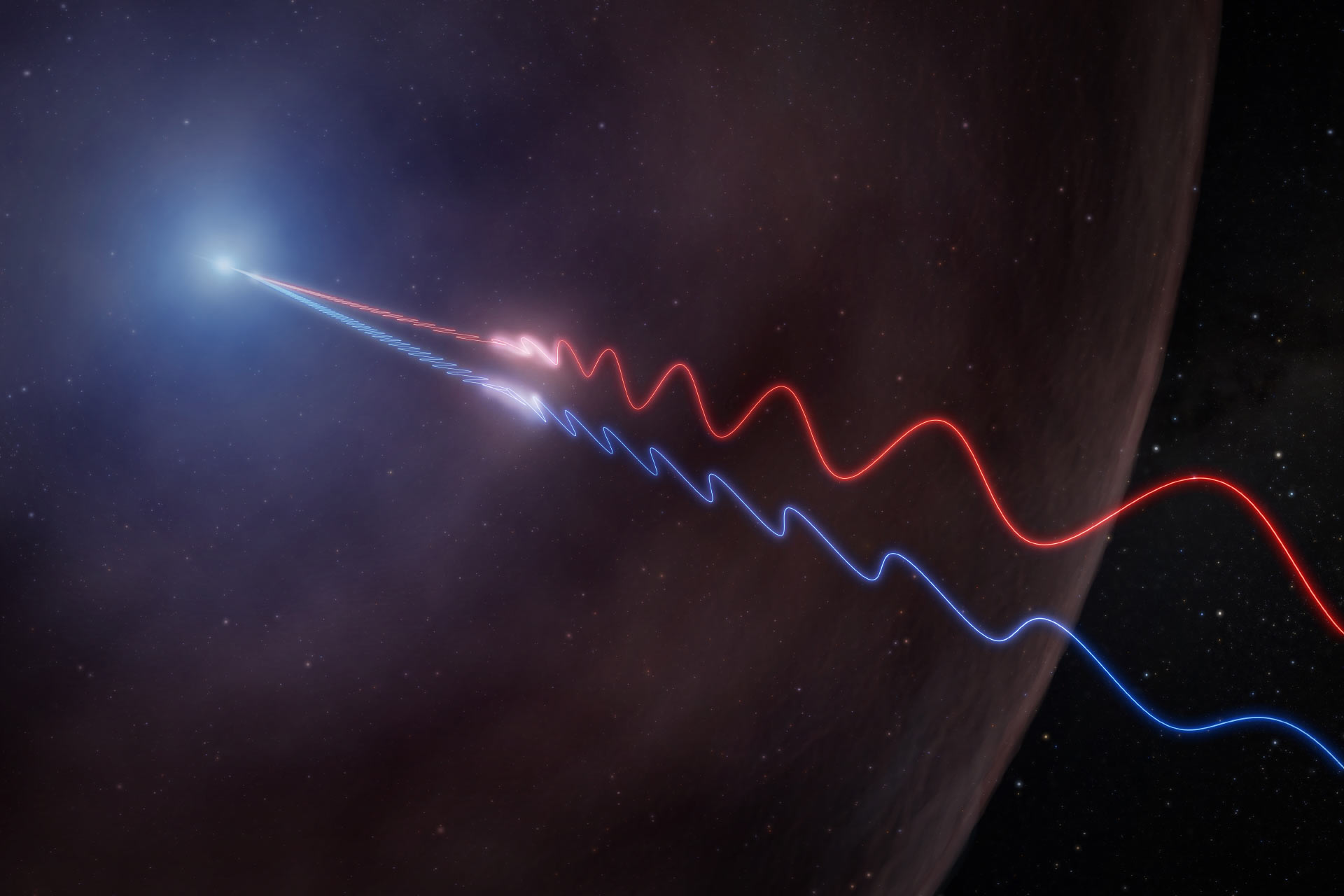
This illustration depicts Faraday rotation in the afterglow of a gamma-ray burst. A powerful jet (upper left) sends polarized radio waves outward through the thin wall of a surrounding bubble of magnetized gas called an HII region. As the light passes through this material, its polarization angle is twisted by the magnetic field. Because the effect is stronger at longer wavelengths, the red and blue waves, which represent different radio wavelengths, exit the bubble oscillating in different directions. By measuring this difference, astronomers were able to map the magnetic environment surrounding GRB 260310A for the first time. Image credit: NSF / AUI / NRAO / M. Weiss
Gamma-ray bursts are the most powerful explosions in the Universe, releasing in a matter of seconds as much energy as the Sun will emit over its entire lifetime.
They are thought to launch narrow jets of particles accelerating to nearly the speed of light, and those jets produce a radio afterglow that can linger for months.
Despite decades of study, the magnetic fields that are believed to accompany these jets and their local environments have remained stubbornly difficult to measure, until now.
The gamma-ray burst event in question, GRB 260310A, was relatively nearby Earth, in cosmic standards, making its radio afterglow one of the brightest seen in decades. That brightness gave astronomers an extraordinary opportunity.
By pointing VLA at the fading explosion, University of Utah astronomer Tanmoy Laskar and colleagues found that the radio waves were polarized, meaning the light waves were oscillating in a preferred direction, much like sunlight reflecting off the surface of water, which polarized sunglasses are designed to filter out.
They also found that the polarization signal changed across different wavelengths, a phenomenon known as Faraday rotation.
Never before detected in a gamma-ray burst, this effect acts like a magnetic fingerprint, encoding information about the strength and structure of the fields the light passed through.
Just as a prism bends different colors of visible light by different amounts, a magnetized plasma can rotate the polarization angle of radio waves.
The faster that rotation changed with wavelength, the stronger the magnetic field the light passed through.
“Gamma-ray bursts are the most powerful explosions in the Universe, and magnetic fields are thought to play a central role in powering them, but probing those fields has been extraordinarily difficult,” Dr. Laskar said.
“By detecting polarized radio emission, we can now directly measure the magnetic environment of one of the Universe’s most violent events.”
“Our new gamma-ray burst observations allow us to use the Universe as our laboratory to test our understanding of how physics operates in such extreme conditions.”
The VLA data revealed a magnetic field along the light’s path that was thousands of times stronger than what could be explained by our own Milky Way Galaxy or the space between galaxies.
Instead, it points to an exceptionally dense, magnetized cloud of gas surrounding the star that exploded to produce GRB 260310A.
That cloud is what astronomers call an HII region, a bubble of ionized hydrogen gas shaped by powerful ultraviolet radiation and stellar winds from a massive young star.
The fact that GRB 260310A appears to have exploded inside such a region is consistent with gamma-ray bursts arising from the explosions of the most massive stars, and may help scientists understand precisely what kinds of stars and environments are capable of producing these extreme events.
“Previous searches for polarization in gamma-ray bursts used facilities like the Atacama Large Millimeter/submillimeter Array (ALMA) that measure shorter wavelengths and had to happen early, before the afterglow light faded,” said Collin Christy, a graduate student at the University of Arizona.
“Now, with VLA, we’ve pushed into the centimeter bands and made the first ever measurement of Faraday rotation in a gamma-ray burst.”
“Each new observation reveals another layer of the magnetic story these explosions are telling us.”
“Future monitoring of gamma-ray burst afterglows with VLA and other radio telescopes will allow scientists to watch magnetic field structures evolve in real time,” said Dr. Kate Denham Alexander, also from the University of Arizona.
“This is a capability that could transform our understanding of how relativistic jets form, how they are powered, and how magnetic energy is released in the most extreme environments the Universe has to offer.”