In a new study of chimpanzees (Pan troglodytes) and bonobos (Pan paniscus), scientists found that embraces, touches and other reassuring gestures before competition for food were linked to more peaceful sharing, suggesting the roots of human social touch stretch back at least six million years.
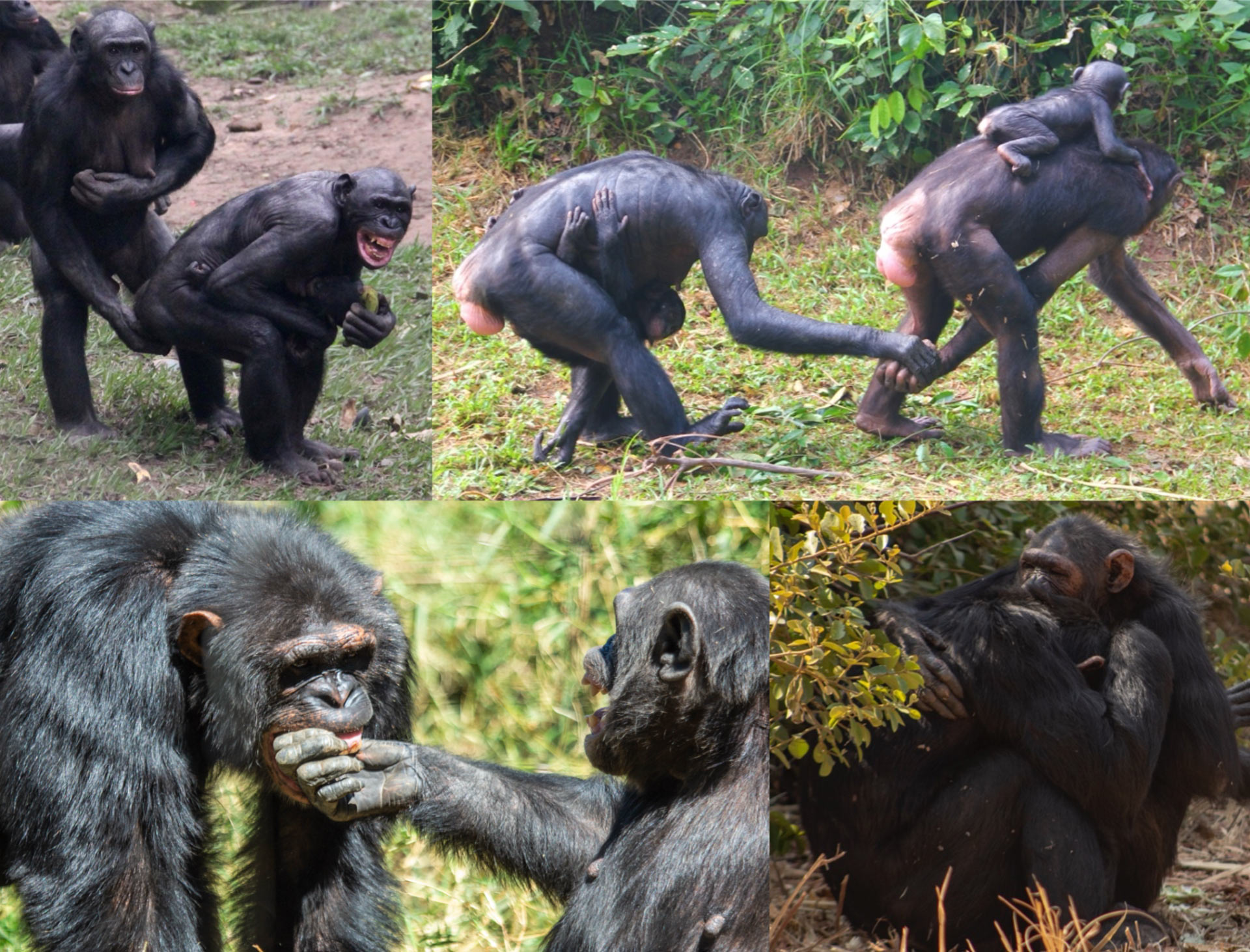
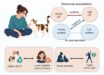
Examples of bonobo and chimpanzee reassurance behaviors. Image credit: Z. Clay / J.S. Brooker.
“Social tolerance, broadly defined as the tendency of conspecifics to gather in close proximity around valuable resources with minimal aggression, is considered a pre-requisite for information transmission and effective cooperation,” said Durham University’s Professor Zanna Clay and colleagues.
“In primates and other animals, tolerant social climates are associated with a range of adaptive social outcomes, including prosocial and cooperative behavior, empathy and social learning.”
“Early behavioral research typically operationalized tolerance using dominance-based paradigms, focusing on whether high-ranking individuals refrained from monopolizing resources, enabling co-drinking and cofeeding in close proximity.”
“However, social tolerance is increasingly recognized as a broader property of social relationships and group climate that can vary across contexts, beyond hierarchical dynamics.”
“Compared with other species, humans are thought to show particularly striking and often extreme levels of tolerance and aggression towards both in- and outgroups. Similar variability is increasingly evident among our closest living relatives, bonobos and chimpanzees.”
In the study, the researchers filmed 116 chimpanzees and bonobos across five semi-wild groups at African sanctuaries, capturing five-minute windows just before food was released into a shared space.
They tracked who touched whom (embraces, pats, even placing fingers in a companion’s mouth) beforehand, then measured how peacefully individuals fed together afterward, alongside recorded incidents of aggression.
In both species, primates that reassured each other through touch before feeding were more likely to feed tolerantly side by side rather than fight.
The pattern differed by sex: among bonobos the effect was strongest between females, reflecting the central role of female alliances in their society, while among chimpanzees it was strongest between males, mirroring male-bond dynamics.
The effect showed up most clearly in the more socially tolerant groups, suggesting reassurance behavior reinforces — rather than simply reflects — a cooperative social climate.
Chimpanzee males frequently engaged in a risky gesture — putting fingers or hands in each other’s mouths — which appeared far more often in the more tolerant group, hinting that the vulnerable act functions as a signal of trust.
Because the behaviors look so similar across the two species, the researchers argue the practice likely traces back to a common ancestor shared by chimps, bonobos, and humans — some six million years ago — making touch one of our oldest tools for defusing social tension and preserving group harmony, well before language evolved.
“Comparing bonobos and chimpanzees — our two closest relatives — offers fascinating insight into the evolutionary roots of social behavior and how they, and we, manage tension, competition and cooperation,” said Dr. Jake Brooker, also from Durham University.
“Social touch is a powerful communicative tool, present long before language and likely one of the earliest channels through which social bonds form.”
“Its use in these contexts seems to be something we share with our closest relatives.”
“The riskier mouth-to-body contacts among chimpanzees, such as placing fingers or hands in another’s mouth, were particularly striking.”
“Chimpanzees are often associated with aggression, but these behaviors reveal a deep level of trust and a willingness to be vulnerable in order to navigate tense moments.”
“We were partly inspired to conduct this study by an observation from our most tolerant chimpanzee group: one male embracing another from behind, then a second joining in, then a third, one by one, until the whole chain settled — what my colleagues and I started calling a ‘reassurance train’.”
“Our study highlights the ancient and deeply powerful role that touch plays in regulating our social relationships, particularly during tense times when emotions run high,” Professor Clay said.
“Although much attention has been placed on the role of aggression and competition in human evolution, our study shows that our lineage has also evolved rich and flexible behavioral toolkits to manage social tension to protect social relationships and promote social harmony.”
“It is striking that many of the reassurance behaviors that we observed in our closest ape cousins mirror those we also see in humans today.”
“This highlights how much we still depend on preserved behavioral tools that hark back millions of years to navigate our social worlds, particularly in the most challenging of moments.”
The study was published in the Proceedings of the Royal Society B: Biological Sciences.
_____
Jake S. Brooker et al. 2026. Reassuring body contact promotes social tolerance in bonobos and chimpanzees. Proc. R. Soc. B 293 (2075): 20253190; doi: 10.1098/rspb.2025.3190