Paleontologists in India have unearthed a partial skeleton of a diminutive, previously unknown neosauropod dinosaur from the Middle Jurassic rocks of Gujarat’s Kachchh Basin. The discovery pushes back the known global spread of the major dinosaur lineage by tens of millions of years.
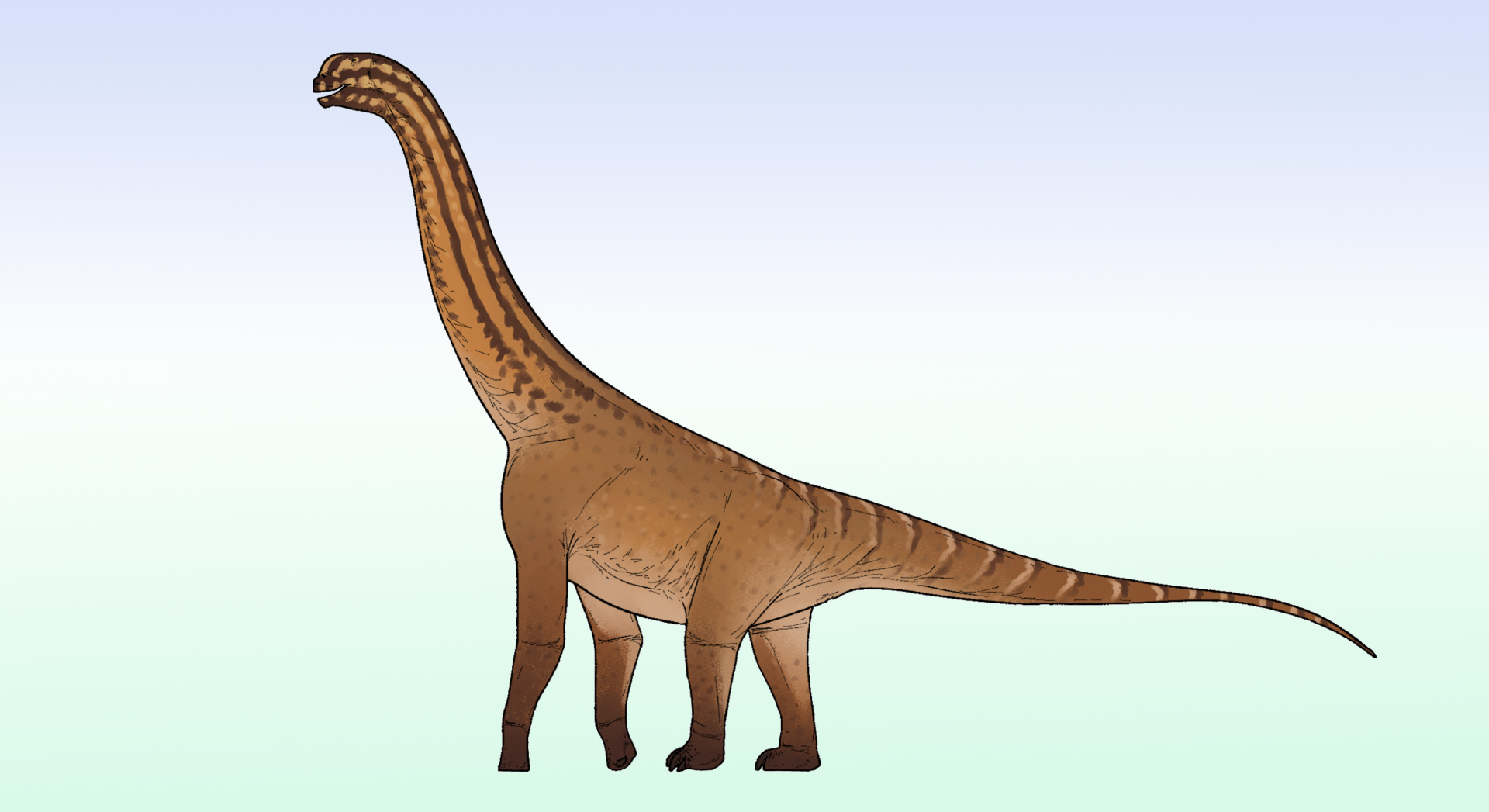
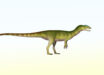
Life reconstruction of Ceratocaudia antiqua, the earliest-known macronarian neosauropod species from India. Image credit: Connor Ashbridge / CC BY 4.0.
Ceratocaudia antiqua was a type of neosauropod, the group that eventually produced colossal dinosaurs such as Diplodocus, Brachiosaurus and Argentinosaurus.
But unlike those titans, the new species appears to have measured only about 7 m (23 feet) long.
“Neosauropoda are one of the most successful groups of saurischian dinosaurs that attained high diversity from the Late Jurassic onwards until the end Cretaceous,” said Dr. Abhishek Natarajan from the Indian Institute of Technology Bombay and colleagues.
“However, the early history of the neosauropodan lineages (Diplodocoidea and Macronaria), as well as membership of their basally diverging taxa, has been controversial, due to multiple factors, viz. lack of suitable outcrops, poor constraints on the ages of Lower-Middle Jurassic deposits, low rates of sampling, and partial and fragmentary preservation.”
“Recent advances in the study of neosauropods have focused on tackling these issues, presenting evidence that both diplodocoids and macronarians had a large geographical distribution, and a rich diversity during the Middle Jurassic, indicating a global distribution of neosauropods by the early Middle Jurassic.”
The partial skeleton of Ceratocaudia antiqua was recovered from the Kaladongar Formation of the Kachchh Basin in western India.
A total of 181 fragments from the excavation site, including vertebrae, ribs, forelimb bones and hind-limb elements, all believed to belong to one individual.
The rock layers containing the fossils are difficult to date precisely, spanning a range from the Pliensbachian stage of the Early Jurassic to the Bajocian stage of the Middle Jurassic, meaning Ceratocaudia antiqua could be as much as 190 million years old.
“The fossils are housed at the Vertebrate Palaeontology Lab, Department of Earth Sciences, Indian Institute of Technology Bombay, Mumbai, Maharashtra, India,” the paleontologists said.
Using digital reconstruction techniques, the researchers modeled Ceratocaudia antiqua’s tail musculature based on comparisons with modern crocodilians and lizards.
Their model suggests this species held its tail horizontally and could swing it forcefully from side to side, a movement they speculate may have served as a modest defense against predators.
“The hypothetical model of Ceratocaudia antiqua suggests that the sauropod tail may have been useful as a mild deterrent to predators even without specialized adaptations like the whip-tail of flagellicaudatans,” they said.
The team’s phylogenetic analysis places Ceratocaudia antiqua as an early-branching macronarian, making it one of the oldest diagnosable members of Neosauropoda found anywhere in the world.
Alongside two Chinese species, Dashanpusaurus dongi and Yuzhoulong qurenensis, it suggests that neosauropods had already achieved a global distribution before the Bajocian stage of the Jurassic.
“The Kachchh sauropod represents one of the earliest neosauropods and adds to the sparse global record of Early/Middle Jurassic neosauropods,” the researchers concluded.
Their paper was published this month in the Journal of Vertebrate Paleontology.
_____
Abhishek Natarajan et al. A new diminutive Jurassic neosauropod from the Kaladongar Formation (Khadir Uplift) of the Kachchh Basin, western India. Journal of Vertebrate Paleontology, published online July 16, 2026; doi: 10.1080/02724634.2026.2677749