Planetary researchers have found the first evidence that bursts of energetic particles from the Sun could warm the lower atmosphere of Mars during massive dust storms, hinting at an unexpected link between space weather and Martian climate.
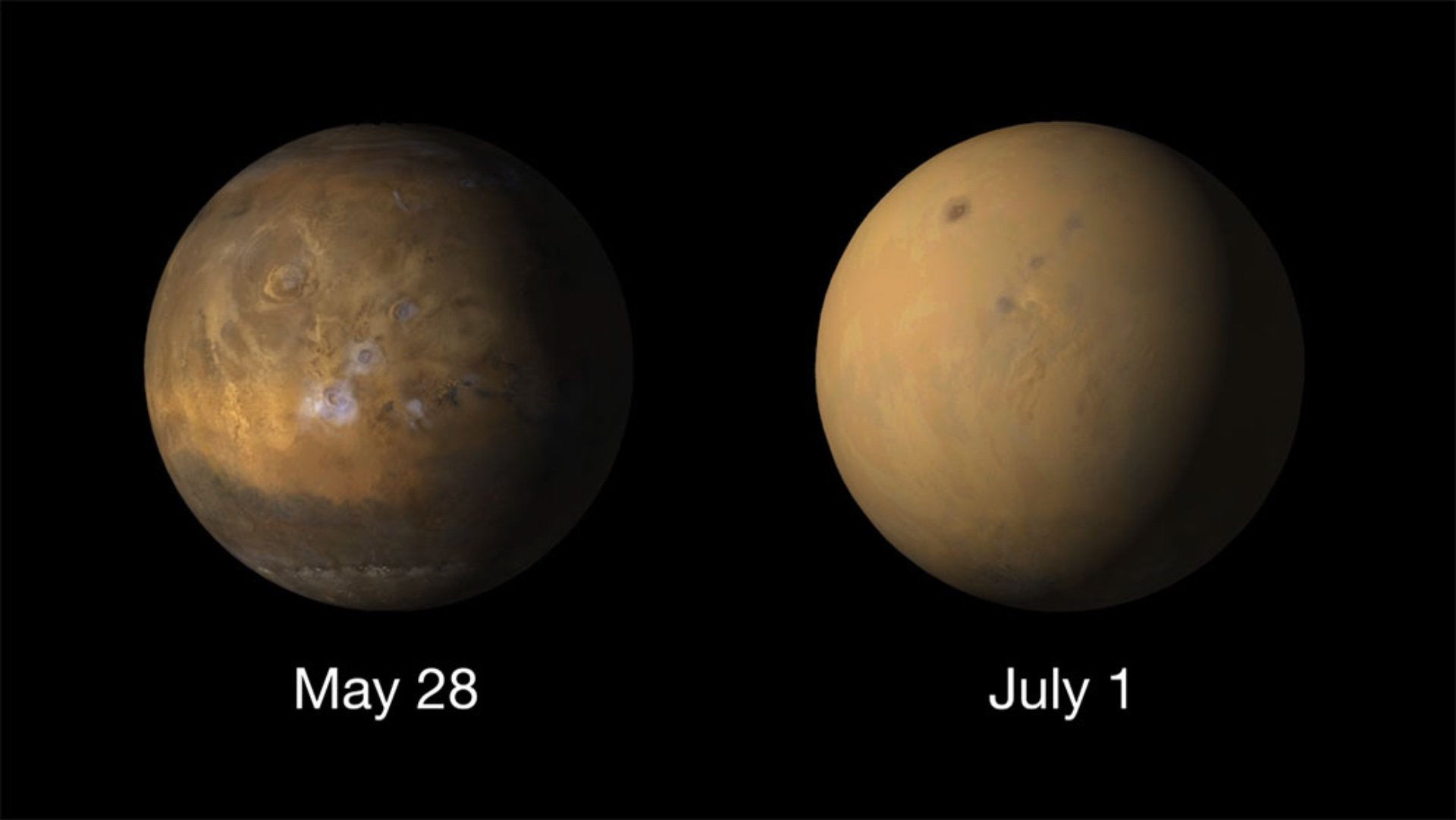
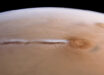
These images from Mars Color Imager (MARCI) aboard NASA’s Mars Reconnaissance Orbiter (MRO) show Mars before (left) and during (right) the June 2018 dust storm. Image credit: NASA / JPL-Caltech / University of Arizona.
“Solar energetic particle (SEP) events occur when solar flares and coronal mass ejections (CMEs) release high-energy charged particles into space,” said Lancaster University astronomer Lana Williams and colleagues.
“Mars is particularly exposed to these particles because it has a thin atmosphere and no strong global magnetic field to shield the planet, as Earth does.”
“Previous research has shown that SEPs can affect Mars’ upper atmosphere, causing ionization, diffuse aurorae and disruption to radio signals.”
“But their possible effects on the lower atmosphere, where weather processes take place, are not well understood.”
“Dust storms naturally heat parts of the Martian atmosphere by absorbing sunlight,” they added.
“However, we found that the pattern of heating observed during the combined event was unusual for a dust storm and could not be explained by the storm alone.”
In the study, Williams and co-authors examined five SEP events at Mars to find out whether long-lasting SEPs could warm Mars’ lower atmosphere, where its weather happens.
Four of the SEP events showed no clear effect, but the fifth — which occurred in June 2018 — unexpectedly coincided with an expanding global dust storm that also wiped out NASA’s Opportunity rover.
It was during this event that signs of lower atmospheric heating were detected.
“We expected that these highly energetic particles might have some effect on temperatures in Mars’ lower atmosphere, but in four of the five events we studied we found no clear evidence of heating,” Williams said.
“The one exception occurred while a global dust storm was expanding across the planet.”
For the study, the astronomers used data from NASA’s Mars Atmosphere and Volatile EvolutioN (MAVEN) spacecraft and ESA’s Trace Gas Orbiter.
They compared the observations with expected temperature profiles from the Mars Climate Database.
They examined temperatures before, during and after the five long-lasting SEP events.
“Dust storms were not originally part of our investigation, so finding one happening at the same time as the heating was unexpected,” Williams said.
“It suggests that Mars’ atmosphere and weather may respond to several events acting together, rather than each source of heating operating independently.”
The researchers presented the findings this week at the 2026 National Astronomy Meeting (NAM2026) in Birmingham, the United Kingdom.
_____
Lana Williams et al. Do solar energetic particle events impact lower-atmospheric temperatures on Mars. NAM2026