Paleontologists have unearthed a remarkably preserved fossil snake in Brazil that is reshaping ideas about how the earliest snakes lived and complicating the long-running debate over whether their ancestors burrowed underground, swam in the sea or crawled the surface.
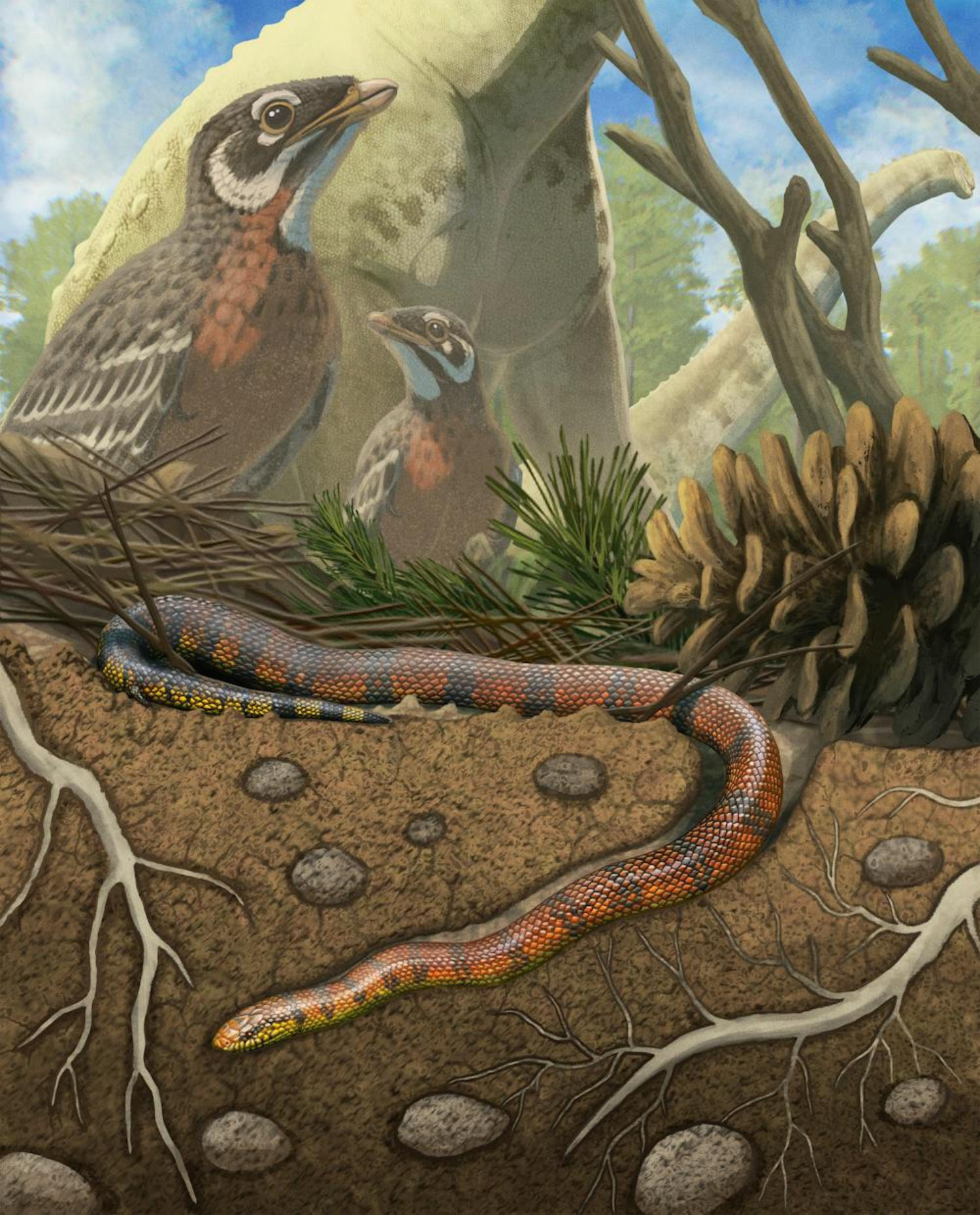
Life reconstruction of Tametara mirim. Image credit: Gabriel Ugueto.
“Snakes are essentially highly modified lizards,” said co-author Dr. Roy Ebel, a researcher at the Museums Victoria Research Institute.
“Sometime in the age of dinosaurs, one lizard lineage lost its limbs and stretched out its body. The key question is why.”
“For more than a century, several ideas have competed with each other.”
“One says the first snakes colonized the water, with a long, limbless body suited for swimming, much like an eel.”
“A second says they lived on the surface of the land, among leaf litter and vegetation, where reduced limbs could have eased their movement through dense ground cover.”
“A third says they went underground, losing their limbs and elongating their bodies to pursue a head-first burrowing lifestyle, much like modern blind snakes.”
“The trouble is that the evidence has rested on a tiny handful of fossils. Fewer than ten early snake skeletons are known from that era.”
In their research, Dr. Ebel and colleagues examined an exceptionally preserved skull and postcranial material of a previously unknown species of stem snake.
Named Tametara mirim, the reptile lived in what is now Brazil during the Late Cretaceous epoch, roughly 85 to 75 million years ago.
The fossil was unearthed in 2020 at a quarry near Presidente Prudente in the Brazilian state of São Paulo.
The specimen is the first articulated snake fossil ever found in Brazil, and one of only a handful of three-dimensionally preserved snake fossils from the Mesozoic era anywhere in the world.
What sets Tametara mirim apart is the extraordinary detail preserved in its skull.
Using high-resolution CT scanning, the paleontologists reconstructed the animal’s brain, cranial nerves and inner ear in unprecedented detail, producing what they describe as the most complete picture yet of brain anatomy in a stem snake.
Their reconstruction revealed a brain shape unlike that of any other early snake or any snake alive today, suggesting far more variation in brain structure — and likely sensory ability — during snake evolution than scientists had previously recognized.
Dr. Ebel and co-authors paired the brain data with an analysis of the fossil’s bone microstructure, a technique that can reveal an animal’s lifestyle from the density and thickness of its skeleton.
Both lines of evidence pointed independently to the same conclusion: Tametara mirim was a burrowing animal.
“Head-first burrowers build denser, thicker bone in the skull roof,” Dr. Ebel said.
“This trait has independently evolved across numerous burrowing lizard lineages.”
“We presume this consolidates the skull against the strain exerted during its use as a digging tool.”
“Tametara mirim shows exactly this trait combination,” he said.
“In fact, our lifestyle reconstruction positions the fossil among the most specialised head-first burrowers living today, and well away from any lizards and snakes that pursue a more generalist lifestyle.”
“But the skull roof was not our only line of evidence.”
“We also digitally rebuilt its brain cavity, the most detailed such reconstruction yet for any early snake.”
“This cavity would have closely matched the shape of the brain in the living animal.”
“The reduced visual centres and simplified forebrain point the same way the bones do: underground.”
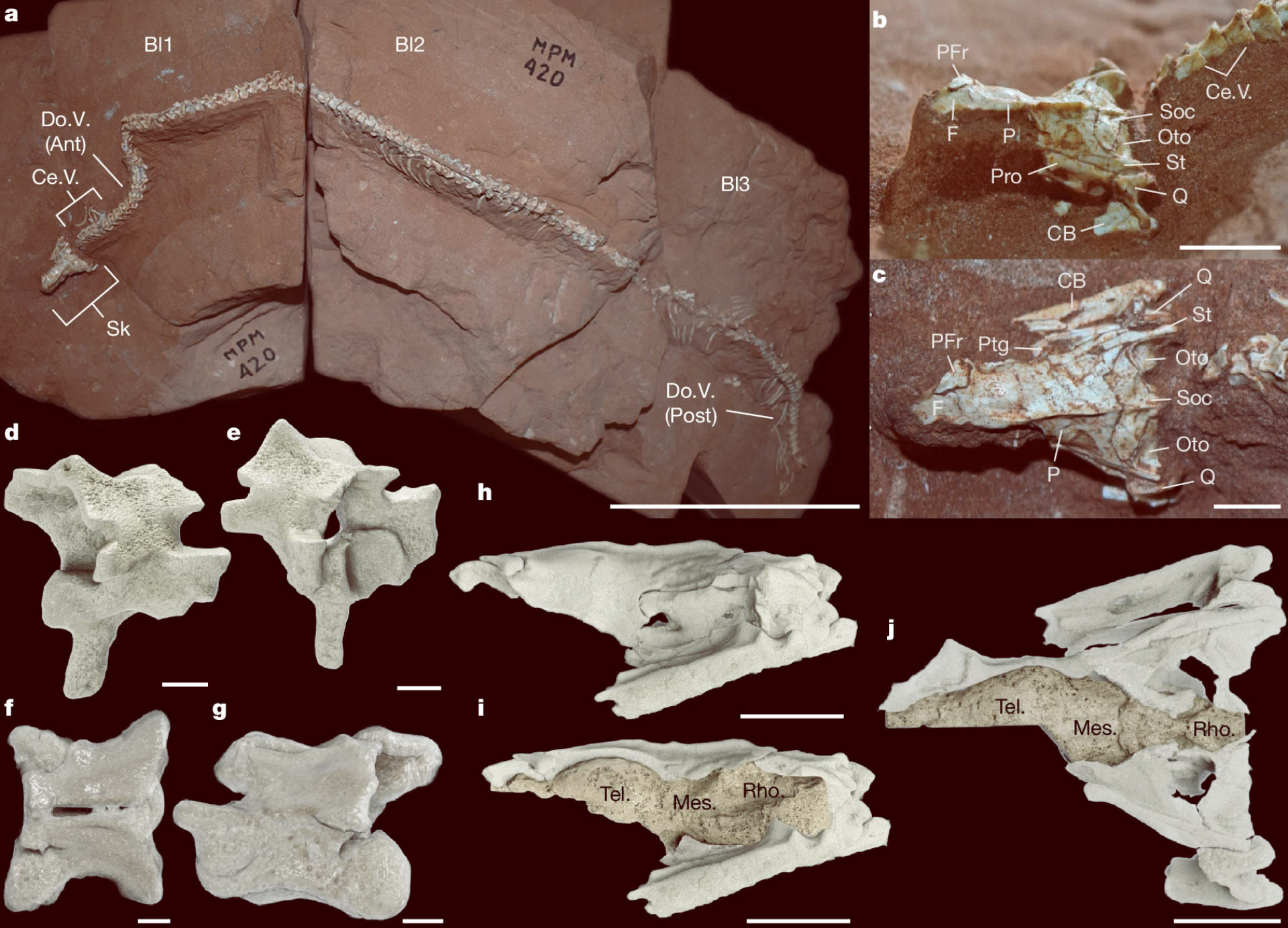
The holotype of Tametara mirim. Image credit: Simões et al., doi: 10.1038/s41586-026-10809-9.
The team’s findings stood in sharp contrast to a similar analysis of Dinilysia patagonica, a stem snake from Argentina and one of the best-known Cretaceous snake fossils, whose brain shape and bone structure instead pointed to a non-burrowing, surface-dwelling existence.
Taken together, the two fossils show that early snake lineages were not ecologically uniform.
Rather than descending from a single ancestor with one settled lifestyle, snakes appear to have branched out early into burrowing, terrestrial and even marine habits, with different lineages adapting repeatedly over tens of millions of years before modern snake groups emerged.
“The two oldest snakes we can study in this detail had brains more different from each other than most snake lineages alive today. Dinilysia patagonica was no burrower. It lived on the surface,” Dr. Ebel said.
“Their brains hint at how differently these two animals sensed their world.”
“Tametara mirim had the reduced eyesight of a creature that spent its life in the dark. Dinilysia patagonica, on the other hand, had senses that were shaped for the open. At the very dawn of their history, snakes were already tuning their senses to very different habitats.”
The findings add to a small but growing body of well-preserved Cretaceous snake fossils that paleontologists are using to piece together one of the more stubborn puzzles in vertebrate evolution: how a lizard-like ancestor gave rise to the elongated, limbless body plan that today numbers more than 4,200 living snake species.
“Our results provide quantitative, multi-system confirmation of fossoriality in a stem snake, resolving a long-standing debate previously addressed mainly through qualitative analyses or isolated anatomical evidence,” the researchers concluded.
“More broadly, they highlight that snake origins were shaped not by a single ecological pathway, but by parallel and overlapping experiments in fossoriality and other lifestyles, underscoring the ecological breadth that underpinned one of the most dramatic body-plan transformations in vertebrate evolution.”
Their paper was published July 22, 2026 in the journal Nature.
_____
T.R. Simões et al. Exceptional brain and ecological diversity in the earliest snakes. Nature, published online July 22, 2025; doi: 10.1038/s41586-026-10809-9