The extinct Eurasian cave lion (Panthera spelaea) and today’s African and Asian lions (Panthera leo) belong to separate evolutionary lineages that diverged roughly 1.7 million years ago — far earlier than previously thought, according to an analysis of 12 cave lion genomes spanning more than 100,000 years.

Cave lions painted in the Chauvet Cave, France.
Lions are among the most abundant and widespread mega-carnivores in the fossil record of the last one million years, with fossils found across four continents, including Africa, Europe, Asia, and the Americas.
The first fossils with clear lion characteristics appear in East Africa from 1.9 million years ago, and outside Africa by one million years ago, in Syria.
They are represented in the fossil record in Europe (Italy and England) from 700,000 years ago, and in North America from 300,000 years ago, reaching the southern parts of North America, and potentially even South America, from 130,000 years ago.
Lions are currently restricted to a single, small population in India and fragmented populations in Africa.
Evidence from skeletal remains, preserved soft tissue, and Pleistocene cave art indicates that extinct Late Pleistocene lions from the Northern Holarctic were morphologically distinct from modern lions. They were larger than their modern counterparts and probably had lighter hair.
Despite their commonness in the Holarctic fossil record throughout much of the later Pleistocene, the cave lions went extinct roughly 13,000 to 14,000 years ago, making them among the earliest casualties of the Late Pleistocene megafaunal extinctions.
At their peak, they ranked among the most ecologically influential predators in the northern hemisphere.
“Cave lions have often been portrayed as just a larger, more rugged version of modern lions,” said lead author Dr. David Stanton, a lecturer at Cardiff University.
“But what we see in their genomes is something much more remarkable — a lineage that has been evolving independently for over a million years, accumulating its own unique biological features.”
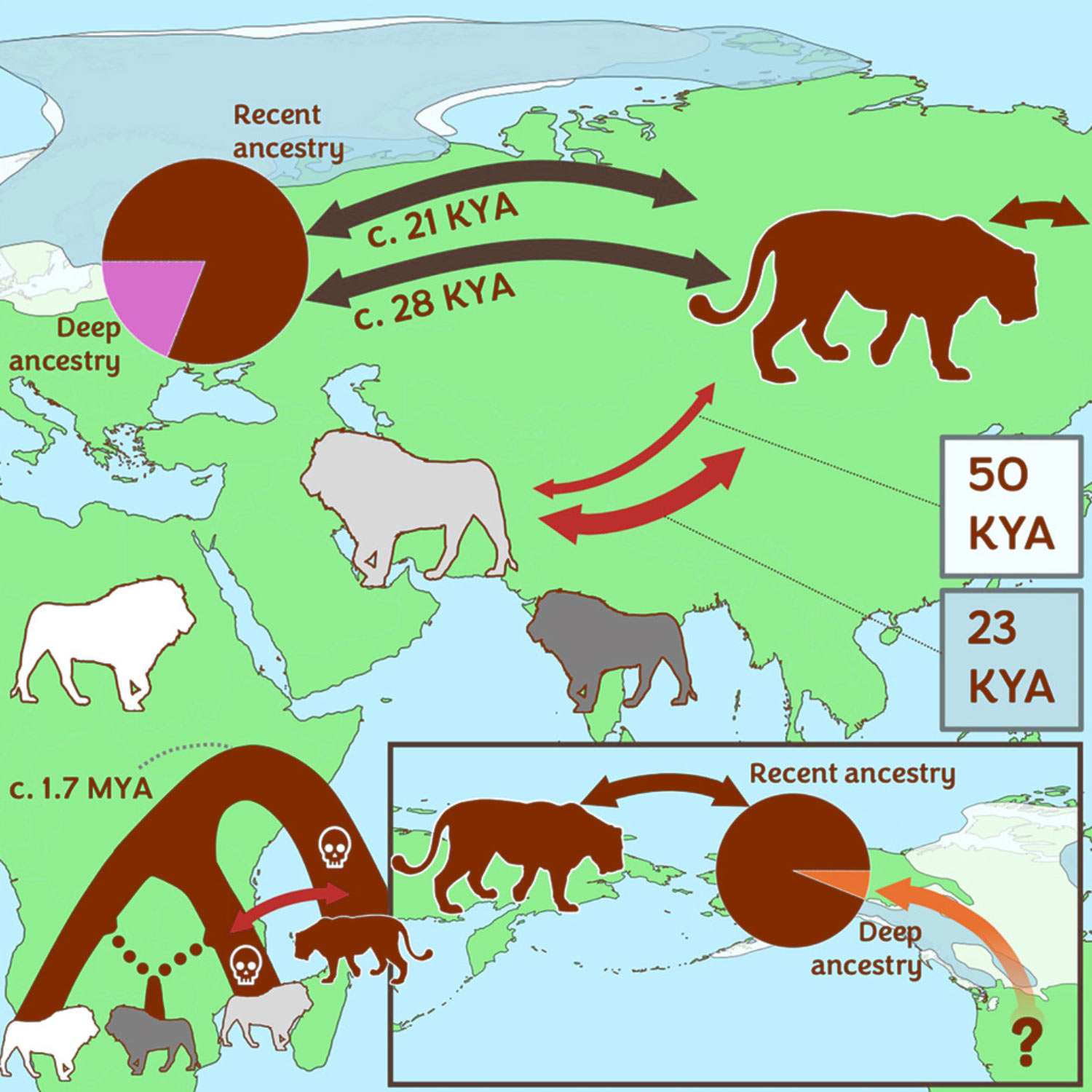
Using 12 cave lion genomes spanning more than 100,000 years, Stanton et al. show that modern and cave lions were distinct evolutionary lineages with separate demographic histories and unique non-synonymous variants. Image credit: Stanton et al., doi: 10.1016/j.cell.2026.05.007.
The researchers analyzed 12 genomes from cave lions sampled across Eurasia and northernmost North America, spanning a period of over 100,000 years, and compared these with 20 genomes from modern lions in Africa and southern Asia.
The cave lion DNA was extracted from teeth and bones, but also some soft-tissue specimens, including two exceptionally well-preserved cave lion cubs from Northern Siberia.
A comparison of the genomes show that cave lions and modern lions formed clearly distinct groups, indicating long term evolutionary separation.
While earlier estimates have suggested a relatively recent divergence, the study supports a much deeper split that may extend back well roughly 1.7 million years.
The scientists also found surprising evidence that the two lineages were not entirely isolated: during periods of peak glacial expansion, cave lions appear to have pushed southward into territory occupied by modern lions, leading to occasional interbreeding.
A cave lion from Central East Asia dating to around 20,000 years ago carried 3.2-4.4% modern lion ancestry — the most likely source being the now-extinct Southwest Asian lion population.
The authors also identified dozens of protein-coding mutations unique to cave lions, concentrated in genes linked to brain function, vision, the circulatory system, and growth — hinting at deep biological adaptations to the frigid Holarctic ecosystems these animals once dominated.
“Our results suggest that past climate change did more than reshape habitats,” said senior author Professor Love Dalén, a research group leader at the Centre for Palaeogenetics in Stockholm.
“It actively brought species together, creating brief opportunities for interbreeding that would not have existed otherwise.”
The team’s results appear in the journal Cell.
_____
David W.G. Stanton et al. Paleogenomes reveal the evolutionary relationship between modern and cave lions. Cell, published online June 3, 2026; doi: 10.1016/j.cell.2026.05.007