Using spectral data from the Magellan Clay telescope at Las Campanas Observatory, astronomers detected helium escaping from LHS 1140b, a rocky exoplanet that orbits in the habitable zone of the nearby low-mass star LHS 1140.
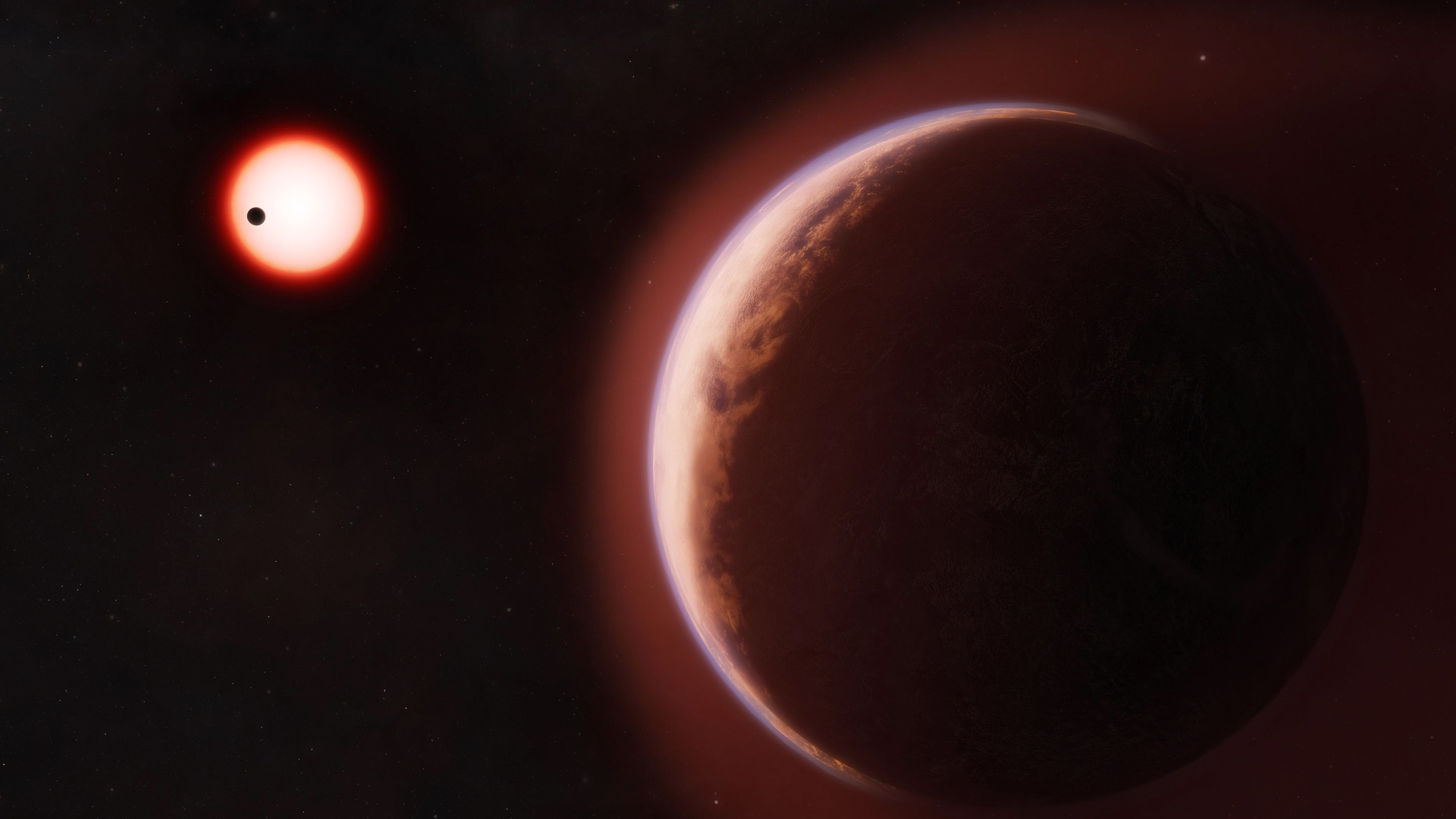
An artist’s concept of rocky planets LHS 1140b and LHS 1140c. Image credit: Melissa Weiss / Harvard & Smithsonian’s Center for Astrophysics.
LHS 1140 is a 3-billion-year-old inactive M-dwarf located approximately 39 light-years away in the constellation of Cetus.
Also cataloged as Gliese 3053 or GJ 3053, it is orbited by three planets: LHS 1140b, c and d.
Discovered in 2017, LHS 1140b has a mass of 5.6 Earth masses and a radius of 1.73 Earth radii.
It has an orbital period of 24.7 days and receives 42% of the stellar irradiation received by Earth, giving it an equilibrium temperature of 226 K (minus 47 degrees Celsius, or minus 53 degrees Fahrenheit).
“Twenty years ago we wondered whether other terrestrial-type planets even existed,” said Harvard University Professor Robin Wordsworth.
“Then we learned they’re common, and found some in the habitable zone. The next question was whether any of them had managed to keep an atmosphere. Now we know at least one has.”
Using a powerful instrument called the Warm Infrared Echelle Spectrograph to Realize Extreme Dispersion (WINERED) on the Magellan Clay telescope at Las Campanas Observatory, the astronomers observed LHS 1140b in 2024 and saw evidence of helium escaping from its atmosphere.
“After much careful analysis and consideration of the spectra, we determined that helium was escaping from LHS 1140b’s atmosphere in 2024 due to heating from stellar X-rays and extreme ultraviolet radiation,” said Dr. Shreyas Vissapragada, an astronomer at Carnegie Science Observatories.
“However, our 2025 observations revealed no escaping helium, so the atmospheric escape appears to be variable.”
“It is a rare privilege to witness the atmosphere of an extrasolar planet change on such short, human timescales!”
Combined with earlier observations and sophisticated models of exoplanet evolution, the researchers interpreted these results to indicate the presence of a highly layered atmosphere.
They predict the planet has a helium-dominated and hydrogen-poor upper atmosphere, and other chemical species like water are trapped at lower altitudes closer to the surface.
They also found no evidence of an atmosphere on the LHS 1140c planet, perhaps indicating that these two worlds may fall on opposite sides of the so-called cosmic shoreline.
On one side are planets that retain their atmospheres for billions of years, and on the other those with atmospheres that boil off quickly into space.
“An atmosphere is essential for a planet to support life as we know it,” said Dr. Collin Cherubim, an astronomer at Harvard University.
“This is the first time anyone has found an atmosphere on a rocky planet in the habitable zone of another star.”
“Because there’s helium there, and because the helium is escaping, the question is: Is LHS 1140b a bare rock with no atmosphere that sometimes burps up some gas that then immediately escapes, or is there a steady-state atmosphere there that will leak out stuff like the Earth does from time to time?” said Dr. Jason Dittmann, an astronomer at the University of Florida.
“Webb data over the next four to five years will look for water, and if there’s water in the atmosphere, then it’s probably a stable atmosphere that will persist.”
A paper on the findings was published today in the journal Science.
_____
Collin Cherubim et al. Helium escaping from the atmosphere of a nearby rocky exoplanet orbiting in a habitable zone. Science, published online July 16, 2026; doi: 10.1126/science.aea9708