Paleontologists working in Brazil have identified a previously unknown species of archosauriform that lived about 240 million years ago and may belong to a poorly understood group of ancient reptiles that closely resembled the ancestors of crocodiles and dinosaurs.
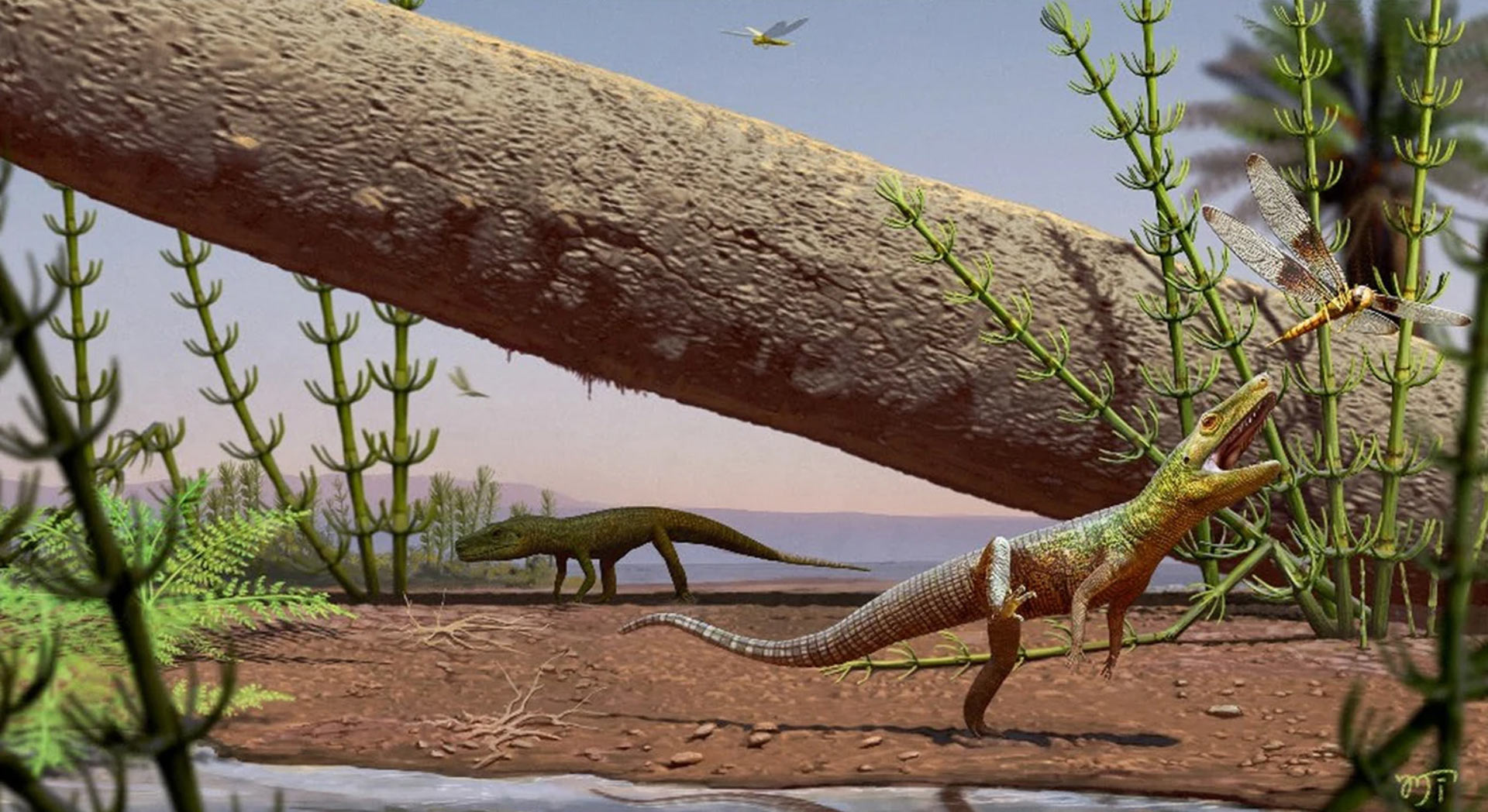
Life reconstruction of Silescelida acristata. Image credit: Matheus Fernandes Gadelha.
Silescelida acristata lived in what is now Brazil during the Middle Triassic, a period when life on Earth was recovering and diversifying after the end-Permian mass extinction.
During this time, archosauriforms — the broader group of reptiles that eventually gave rise to dinosaurs, pterosaurs and crocodilians — were beginning to dominate terrestrial ecosystems.
The new species was likely related to a rare and still poorly understood group of archosauriforms called Euparkeriidae.
The most famous euparkeriid species, Euparkeria capensis, was first described from South Africa in 1913 and remains the only definitive member of the group.
“Euparkeriidae is mainly known by the emblematic stem archosaur Euparkeria capensis from the Early to Middle Triassic of South Africa, and is currently the only definite member of this clade,” said lead author Maurício Garcia from the Universidade Federal de Santa Maria and colleagues.
“Other putative euparkeriids come essentially from China and Europe.”
“Euparkeria capensis and Euparkeriidae have been placed just outside Archosauria in all the major modern phylogenetic analyses of non-archosaurian archosauriforms.”
“As a result, this species, along with other putative euparkeriids, holds great importance for understanding archosaurian origins, as it has long been regarded as representing an approximation of the ancestral body plan of Archosauria.”
Silescelida acristata’s skeletal remains — a left shoulder blade, a right hip bone and a left thighbone (nearly 17.3 cm in length) — were found at the site of Posto in the municipality of Dona Francisca, Rio Grande do Sul, Brazil.
Based on comparisons with related animals, the new species likely resembled a long-limbed, agile lizard-like predator.
The discovery of Silescelida acristata expands the known geographic range of the euparkeriid lineage.
It also confirms that South America was a critical arena in the early evolution of archosauriforms.
“This discovery not only informs on the temporal and paleogeographic distribution of euparkeriids but also sheds light on the origin and early evolution of eucrocopodans, representing the first record of this archosauriform grade in the Triassic of Brazil,” the paleontologists concluded.
“More broadly, the new species underscores the significance of South American Triassic deposits within the evolutionary history of archosauriforms.”
The team’s paper was published June 10 in the journal Scientific Reports.
_____
M.S. Garcia et al. 2026. A new eucrocopodan archosauriform from the Middle Triassic of southern Brazil and the phylogeny of Euparkeriidae. Sci Rep 16, 16585; doi: 10.1038/s41598-026-53740-9