Scientists at the Max Planck Institute for Chemical Ecology have found that moth wings are equipped with odor-detecting receptors, suggesting the insects use their wings — not just their antennae — to sense chemical cues in the air while flying.
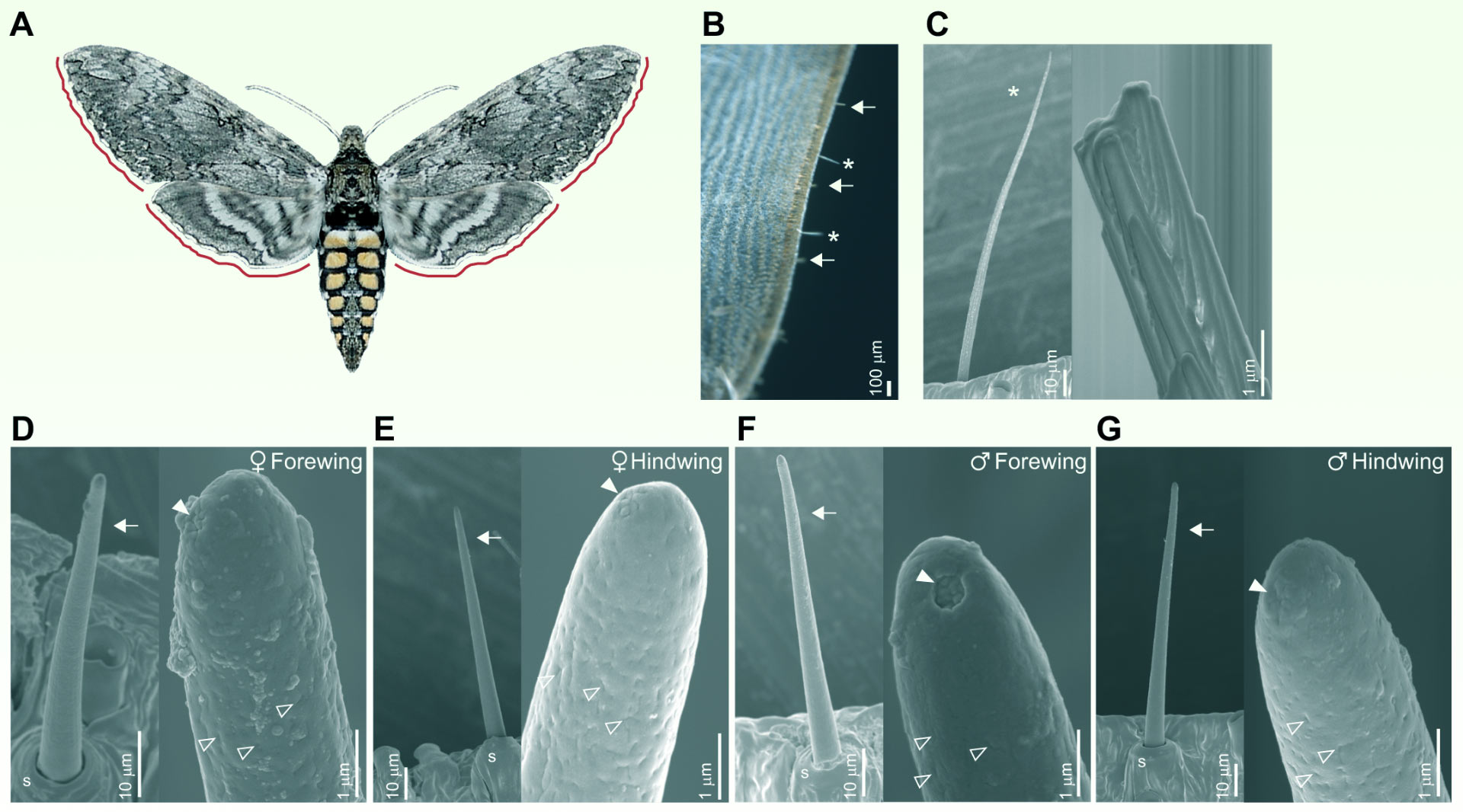
Reda Ismaieel et al. examined the olfactory capabilities of the wings of the tobacco hawkmoth (Manduca sexta). Image credit: Reda Ismaieel et al., doi: 10.1242/jeb.252047.
“The tobacco hawkmoth (Manduca sexta) was recently found to have receptor proteins in its wings that could detect different smells and tastes,” said Dr. Sonja Bisch-Knaden, lead author of a study published in the Journal of Experimental Biology.
“But receptor proteins are only the beginning of the sensory cascade that converts scents into nerve signals to transmit the sense of smell.”
“We knew that tobacco hawkmoth wings would also require specialized odor-sensitive hairs distributed along the edges of their wings to have a true sense of smell. We looked for the essential scent hairs.”
After gently snipping the edges from tobacco hawkmoth wings, the researchers sprayed a fine mist of gold over the portions before scrutinizing them with a scanning electron microscope.
Interspersed between slender touch sensitive hairs, they could see stubbier porous hairs, the hallmarks of scent sensors, suggesting that the shorter hairs might contribute to the insect’s sense of smell.
They also collected mRNA from the insects’ wings, which codes for the proteins that recognize specific scents.
After months of painstaking analysis, they identified the mRNA for 33 taste and scent receptors, with the mRNA for 15 receptors produced along the wing’s edge, where the odor-sensing hairs are located.
And when the authors cross-referenced the receptor proteins that they had found in the wing with the odors that the receptors sense in other insects, they concluded that the moth’s wings likely sense bitter flavors and the aroma of amines, which smell like rotting fish to us.
To find out which scents the moth wing could smell, they rigged up a wing to an electrical circuit and blew puffs of odors — from putrid pyridine and fruity methyl hexanoate to the heady scent of Datura flowers — onto the wing.
Surprisingly, the wing only picked out two odors, pyrrolidine and piperidine, both of which are stinky amines that are in the leaves of nightshade plants, upon which tobacco hawkmoths prefer to lay their eggs.
And when the researchers trimmed the edges off the wings and retested their sense of smell, they found the wings could still detect the unpleasant amine odors.
“This suggests that the moth has special sensory hairs across its wings, not just along the edges, that can smell those odors,” Dr. Bisch-Knaden said.
_____
Ahmed Reda Ismaieel et al. 2026. Noses on the wing: the olfactory capacity of hawkmoth wings. J Exp Biol 229 (14): jeb252047; doi: 10.1242/jeb.252047