The Chicxulub impact not only plunged Earth into an impact winter but also produced a dust blanket that later overheated the planet, according to new research from Purdue University and the University of Colorado, Boulder.

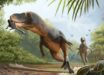
Ankylosaurus magniventris, a large armored dinosaur species, witnesses the impact of an asteroid, falling on the Yucatan peninsula 66 million years ago. Image credit: Fabio Manucci.
About 66 million years ago (Cretaceous period), a massive asteroid crashed into Earth near the site of the small town of Chicxulub in what is now Mexico.
The magnitude of the impact released energy equivalent to 1023 joules, enough to generate gigantic earthquakes, mega-tsunamis, and form a crater of 180-200 km in diameter in the Yucatan Peninsula.
The catastrophic event eradicated roughly 75% of the animal and plant species on Earth, including whole groups like non-avian dinosaurs and ammonites.
Scientists have long debated exactly how the asteroid impact triggered the mass extinction.
In a new study, Purdue University planetary scientist Brandon Johnson and his colleagues revisited the idea that extreme heat and widespread wildfires were among the deadliest consequences for life on land.
“We’re in the realm where we might be essentially killing off everything within that first hour or two,” Dr. Johnson said.
“This result reinvigorates the decades-long debate around whether it was the asteroid impact or another after effect that killed the dinosaurs.”
According to the researchers, debris blasted into space by the Chicxulub impact circled the globe before reentering Earth’s atmosphere.
During that journey, molten droplets known as spherules separated from vaporized rock.
Geological evidence indicates that the hot vapor later cooled into vast amounts of fine dust suspended in the atmosphere.
As the spherules fell back to Earth, friction with the atmosphere generated intense heat.
The fine dust amplified that heating by trapping additional heat near the surface.
Together, those effects would have scorched the land and fueled widespread fires, suggesting that extreme heat may have been a major driver of the extinction of terrestrial plants and animals.
“It probably looked more like hell than like Venus,” Dr. Johnson said.
“The clouds would have blocked daylight so to any animal, like humans, that don’t see far into the infrared, the surface would have probably looked dark.”
“You would only have been able to see a reddish glow from the wildfires. But there really wouldn’t be anything alive to do the seeing anyway, except for any animal that was able to burrow or swim or shelter in some way, to find a way to survive. It would have been terrible.”
The results were published July 28 in the Journal of Geophysical Research: Biogeosciences.
_____
Brandon C. Johnson et al. 2026. Heat and Wildfires during the K-Pg Mass Extinction Enhanced by Fine Dust. Journal of Geophysical Research: Biogeosciences 131 (7): e2026JG009837; doi: 10.1029/2026JG009837