Paleontologists have identified the earliest-known cephalopod equipped with a siphuncle — a tubular extension of the mantle found in shelled cephalopods — pushing back the fossil record of this key evolutionary feature to the Early Cambrian, roughly 520 million years ago.
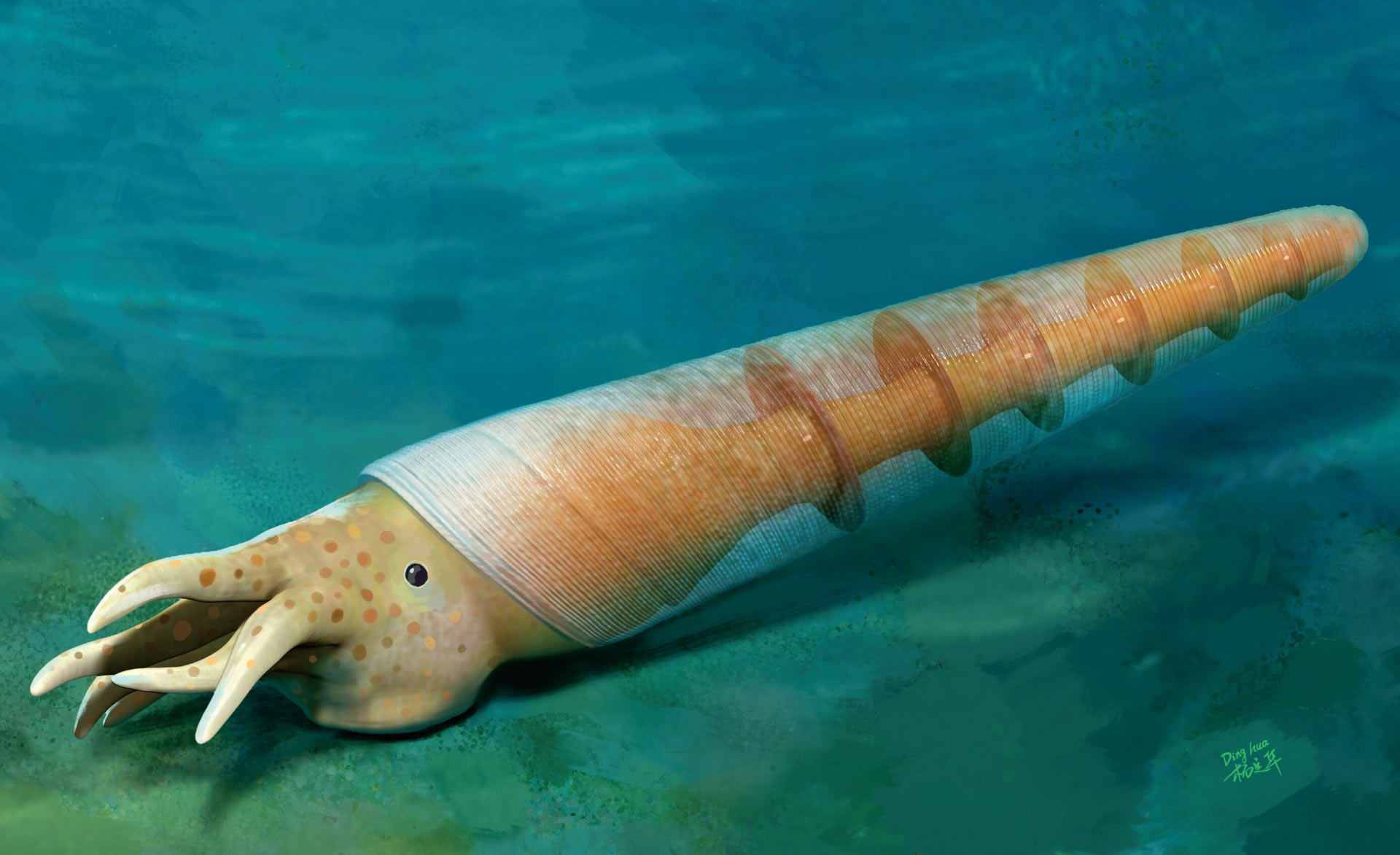
Life reconstruction of Eoceras shaanxiense. Image credit: Dinghua Yang.
Cephalopods are a group that today includes octopuses, squid, cuttlefish and nautiluses, and once included the extinct ammonites.
They are unusual among mollusks for the internal architecture they evolved to stay buoyant.
Chambered shells regulated that buoyancy through structures such as septa and, crucially, the siphuncle, a tube that could be filled with water or gas and is considered one of the defining innovations separating cephalopods from other mollusks.
But because fossils from the Early Cambrian epoch are sparse, scientists have had only a fragmentary picture of how that system first evolved.
“Combined with jet propulsion, the siphuncle enables cephalopods to engage in a nektonic and mostly predatory lifestyle through long-term regulation of their buoyancy,” said Chang’an University paleontologist Zuchen Song and colleagues.
“The origin of this key innovation remains unknown, as major gaps exist between the earliest accepted cephalopod, Plectronoceras cambria from the Late Cambrian era, and molecular clock estimates placing the divergence of the lineage from other mollusks in the Early Cambrian.”
In a new study, the researchers examined 32 specimens of a previously unknown cephalopod species from the Shuijingtuo Formation in China.
Named Eoceras shaanxiense, the animal lived in the Early Cambrian oceans approximately 520 million years ago.
Millimeters in size, it had a straight, cone-shaped shell, a tilted opening, multiple internal walls, and a segmented tube running along the underside of the shell that connected to the chambers through tiny canals.
After comparing that structure to known cephalopod siphuncles, the paleontologists concluded it qualified as one, making Eoceras shaanxiense the earliest siphuncle-bearing cephalopod yet found, and representing a transitional step between earlier chambered-shell species and later cephalopods with more advanced buoyancy systems.
“Internally, the shell exhibits multiple septa along with a peripherally situated segmented tube that appears to bridge the septa through minute canals, indicating that the soft body migrated aperturally to form successive chambers during growth while maintaining contact with earlier chambers via the tube,” they said.
“Collectively, these features identify the segmented tube in Eoceras shaanxiense as a candidate primordial cephalopod siphuncle.”
Because its buoyancy system was still primitive, Eoceras shaanxiense probably spent most of its life on the seafloor rather than swimming freely, though its soft-tissue anatomy remains unknown.
“The discovery extends the known range of stem cephalopods back to the Early Cambrian and reveals the early stages in the evolutionary assembly of a chambered phragmocone employed in buoyancy regulation,” the scientists concluded.
Their paper was published this week in the journal Nature.
_____
Z. Song et al. Earliest siphuncle-bearing cephalopod from the early Cambrian. Nature, published online July 29, 2026; doi: 10.1038/s41586-026-10868-y