A new analysis of orbital and lander data from Mars suggests the exposed north-polar water ice contains less than 3% dust, far below earlier estimates of up to 25%.
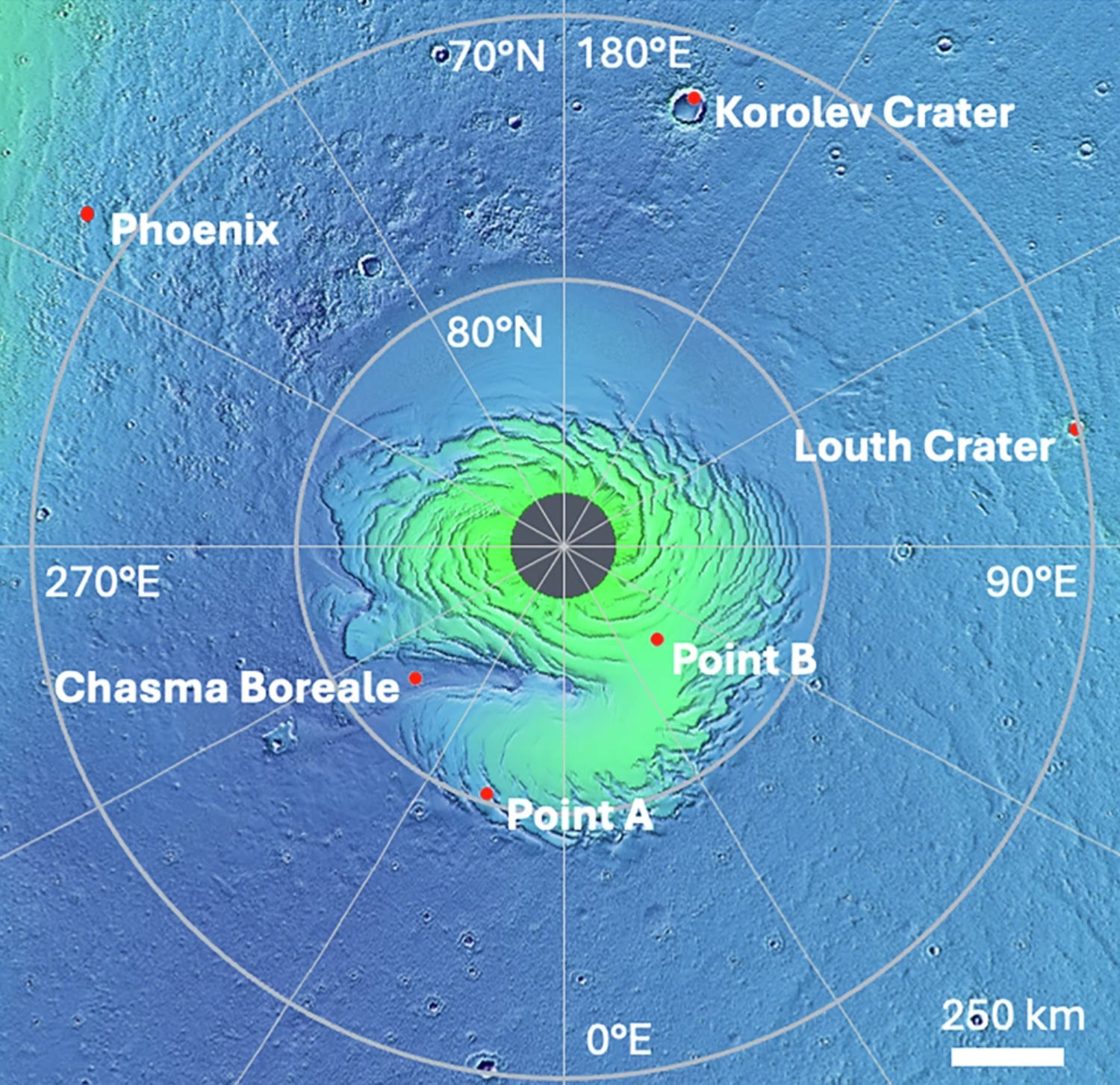
Map of the six north polar locations analyzed by P. Mohan & A.R. Khuller, where water ice is exposed at the Martian surface. Image credit: P. Mohan & A.R. Khuller, doi: 10.1038/s44453-026-00054-9.
Planetary scientists learn about Martian ice by studying how it reflects light, as measured by orbiters such as ESA’s Mars Express and NASA’s Mars Reconnaissance Orbiter, as well as by NASA’s Phoenix lander.
But reflectance depends on several things at once, including grain size, dust content and layering, and past studies have matched similar spectra with very different combinations of those parameters.
At the Phoenix landing site, for instance, dust estimates have varied by up to a factor of 25.
“We know there is water ice in the area surrounding the north pole of Mars, but there has been widespread disagreement as to how dusty that ice is,” said Dr. Aditya Khuller, a researcher at the University of Washington.
“If it is dustier, the ice will be darker. Just like a dark T-shirt in the Sun makes you warmer, dusty ice gets warmer and vaporizes faster on Mars.”
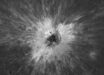
Dr. Khuller and University of Edinburgh’s Dr. Pari Mohan used a physically based model originally developed for terrestrial snow and ice, and applied it to data from six north polar locations: two spots on the residual polar cap, Korolev and Louth craters, Chasma Boreale, and the Phoenix landing site.
Their results differ sharply from some earlier works: an analysis of Mars Express data from Korolev crater, for example, had implied dust contents of about 15-22% by mass; the new study finds roughly 0.2-0.4% in the top layer for the same observations.
The findings also suggest that the north pole is stacked ‘like an ice-cream sandwich,’ with layers of dustier ice between slabs of cleaner ice.
A dusty layer of frost forms over the ice every winter and disappears in the summer, revealing older, cleaner ice.
“By looking at how the brightness changed over time, we figured out that there is a frost that forms in the winter and it’s more dusty,” Dr. Khuller said.
“In the Martian summer it goes away, exposing cleaner, older ice.”
“These layers contain key details about the climate of Mars thousands of years ago, when the ice is thought to have formed from snowfall.”
“Mars experiences massive ice ages that have deposited shallow ice on roughly one-third of the planet.”
“Earth is stabilized by the gravitational pull of its moon. Mars, having only two small moons, oscillates wildly, which causes these dramatic ice ages.”
A paper on the findings appears in the journal npj Space Exploration.
_____
P. Mohan & A.R. Khuller. 2026. Revised dust content and grain size of exposed water ice at the North Pole of Mars. npj Space Explor 2, 36; doi: 10.1038/s44453-026-00054-9