Scientists have isolated a new strain of the Psychrobacter cryohalolentis species from 5,000-year-old ice from Scarisoara Ice Cave in Romania. Remarkably, the strain — labeled SC65A.3 — shows resistance to 10 widely used antibiotics, including drugs typically reserved for severe infections such as tuberculosis and urinary tract infections.
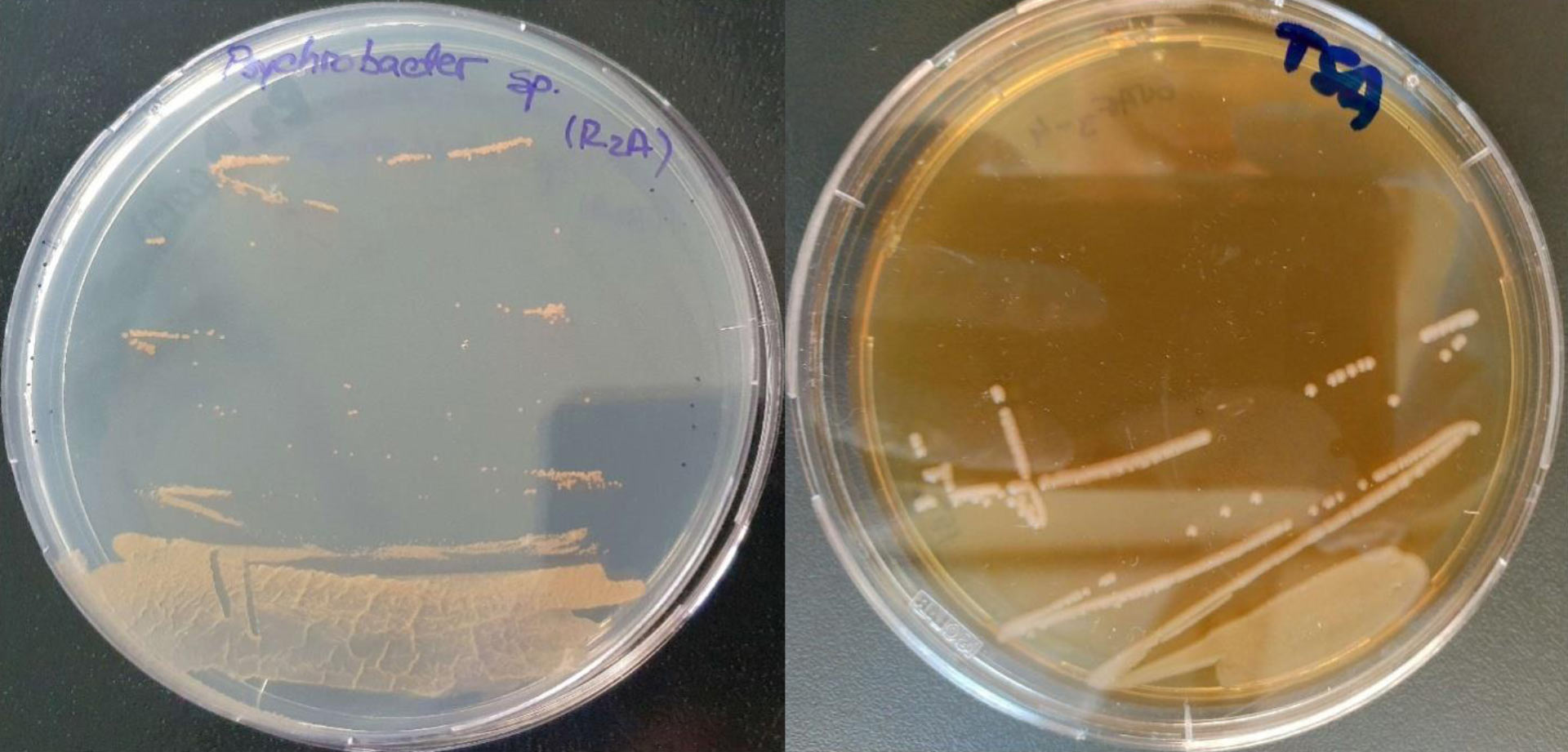
Isolated colonies of Psychrobacter SC65A.3 on R2A medium at 4 degrees Celsius (A) and on TSA medium at 15 degrees Celsius (B). Image credit: Ioana Paun et al., doi: 10.3389/fmicb.2025.1713017.
Psychrobacter is a genus of around 50 bacterial species evolutionary adapted to cold and saline environments.
First described in 1986 with Psychrobacter immobilis as the type species, it has a widespread distribution.
Psychrobacter species form cream to orange colonies and thrive at low temperatures, however tolerating up to 35-37 degrees Celsius and varying salinities. Some species can cause infections in humans or animals.
They are strictly aerobic, catalase- and oxidase-positive, and utilize amino and organic acids as carbon sources while displaying limited biochemical versatility.
“The Psychrobacter SC65A.3 bacterial strain isolated from Scarisoara Ice Cave, despite its ancient origin, shows resistance to multiple modern antibiotics and carries over 100 resistance-related genes,” said Dr. Cristina Purcarea, a researcher at the Institute of Biology Bucharest of the Romanian Academy.
“But it can also inhibit the growth of several major antibiotic-resistant ‘superbugs’ and showed important enzymatic activities with important biotechnological potential.”
Psychrobacter SC65A.3 was isolated from the 5,000 years old ice layer, part of the 25.33-m ice core from Scarisoara Ice Cave.
“Studying microbes such as Psychrobacter SC65A.3 retrieved from millennia-old cave ice deposits reveals how antibiotic resistance evolved naturally in the environment, long before modern antibiotics were ever used,” Dr. Purcarea said.
The researchers sequenced the genome of Psychrobacter SC65A.3 to identify the genes that enable the bacterium to survive extreme cold and those that underpin its resistance to antimicrobial drugs as well as its antimicrobial activity.
They also tested the strain against 28 antibiotics spanning 10 drug classes commonly used to treat bacterial infections, including medicines already known to face resistance through specific genes or mutations that blunt their effects.
“The 10 antibiotics we found resistance to are widely used in oral and injectable therapies used to treat a range of serious bacterial infections in clinical practice,” Dr. Purcarea said.
The resistance profile of the strain suggests that bacteria adapted to cold environments may serve as reservoirs of resistance genes.
“If melting ice releases these microbes, these genes could spread to modern bacteria, adding to the global challenge of antibiotic resistance,” Dr. Purcarea said.
“On the other hand, they produce unique enzymes and antimicrobial compounds that could inspire new antibiotics, industrial enzymes, and other biotechnological innovations.”
The findings were published in the journal Frontiers in Microbiology.
_____
Victoria Ioana Paun et al. 2026. First genome sequence and functional profiling of Psychrobacter SC65A.3 preserved in 5,000-year-old cave ice: insights into ancient resistome, antimicrobial potential, and enzymatic activities. Front. Microbiol 16; doi: 10.3389/fmicb.2025.1713017