For the first time, astronomers have mapped the vertical structure of Uranus’ ionosphere, uncovering unexpected temperature peaks, weakened ion densities, and puzzling dark regions shaped by the planet’s extreme magnetic field. The results, made possible by nearly a full day of observations with the NIRSpec instrument onboard the NASA/ESA/CSA James Webb Space Telescope, confirm that Uranus’ upper atmosphere has been cooling for decades and offer a rare glimpse into how the ice giant interacts with space in ways unlike any other world in the Solar System.

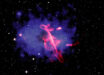
Tiranti et al. mapped the vertical structure of Uranus’ upper atmosphere, uncovering how temperature and charged particles vary with height across the planet. Image credit: NASA / ESA / CSA / Webb / STScI / P. Tiranti / H. Melin / M. Zamani, ESA & Webb.
The upper atmosphere of Uranus is one of the least understood in our Solar System, despite being critical for understanding how giant planets interact with their space environment.
Using Webb’s NIRSpec instrument, Northumbria University astronomer Paola Tiranti and her colleagues observed Uranus for almost a full day.
They measured the vertical structure of its ionosphere — the charged layer of the atmosphere where aurorae form.
“This is the first time we’ve been able to see Uranus’ upper atmosphere in three dimensions,” Dr. Tiranti said.
“With Webb’s sensitivity, we can trace how energy moves upward through the planet’s atmosphere and even see the influence of its lopsided magnetic field.”
The measurements show that temperatures peak around 3,000-4,000 km above the planet, while ion densities peak near 1,000 km, and are significantly weaker than predicted by models.
Webb also detected two bright bands of auroral emission close to Uranus’ magnetic poles, as well as a surprising region where both emission and density are depleted, likely linked to the unusual geometry of Uranus’ tilted and offset magnetic field.
These discoveries not only confirm that Uranus’ upper atmosphere has been cooling for decades, but also reveal new structures shaped by its magnetic environment.
Together, they provide critical benchmarks for future missions and improve our understanding of how giant planets (both in our Solar System and beyond) balance energy in their upper atmospheres.
“Uranus’ magnetosphere is one of the strangest in the Solar System,” Dr. Tiranti said.
“It’s tilted and offset from the planet’s rotation axis, which means its auroras sweep across the surface in complex ways.”
“Webb has now shown us how deeply those effects reach into the atmosphere.|
“By revealing Uranus’ vertical structure in such detail, Webb is helping us understand the energy balance of the ice giants.”
“This is a crucial step towards characterizing giant planets beyond our Solar System.”
The results were published in the journal Geophysical Research Letters.
_____
Paola I. Tiranti et al. 2026. JWST Discovers the Vertical Structure of Uranus’ Ionosphere. Geophysical Research Letters 53 (4): e2025GL119304; doi: 10.1029/2025GL119304