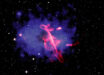
With the record-setting image from the Atacama Large Millimeter/submillimeter Array (ALMA), astronomers have mapped the molecular heart of our Milky Way Galaxy in breathtaking detail.
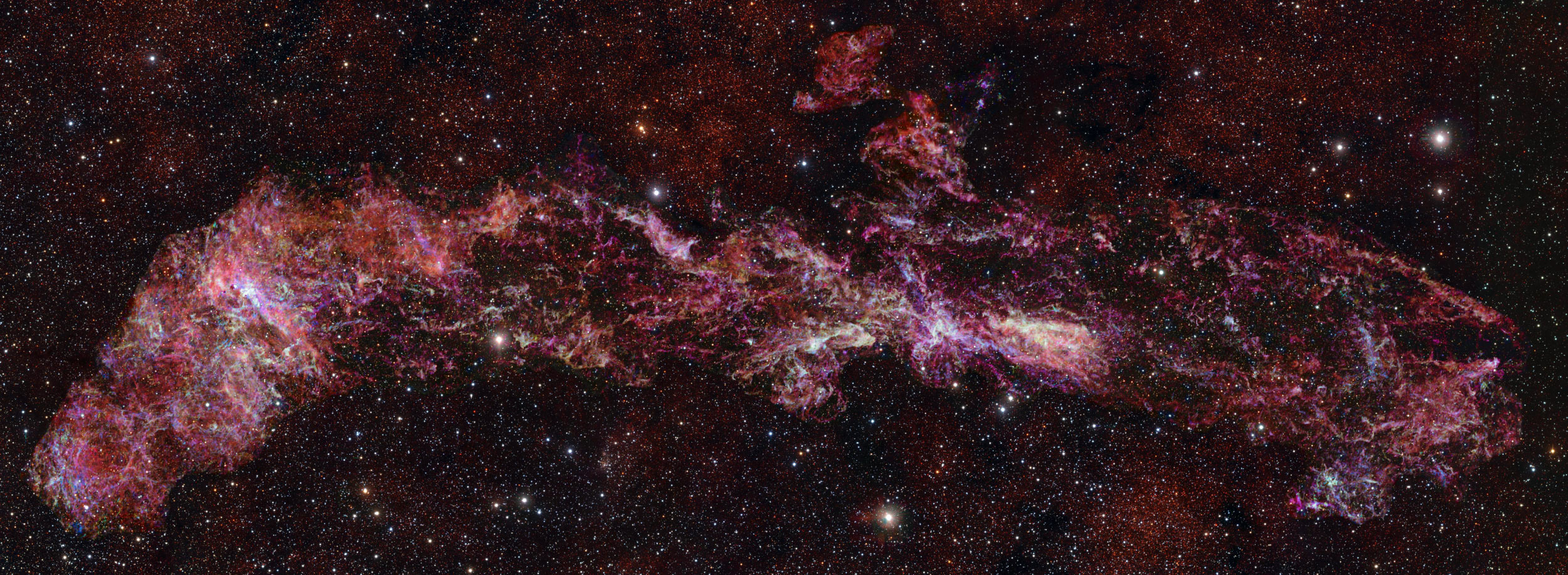
This image shows the complex distribution of molecular gas in the Central Molecular Zone (CMZ) of the Milky Way. Image credit: ALMA / ESO / NAOJ / NRAO / Longmore et al. / Minniti et al.
“It’s a place of extremes, invisible to our eyes, but now revealed in extraordinary detail,” said Dr. Ashley Barnes, an astronomer at ESO.
As part of the ALMA CMZ Exploration Survey (ACES), Dr. Barnes and colleagues mapped more than 650 light-years across the Central Molecular Zone, the extreme environment that surrounds our Galaxy’s supermassive black hole.
By detecting dozens of molecules, from simple silicon compounds to complex organic species, this survey provides the most comprehensive view yet of the cold gas that fuels star formation in this turbulent region.
“It is the only galactic nucleus close enough to Earth for us to study in such fine detail,” Dr. Barnes said.
“We anticipated a high level of detail when designing the survey, but we were genuinely surprised by the complexity and richness revealed in the final mosaic,” said Dr. Katharina Immer, an ALMA astronomer at ESO.
The dataset reveals the Central Molecular Zone like never before, from gas structures dozens of light-years across all the way down to small gas clouds around individual stars.
“The Central Molecular Zone hosts some of the most massive stars known in our Galaxy, many of which live fast and die young, ending their lives in powerful supernova explosions, and even hypernovae,” says ACES leader Professor Steve Longmore, an astrophysicist at Liverpool John Moores University.
With ACES, astronomers hope to better understand how these phenomena influence the birth of stars and whether our theories of star formation hold in extreme environments.
“By studying how stars are born in the Central Molecular Zone, we can also gain a clearer picture of how galaxies grew and evolved,” Professor Longmore said.
“We believe the region shares many features with galaxies in the early Universe, where stars were forming in chaotic, extreme environments.”
The new ACES results appear in a series of papers in the Monthly Notices of the Royal Astronomical Society.