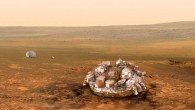
A new image from NASA’s Mars Reconnaissance Orbiter (MRO) shows a bright spot that may be a parachute of ESA’s ExoMars Schiaparelli module, and a larger...
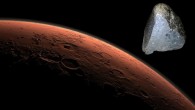
New analysis of the most famous Martian meteorite ever recovered has changed our understanding of the early volcanic history and evolution of the Red Planet....
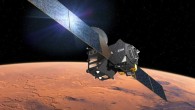
ESA’s ExoMars Trace Gas Orbiter (TGO) has entered an elliptical orbit around Mars, while contact has not yet been confirmed with the Schiaparelli lander.
ESA’s...
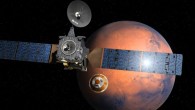
Artist’s impression depicting the separation of the Schiaparelli module from the Trace Gas Orbiter, and heading for Mars. Image credit: D. Ducros / ESA.
ESA’s...
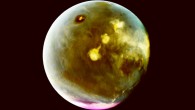
New images from NASA’s Mars Atmosphere and Volatile Evolution (MAVEN) spacecraft show the ultraviolet glow from the Red Planet’s atmosphere in detail,...
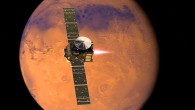
Artist’s impression visualizing the ExoMars 2016 Trace Gas Orbiter, with its thrusters firing, beginning its entry into Mars orbit on October 19, 2016....
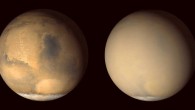
A global-scale dust storm could envelop the Red Planet within the next few months, according to planetary researchers at NASA’s Jet Propulsion Laboratory...
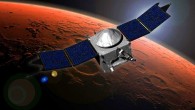
NASA’s Mars Atmosphere and Volatile EvolutioN (MAVEN) spacecraft, sent to Mars to explore its upper atmosphere, ionosphere and interactions with the...
Curiosity has found evidence that chemistry in the Martian surface material contributed dynamically to the makeup of the planet’s atmosphere over time.
This...
The combination of seismic activity and water locked away at depth within Mars could be releasing sufficient hydrogen gas to support communities of microorganisms,...
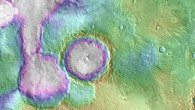
ESA’s Mars Express, NASA’s Mars Reconnaissance Orbiter and Mars Global Surveyor have sent back new images and data from the Red Planet that indicate...
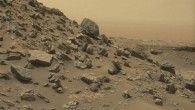
A set of new photos taken by NASA’s Curiosity Mars rover reveals signs of past geologic activity.
This view from Curiosity’s Mast Camera shows a sloping...
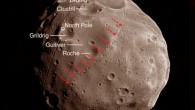
Anomalous grooves on Phobos, the larger of the two Martian moons, are the result of debris ejected by impacts eventually falling back onto the surface...
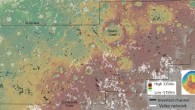
An international team of scientists led by University College London researcher Joel Davis has identified over 10,500 miles (17,000 km) of ancient river...
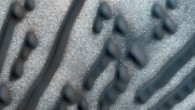
The latest images released by NASA’s HiRISE (High Resolution Imaging Science Experiment) team show ‘Morse code’ dunes on the Martian surface.
‘Morse...
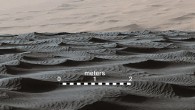
A team of planetary scientists led by researchers at the California Institute of Technology (Caltech) has discovered a type of dune on Mars intermediate...
ESA’s ExoMars Trace Gas Orbiter (TGO) has snapped its first photo of the Red Planet.
ExoMars acquired its first image of Mars on June 13. The line-of-sight...
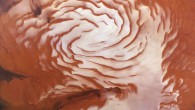
Researchers using data from NASA’s Mars Reconnaissance Orbiter have found evidence of an ice age recorded in the Red Planet’s polar caps.
This image,...
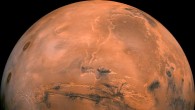
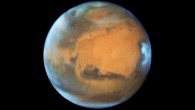
On May 12, 2016, the Wide Field Camera 3 (WFC3) instrument on the NASA/ESA Hubble Space Telescope captured this incredible photo of Mars, when the planet...
Massive meteorite impacts triggered two mega-tsunamis in the early Martian ocean 3.4 billion years ago, according to scientists writing in the journal...