A new analysis of three skull fragments unearthed at the Gran Dolina cave site in Spain indicates that Homo antecessor had bone thickness closer to that...
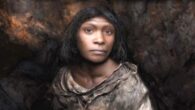
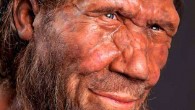
Neanderthals vanished roughly 42,000 years ago, but a piece of their biology appears to be quietly at work in some people today, according to a new study...
New research led by the University of California, Berkeley reveals that beyond Neanderthals and Denisovans, humans interbred with two mysterious ‘ghost’...
Ararat-1, a modest limestone cave that lies at an elevation of 1,034 m on the eastern flanks of the Ararat Depression in central Armenia, has yielded a...
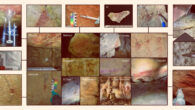
For the first time, researchers have extracted ancient human DNA directly from the walls of a cave. Although their results do not conclusively link ancient...
Scientists have generated genetic data from 27 Neanderthals who lived in Belgium and France less than approximately 52,500 years ago, painting a richer...
Mitochondrial DNA (mtDNA) from eight fossils found in Stajnia Cave in Poland reveals a tight-knit group of Neanderthals who lived about 100,000 years ago,...
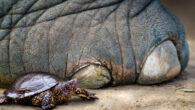
New evidence from Germany suggests Neanderthals captured European pond turtles (Emys orbicularis) around 125,000 years ago, likely valuing their shells...
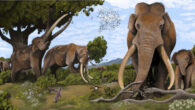
Chemical clues preserved in the teeth of straight-tusked elephants (Palaeoloxodon antiquus) from the 125,000-year-old site of Neumark-Nord in Germany suggest...
Prehistoric humans and Neanderthals didn’t just interbreed, they did so with a consistent sex bias, as male Neanderthals and female modern humans mated...
The hominin fossils discovered in the Grotte à Hominidés at Thomas Quarry I in Casablanca, Morocco, are providing new evidence about the deep origins...
The Middle to Upper Paleolithic Transition approximately 50,000 to 38,000 years ago is marked by the decline and extinction of Neanderthals, the emergence...
Kissing occurs in most living large apes, and likely also occurred in Neanderthals, first evolving in the ancestor to this group 21.5-16.9 million years...
University of Edinburgh scientist Hannah Long and colleagues show how a region of Neanderthal DNA is better at activating a jaw-forming gene than the human...
The Crimean Peninsula in Ukraine contains key Middle to Upper Paleolithic transitional archaeological sites, including the site of Starosele, where archaeologists...
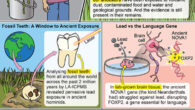
Several hominids — Australopithecus africanus, Paranthropus robustus, early Homo sp., Gigantopithecus blacki, Pongo sp., Papio sp., Homo neanderthalensis,...