Geoscientists from Australia and France have used the geological record of Earth’s deep oceans to discover a connection between the orbits of our home...
A Brazilian anthropologist has reconstructed the face of the archaic human species Homo longi from a well-preserved skull discovered in northeastern China...
Gigantopithecus blacki, the largest ever primate and one of the largest species of the southeast Asian megafauna, persisted in China from about 2 million...
Birds are among the best-studied animal groups, but their prehistoric diversity is poorly known due to low fossilization potential. Hence, while many human-driven...
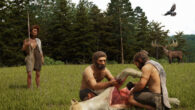
Archaeologists from MONREPOS, the Johannes Gutenberg University of Mainz and Leiden University have recently learned that around 125,000 years ago, hunting...
Archaeologists from the Johannes Gutenberg University Mainz, the Leibniz Zentrum für Archäologie and Leiden University say they have found cut marks...
Archaeologists from the Senckenberg Centre for Human Evolution and Palaeoenvironment at the University of Tübingen have analyzed the ancient animal remains...
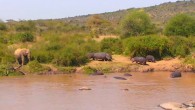
Paleontologists have redescribed a skull of the living species Hippopotamus amphibius recovered from a quarry called Cava Montanari at Tor di Quinto —...
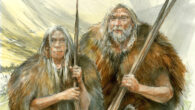
Paleoanthropologists have reconstructed the face of a Neanderthal man whose 56,000-year-old remains were found at La Chapelle-aux-Saints in south-central...
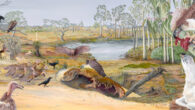
Paleontologists have uncovered the fossilized remains of a new species of the Pleistocene eagle genus Dynatoaetus in Victoria Fossil Cave at Naracoorte,...
Paleontologists have discovered a trackway of seven moa footprints and an associated separate footprint at a riverbank outcrop of the Maniototo Conglomerate...
Anthropologists in Greece have used facial reconstruction techniques to show how Homo heidelbergensis, a poorly understood relative of Neanderthals that...
During the Upper Paleolithic, lions become an important theme in Paleolithic art and are more frequent in anthropogenic faunal assemblages. However, the...
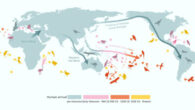
Our species, Homo sapiens, dispersed from Africa into Eurasia multiple times in the Middle and Late Pleistocene. According to new research led by Shantou...
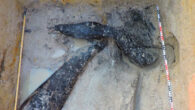
Archaeologists have found an ancient wooden structure at the archaeological site of Kalambo Falls in Zambia. This structure — dated to about 476,000...
Today, there are more than 8 billion human beings on the planet. Our species dominate Earth’s landscapes, and our activities are driving large numbers...
The American lion (Panthera atrox) may have roared, while the saber-toothed cat Smilodon fatalis may have produced vocalizations similar to living purring...
New paleoclimate evidence shows that around 1.1 million years ago, the southern European climate cooled significantly and caused an extinction of archaic...