Scientists have for the first time determined the mass of a non-transiting extra-solar planet.
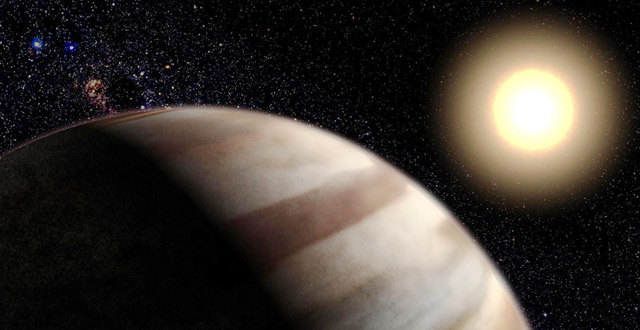
Artist's impression of Tau Boötis b looking at its sun (NASA)
Although there have been about 800 extra-solar planets discovered so far in our galaxy, the precise masses of the majority of them are still unknown, as the most-common planet-finding technique provides only a general idea of an object’s mass.
Knowing a body’s mass is essential first to confirm it is a planet and if so, to determine whether it is rocky and possibly habitable or large and gassy. Until now, only the masses of transiting planets have been measured. Transiting planets are also the only type of extra-solar objects on which atmospheres have been detected.
Former Carnegie scientist Dr Mercedes López-Morales along with her colleagues measured the exact mass of a non-transiting planet. They did this using a new method that involves studying the carbon monoxide signature of the planet’s atmosphere – detecting, in the process, the atmosphere of this non-transiting planet. The new technique is described in a paper published in the Astrophysical Journal Letters.
This extra-solar planet known as Tau Boo b is located in the constellation of Bootes. It orbits a star about 50 light years away that’s bright enough to be visible to the naked eye.
The planet is similar in size to Jupiter and is so close to its star (only 8 stellar radii), that a year for this planet lasts only 3.3 Earth days. Furthermore, its surface temperature reaches 1,500 ° C, making it inhospitable to life.
Discovered in 1996, Tau Boo b was one of the first planets originally detected by the radial velocity method. This planet does not transit, but its presence and characteristics were initially determined by the wobble of its host star. This technique only provides a rough indication of a detected planet’s mass.
In June 2011, Dr López-Morales’ team conducted five hours of observations at near infrared wavelength – 2.3 microns. They obtained data from the high-resolution spectrograph CRIRES, an instrument mounted on one of the four 8.2m Very Large Telescopes of the European Southern Observatory in Chile.
The observations and subsequent data analysis revealed the presence of carbon monoxide in the planet’s atmosphere. In addition, by studying the planet’s orbital motion through the displacement of spectral lines of carbon monoxide, the team was able to calculate its exact mass – 5.6 times Jupiter – a first using this particular method, and also a first for a non-transiting planet.
An independent study conducted by researchers at the University of Leiden in the Netherlands obtained a similar result for the same planetary system, confirming the potential of this technique.
“This method represents a strong advance in the field of exoplanets,” said Dr Lopez-Morales. “It opens a new path to determine masses of exoplanets and the composition of their atmospheres.”
_______
Bibliographic information: Rodler F, Lopez-Morales M, and Ribas I. 2012. Weighing the Non-transiting Hot Jupiter τ Boo b. ApJ 753 L25; doi:10.1088/2041-8205/753/1/L25