The newly-discovered minuscule fossils of Purgatorius — a shrew-sized mammal considered the earliest known relative of all primates, including humans, and long thought to be confined to northern North America — extend the known range of this mammal hundreds of km south. Described this week in a paper in the Journal of Vertebrate Paleontology, the discovery from Colorado’s Denver Basin challenges prevailing ideas about early primate biogeography and suggests that their initial diversification occurred rapidly after the end-Cretaceous mass extinction.

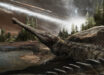
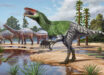
Shortly after the end-Cretaceous mass extinction, the earliest known primates, such as Purgatorius mckeeveri shown in the foreground, quickly set themselves apart from their competition — like the archaic ungulate mammal on the forest floor — by specializing in an omnivorous diet including fruit found up in the trees. Image credit: Andrey Atuchin.
The origin and early biogeographic history of primates is a fascinating, albeit controversial topic.
The oldest archaic primate, Purgatorius, is a small, tree-dwelling mammal that first appears in North America around 65.9 million years ago.
Until now, Purgatorius material had only been found in northern regions such as Montana and Saskatchewan, leaving scientists with an incomplete picture of how and where these animals evolved.
In their new paper, City University of New York paleontologist Stephen Chester and his colleagues described the southernmost fossils of Purgatorius.
The specimens were recovered through careful screen washing of ancient sediments at the Corral Bluffs study area in Colorado’s Denver Basin.
“This discovery helps fill a gap in understanding the geography and evolution of our earliest primate relatives after dinosaur extinction,” Dr. Chester said.
The fossils examined by the authors are tiny teeth that show a unique mix of features, suggesting they may belong to a previously unknown, early species of Purgatorius.
“The presence of these fossils in Colorado suggests that archaic primates originated in the north and then spread southward, diversifying soon after the mass extinction at the end of the Cretaceous period,” Dr. Chester said.
Scientists thought Purgatorius might be absent from southern regions during this time, but the new findings suggest that this was likely due to limited fossil sampling, not true absence.
“Our results demonstrate that small fossils can easily be missed,” Dr. Chester said.
“With more intensive searching, especially using screen-washing techniques, we will undoubtedly discover many more important specimens.”
The study also challenges long-standing assumptions about where archaic primates lived.
“Ankle bones of Purgatorius exhibit features that indicate it lived in trees, so we initially thought its absence south of Montana could be related to the sweeping devastation of forests from the asteroid impact 66 million years ago,” Dr. Chester said.
“However, our paleobotanical colleagues suggested the recovery of plants in North America was fast leading us to believe that Purgatorius should also be in more southern regions and perhaps we simply hadn’t looked hard enough.”
_____
Stephen G.B. Chester et al. Southernmost occurrence of Purgatorius sheds light on the biogeographic history and diversification of the earliest primate relatives. Journal of Vertebrate Paleontology, publishred online March 2, 2026; doi: 10.1080/02724634.2026.2614024