Paleontologists at the University of Toronto Mississauga have found dozens of tooth marks on the fossilized bones of three juveniles of Diadectes, one of the earliest large plant-eating vertebrates to walk on land. The scars offer what the researchers say is the oldest direct evidence of predator-prey interactions between terrestrial carnivores and herbivores.
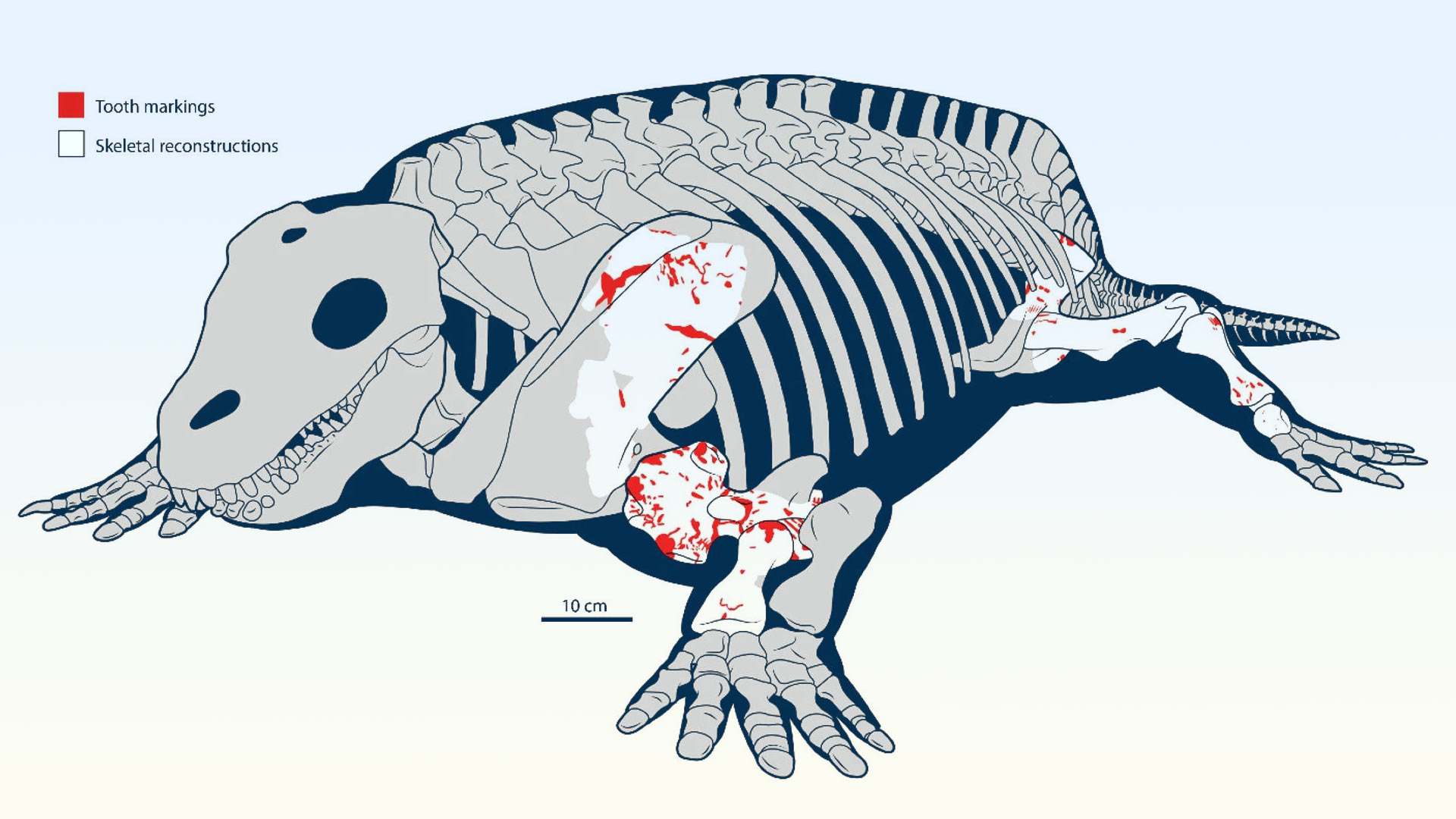
Skeletal reconstruction of Diadectes sideropelicus with overlaid left and right tooth and bore marks in right lateral view. Image credit: Young et al., doi: 10.1038/s41598-026-38183-6.
Although paleontologists have long known that apex predators stalked Permian landscapes, clear, physical proof that they fed on the first large herbivores has been elusive.
Unlike the Mesozoic Era, famous for dinosaur bite marks, the earlier fossil record has yielded little direct evidence of such encounters.
“Our discovery shows predator-prey hierarchies were formed earlier than previously expected,” said senior author Professor Robert Reisz, a paleontologist at the University of Toronto Mississauga.
“While these interactions are well known in the ‘Age of Reptiles’ there has been little information available in the Paleozoic Era, when terrestrial vertebrates first evolved into large apex predators and herbivores.”
In their research, Professor Reisz and his colleagues examined three disarticulated juvenile skeletons of the herbivore Diadectes from the Early Permian epoch.
The fossils were found at the Mud Hill locality of the Vale Formation in Texas, the United States.
The paleontologists documented five distinct kinds of damage on the bones: shallow scoring, deeper pitting, furrows carved along shafts, conical punctures and tiny boreholes.
Many of the marks cluster around joints rich in cartilage, suggesting that the predators were stripping muscle and prying into connective tissues.
Some furrows run parallel to the long axis of the bones, consistent with a head-pulling motion as flesh was torn free.
“The puncturing, pitting, scoring and furrowing marks on the skeletons of these three young plant-eating animals are indicative of large predators found in this site and in nearby areas include varanopid (Varanops) and sphenacodontid (Dimetrodon) synapsids,” said University of Toronto Mississauga researcher Jordan M. Young, first author of the study.
“Scavengers and small arthropods also joined in on the ‘Paleozoic feast’.”
“The skeletons showed arthropod borings on areas where cartilaginous bone ends would be on the carcass.”
The study was published on February 26, 2026 in the journal Scientific Reports.
_____
J.M. Young et al. 2026. Earliest direct evidence of trophic interactions between terrestrial apex predators and large herbivores. Sci Rep 16, 6977; doi: 10.1038/s41598-026-38183-6