Beyond their value for classification and evolutionary relationships, changes in the size and shape of the hominin face through time can reflect important functional adaptations. The recently-recovered, well-preserved Australopithecus skulls — especially the 3.67-million-year-old skull known as StW 573, or ‘Little Foot,’ from Sterkfontein in South Africa — have substantially enriched the fossil record. Although StW 573 is nearly complete, it suffered post-depositional damage that displaced and fragmented parts of the facial skeleton. In new research, paleoanthropologists aimed to digitally reconstruct the StW 573 face.
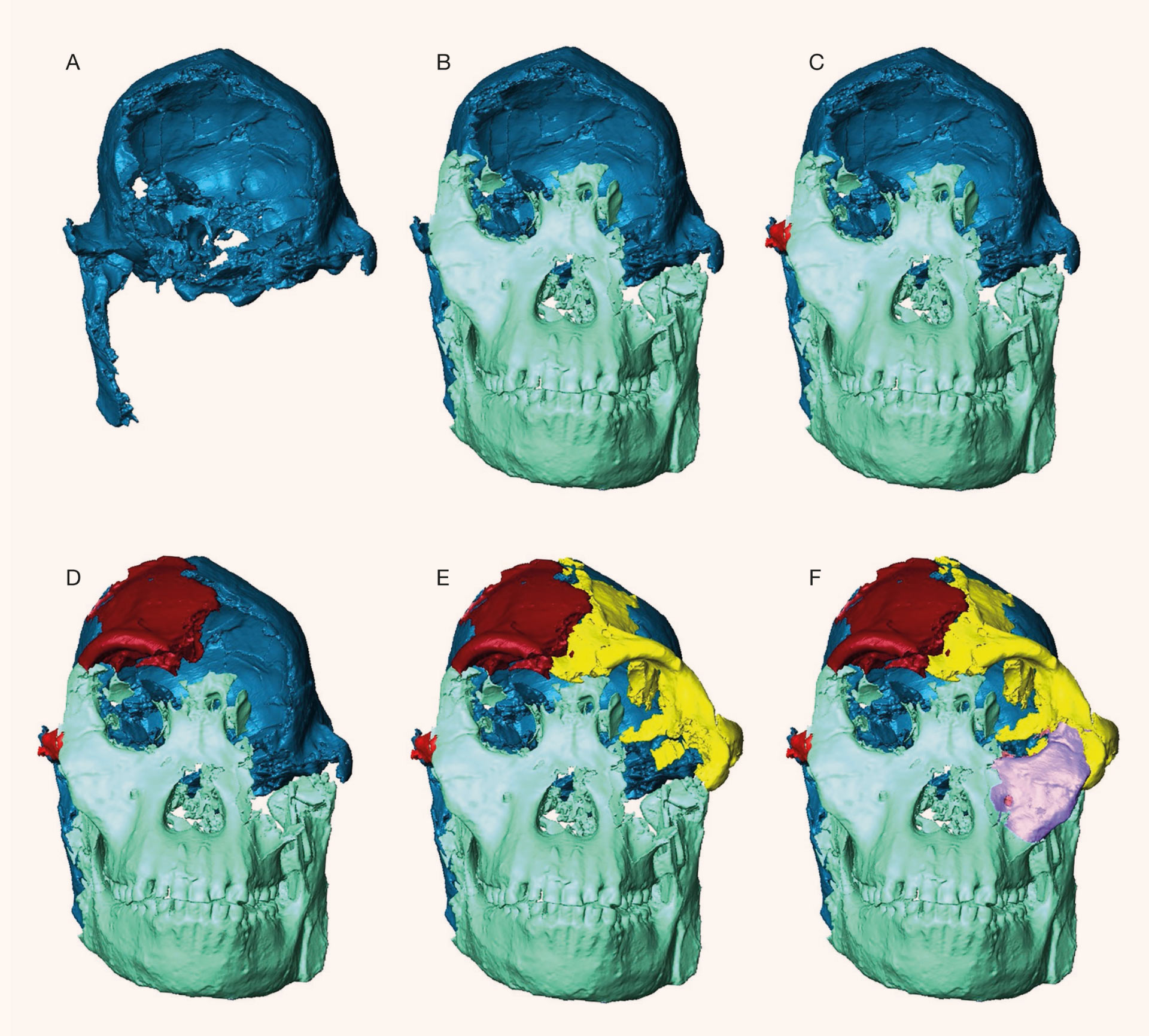
Reconstruction of the face of StW 573. Image credit: A. Beaudet.
The Little Foot fossil was discovered in 1994 in a cave at Sterkfontein in central South Africa.
Also known as StW 573, the specimen was named for four small foot bones found in a box of animal fossils that led to the skeleton’s discovery.
In the 2010s, paleoanthropologist Ronald Clarke attributed the Little Foot to Australopithecus prometheus. Others maintained it was Australopithecus africanus, a hominin species known from the same site, or a completely new species of Australopithecus.
While much of the StW 573 skeleton has been, and continues to be, studied, the face has been distorted by millions of years of geological processes that were impossible to correct using physical reconstruction methods.
In the new study, Dr. Amelie Beaudet, a researcher from the Université de Poitiers and the University of the Witwatersrand, and her colleagues digitally reassembled the facial bones, producing one of the most complete Australopithecus faces known.
They analyzed nine linear facial measurements and applied 3D geometric morphometrics to compare the Little Foot to those of several other extant great apes as well as with three other Australopithecus fossils.
The results show that the overall size of the face, the shape and dimensions of the eye sockets, and the general facial architecture of the Little Foot more closely resemble the East African fossils than the younger South African comparative specimen, although the study is limited to a couple of fossil specimens due to the scarcity of complete faces.
“This pattern is unexpected, given the geographic origin of Little Foot and suggests a more dynamic evolutionary history than previously assumed,” Dr. Beaudet said.
“Little Foot, for instance, may represent a lineage closely related to East African populations, while later South African hominins developed more distinct facial features through local evolutionary processes.”
The researchers also identified evidence of selective pressures acting on the orbital region (the eyes), which may relate to changes in visual capacity and ecological behavior.
“Besides the fact that our study, limited to one anatomical region and a couple of comparative fossil specimens, provides additional data on the affinities between Australopithecus populations across Africa, we demonstrate that the orbital part of the face has possibly been under evolutionary pressure at that time,” Dr. Beaudet said.
“While we know that the hominin face evolved through time to become less projected and more gracile, we still ignore when such changes occur, and the nature of the evolutionary mechanisms involved.”
“Rather than viewing early hominin evolution as occurring in isolated regions, the study supports the idea of Africa as a connected evolutionary landscape, with populations adapting to ecological pressures while remaining linked through shared ancestry,” said Professor Dominic Stratford, a researcher at the University of the Witwatersrand and Stony Brook University.
“Through digestive, visual, respiratory, olfactory, and non-verbal communication systems, the face plays a central role in the interactions primates have with their physical and social environments.”
“In this context, the face is a key anatomical region for understanding how the hominins adapted to, and engaged with, their surroundings.”
“Only a handful of Australopithecus fossils preserve an almost complete face, making Little Foot a rare and valuable reference point,” Dr. Beaudet said.
“Little Foot’s face preserves key anatomical regions involved in vision, breathing and feeding, and its skull will offer further key elements for understanding our evolutionary history.”
The results were published this month in the journal Comptes Rendus Palevol.
_____
Amélie Beaudet et al. 2026. Virtual reconstruction and comparative study of the face of StW 573 (“Little Foot”). Comptes Rendus Palevol 25 (3): 43-56; doi: 10.5852/cr-palevol2026v25a3