Using NASA’s Chandra X-ray Observatory and other telescopes, astronomers have traced a short-duration gamma-ray burst event called GRB 230906A to a faint dwarf galaxy embedded in a vast stream of intergalactic gas. This discovery suggests that some neutron-star mergers — violent collisions that forge heavy elements like gold and platinum — can occur far from the bright centers of galaxies, potentially explaining why some bursts appear to have no host galaxy at all.

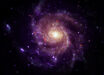
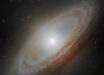
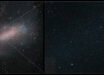
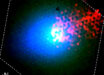
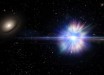
GRB 230906A occurred in a tiny galaxy in a stream of gas located about 4.7 billion light-years from Earth. Image credit: NASA / CXC / Penn State Univ / S. Dichiara / ESA / STScI / ERC BHianca 2026 / Fortuna and Dichiara, CC BY-NC-SA 4.0 / SAO / P. Edmonds.
Neutron stars are the cores left behind after a star much heavier than the Sun runs out of fuel, collapses on itself, and then explodes.
They are small but slightly more massive than the Sun, making them amazingly dense.
Astronomers consider them to be some of the most extreme objects in the Universe.
In recent years, they have collected data on mergers of two neutron stars inside of moderately sized or large galaxies.
This latest discovery, however, shows that a neutron star collision may take place inside a tiny galaxy.
“Finding a neutron star collision where we did is game changing,” said Dr. Simone Dichiara, an astronomer at Penn State University.
“It may be the key to unlocking not one, but two important questions in astrophysics.”
The first puzzle this unprecedented location for a neutron star collision may explain may explain is the fact that gamma-ray bursts, which can be produced by the collapse of two neutron stars, sometimes do not appear within the core of a galaxy, or any galaxy at all.
The other question this result could address is how elements like gold and platinum have been found in stars located at large distances from the centers of galaxies.
This neutron star collision is unexpectedly located in a tiny galaxy, about 4.7 billion light-years away, embedded within a stream of gas that stretches some 600,000 light-years long.
This stream was likely created when a group of galaxies collided hundreds of millions of years ago, stripping gas and dust from the galaxies and leaving it in intergalactic space.
“We found a collision within a collision,” said Dr. Eleonora Troja, an astronomer at the University of Rome.
“The galaxy collision triggered a wave of star formation that, over hundreds of millions of years, led to the birth and eventual collision of these neutron stars.”
To discover the GRB 230906A event, which occurred on September 6, 2023, the astronomers needed several NASA telescopes including the Chandra X-ray Observatory, Fermi Gamma-ray Space Telescope, Neil Gehrels Swift Observatory, and Hubble Space Telescope.
Fermi discovered the neutron star collision by picking up the distinctive signal of a gamma-ray burst, or GRB, explosion.
After using the InterPlanetary Network to derive a preliminary location for the Fermi source, astronomers then needed the sharp vision of Chandra, Swift, and Hubble to more precisely pinpoint the location of the object.
NASA’s missions are part of a growing, worldwide network that watches for these changes, to solve mysteries of how the Universe works.
“Chandra’s pinpoint X-ray localization made this study possible,” said Dr. Brendan O’Connor, a postdoctoral researcher at Carnegie Mellon University.
“Without it, we couldn’t have tied the burst to any specific source.”
“And once Chandra told us exactly where to look, Hubble’s extraordinary sensitivity revealed the tiny, extremely faint galaxy at that position.”
“We were only able to make this discovery after we put all the pieces together.”
This finding may explain why some GRBs do not appear to have host galaxies.
This result implies that some host galaxies are too small and faint to be seen in most optical light images from ground-based observatories.
The unusual location of GRB 230906A may also help explain how astronomers have spotted elements like gold and platinum in stars at relatively large distances from galaxies.
Such stars are generally expected to be older and to have formed from gas that had less time to be enriched in heavy elements from supernova explosions.
Through a chain of nuclear reactions, a collision between two neutron stars can produce heavy elements like gold and platinum, which astronomers witnessed in a well-documented collision seen in 2017.
Events like GRB 230906A could generate elements like these and spread them throughout the outskirts of galaxies, eventually appearing in future generations of stars.
An alternative explanation for the explosion is that it is located in a much more distant galaxy that is behind the galaxy group.
“We consider this to be a less likely explanation than the tiny galaxy idea,” the researchers said.
The discovery is reported in a paper published in the Astrophysical Journal Letters.
_____
S. Dichiara et al. 2026. A Merger within a Merger: Chandra Pinpoints the Short GRB 230906A in a Peculiar Environment. ApJL 999, L42; doi: 10.3847/2041-8213/ae2a2f