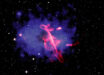
The Chandra team has released a striking new composite image of the Cocoon Nebula, a reflection and emission nebula in the constellation of Cygnus. The image blends high-energy X-rays with optical and infrared light to expose a cluster of newborn stars emerging through clouds of dust and gas.
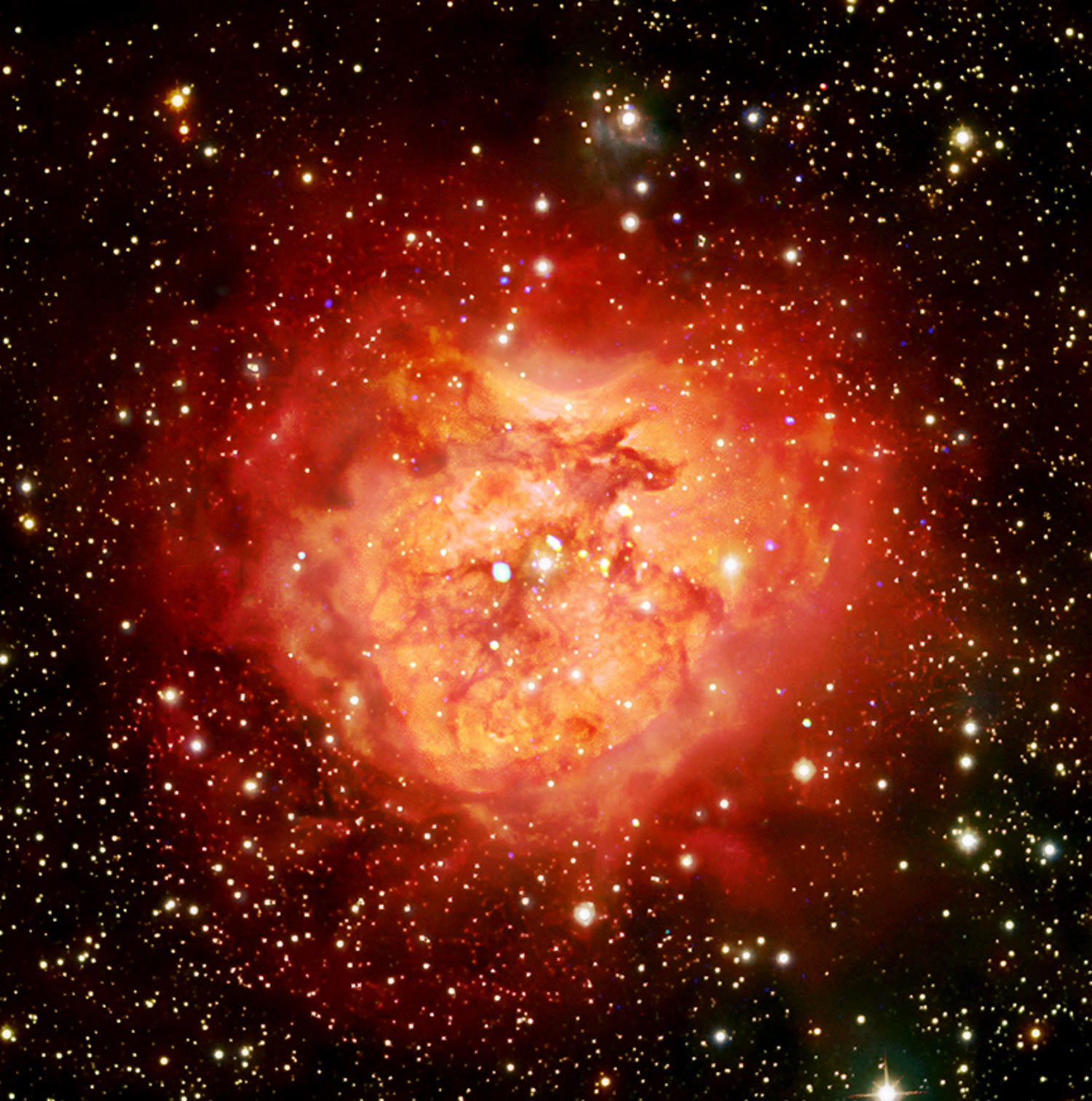
This composite image shows the heart-shaped Cocoon Nebula: X-ray data from Chandra reveal a cluster of new stars that are just poking through the stunning nebula; optical light data from astrophotographers Michael Adler and Barry Wilson, as well as infrared light data from WISE mission are also included. Image credit: NASA / CXC / SAO / JPL / Caltech / WISE / M. Adler / B. Wilson / L. Frattare.
The Cocoon Nebula is located approximately 2,650 light-years away in the constellation of Cygnus.
Otherwise known as IC 5146 or Collinder 470, the nebula is about 15 light-years across.
The object was first discovered by the American astronomer Edward Emerson Barnard on October 11, 1893.
“This image shows the Cocoon Nebula as a glowing, heart-shaped cloud set against a dense backdrop of countless stars scattered across the Milky Way,” the Chandra astronomers said in a statement.
“The nebula’s center is filled with warm reds, oranges, and golds, forming a luminous cocoon of gas and dust with soft, uneven edges that fade into the surrounding darkness.”
“Embedded within this glowing cloud are many young stars, some appearing as bright white or bluish points, while others are hidden and revealed only through X-ray light detected by NASA’s Chandra X-ray Observatory.”
“These X-rays trace a cluster of newly-formed, highly active stars concentrated near the nebula’s core,” they explained.
“The heart-shaped nebula itself shines through a mix of light emitted by these young stars and starlight reflected off surrounding dust.”
“Optical data from two astrophotographers and infrared observations from NASA’s Wide-field Infrared Survey Explorer (WISE) provide depth and texture, revealing a sparkling star field and the thick, dusty structures where new stars continue to form.”