Astronomers using the NASA/ESA/CSA James Webb Space Telescope have for the first time identified hydrogen sulfide gas in the atmospheres of three gas-giant exoplanets orbiting HR 8799, a 30-million-year-old star located in the constellation of Pegasus. They’ve found that the sulfur must have originated from solid material in the planets’ birth disk.

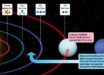
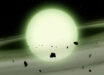
Artist’s rendering of the planetary system HR 8799 at an early stage in its evolution, showing the planet HR 8799c, a disk of gas and dust, and interior planets (Dunlap Institute for Astronomy & Astrophysics / Mediafarm)
HR 8799 resides approximately 129 light-years away from us in the constellation of Pegasus.
The star hosts a massive debris disk and four super-Jupiters: HR 8799b, c, d, and e.
The smallest planet is five times more massive than Jupiter, and the largest is ten times more.
The planets are far from their star — the closest one is 15 times farther away than Earth is from the Sun.
Unlike most exoplanet discoveries, which are inferred from analysis of data, these worlds are directly visible through ground-based telescopes.
“HR 8799 is somewhat unique because, thus far, it’s the only imaged system with four massive gas giants, but there are other known systems with one or two even larger companions and whose formation remains unknown,” said Dr. Jean-Baptiste Ruffio, an astronomer at the University of California, San Diego.
Using Webb’s unprecedented sensitivity, Dr. Ruffio and colleagues measured in detail the chemical make-up of three planets orbiting HR 8799: HR 8799c, d, and e.
The planets are about 10,000 times fainter than their star, and to extract the weak signal from the Webb data, the researchers developed new data analysis techniques.
“Carbon and oxygen in these planets have been studied from Earth-based observations in the past, but they’re not good signatures for solid matter because they can come from both ice or solids in the disk, or from gas,” said Dr. Jerry Xuan, a postdoctoral researcher at the University of California, Los Angeles and Caltech.
“But sulfur is unique because at the distance these planets are from their star, it has to be in the solids.”
“There’s no way these planets could have accreted sulfur as gas.”
The discovery of hydrogen sulfide means that the sulfur was accreted, or accumulated, in the form of solid matter from solids already present in the disk around the star from which the planets were born.
These solids were gobbled up as the planet formed, and because the young planet’s core and atmosphere were extremely hot, the solids evaporated into the sulfur gas present today.
The ratio of sulfur to hydrogen, as well as that of carbon and oxygen to hydrogen, is much higher than what is found in the star; therefore, the composition of the planets has to be quite different from that of the star.
The same puzzling pattern of uniform enrichment in heavy elements is also found in Jupiter and Saturn.
“It’s not easy to explain the uniform enrichment of carbon, oxygen, sulfur and nitrogen for Jupiter, but the fact that we’re seeing this in a different system is suggesting that there’s something universal going on in the formation of planets, that it’s quite natural to have them accrete all heavy elements in nearly equal proportions,” Dr. Xuan said.
According to the authors, their discovery will help the search for Earth-like exoplanets.
“The technique applied here, which lets researchers visually and spectrally separate the planet from the star, will be useful for studying exoplanets at great distances from Earth in clear detail,” Dr. Xuan said.
“The method is still limited to studying gas giants, but eventually, as telescopes get bigger and as instruments improve, scientists will be able to apply this kind of technique to study Earth-like planets.”
“Finding an Earth analog is the Holy Grail for exoplanet search, but we’re probably decades away from achieving that.”
“But maybe in 20-30 years, we’ll get the first spectrum of an Earth-like planet and search for biosignatures like oxygen and ozone in its atmosphere.”
The findings were published February 9, 2026 in the journal Nature Astronomy.
_____
JB. Ruffio et al. Jupiter-like uniform metal enrichment in a system of multiple giant exoplanets. Nat Astron, published online February 9, 2026; doi: 10.1038/s41550-026-02783-z