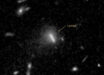
A stunning new image from the NASA/ESA Hubble Space Telescope captures an ongoing cosmic collision between two disk galaxies.

This Hubble image shows two interacting galaxies, known collectively as NGC 6052. The picture was snapped by Hubble’s Wide Field Camera 3 (WFC3). Five filters were used to sample various wavelengths. The color results from assigning different hues to each monochromatic image associated with an individual filter. Image credit: NASA / ESA / Hubble / A. Adamo et al.
NGC 6052 is located in the constellation Hercules, approximately 228 million light-years away.
Also known as Mrk 297, LEDA 57039 and Arp 209, the pair was first discovered on June 11, 1784 by the British astronomer William Herschel.
It was originally classified as a single irregular galaxy because of its odd shape.
However, astronomers now know that NGC 6052 actually consists of two disk galaxies that are in the process of colliding.
A long time ago gravity drew the two galaxies — NGC 6052A and NGC 6052B — together into the chaotic state we now observe.
Stars from within both of the original galaxies now follow new trajectories caused by the new gravitational effects.
However, actual collisions between stars themselves are very rare as stars are very small relative to the distances between them.
Eventually things will settle down and one day the two galaxies will have fully merged to form a single, stable galaxy.
Our own galaxy, the Milky Way, will undergo a similar collision in the future with our nearest galactic neighbor, the Andromeda Galaxy.
Although this is not expected to happen for around 4 billion years so there is nothing to worry about just yet.