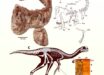
Paleontologists have confirmed that Praearcturus gigas, a creature that prowled shallow waters during the Devonian period, 415 million years ago, is the largest scorpion ever found.
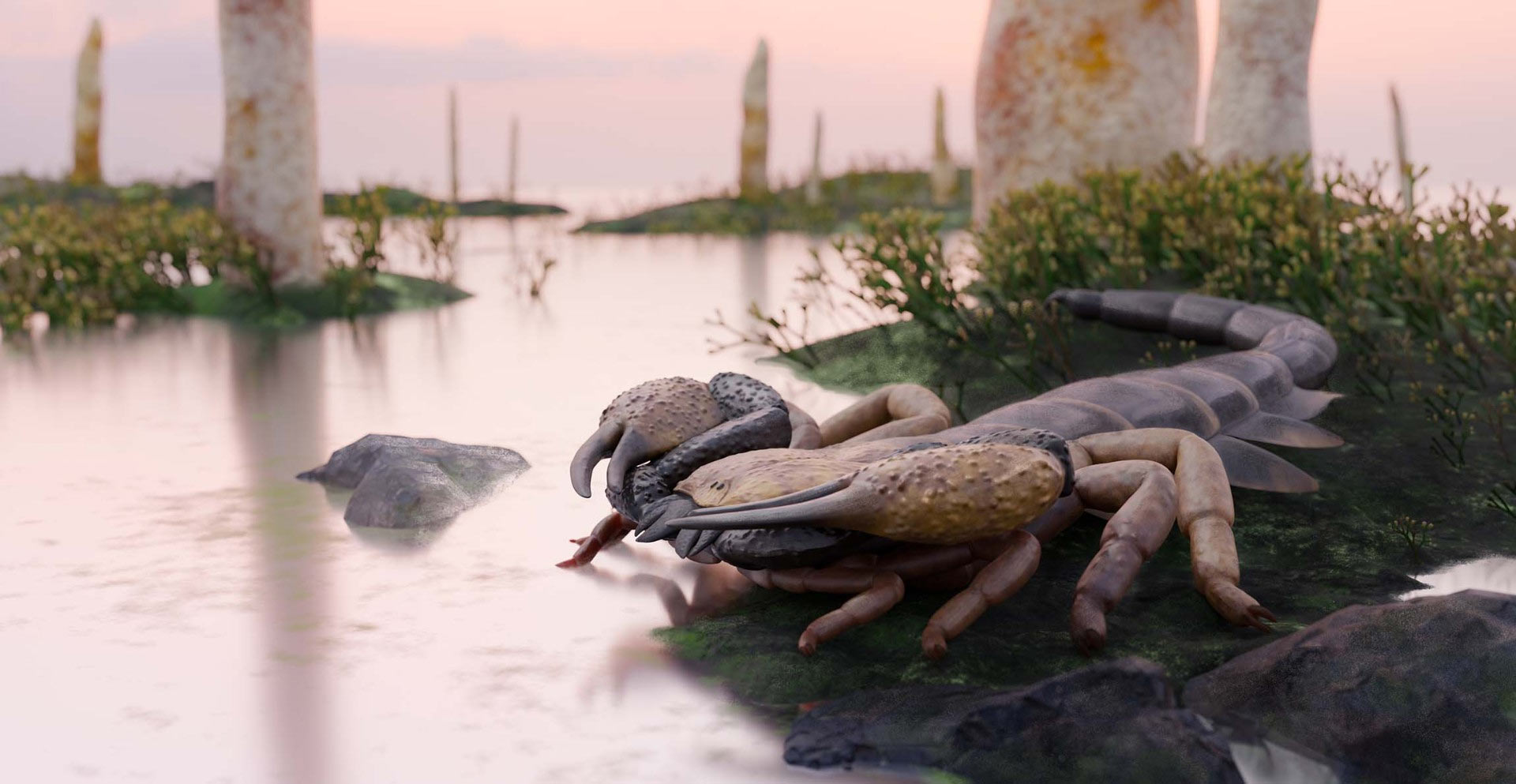
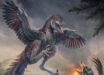
Praearcturus gigas. Image credit: Franz Anthony.
Measuring around 1 m (3.3 feet) in length and armed with pincers over 16 cm (6.3 inches) long, Praearcturus gigas would have been a formidable predator stalking floodplains around 415 million years ago.
Originally described as an isopod in 1871, and subsequently compared to various arthropod groups, it was re-described with limited illustration as a gigantic scorpion in the 1980s.
“When we think of giant arthropods, people often picture Carboniferous rainforests with giant millipedes or dragonfly-like insects from later in Earth’s history,” said lead author Dr. Richard Howard, curator of fossil arthropods at the Natural History Museum, London.
“But Praearcturus gigas lived at least 50 million years earlier, well before the evolution of trees, when life on land was only just getting started.”
“Confirming that this animal is a scorpion fundamentally changes our understanding of how and when these creatures evolved to such extraordinary sizes.”
In the new research, Dr. Howard and his colleagues used modern analytical techniques and comparisons with fossil species to suggest that Praearcturus gigas is a scorpion.
“Praearcturus gigas has puzzled us paleontologists for more than a century,” said co-author Dr. Russell Garwood, a paleontologist at the University of Manchester.
“By bringing together material from several collections and using cutting edge imaging techniques , we’ve been able to build a clearer picture of the animal than was previously possible, which is really exciting.”
“What makes Praearcturus gigas so interesting is that it became enormous at a time when life on land was otherwise very small. But it was a world that could somehow support a giant predator.”
“To try and better understand this ancient world we compared the size of fossil scorpions with other animals alive at the time.”
“To reach such extraordinary sizes, and conclude that perhaps it lived in water, where life was bigger.”
Praearcturus gigas lived during the Early Devonian epoch. Small plants and fungi had only recently begun to spread across the landscape, and complex terrestrial ecosystems like forests had yet to evolve.
This means that, unlike later giant arthropods, this scorpion did not benefit from the high atmospheric oxygen levels associated with the rise of forests.
Instead, its enormous size may reflect a world with relatively little competition from other large predators.
This suggests that Praearcturus gigas might have grown so big simply because there weren’t many other large animals around meaning it could dominate its environment in a way that wouldn’t be possible later on.
The fossils also hint that this giant scorpion may have led a partly aquatic lifestyle.
“The boundary between land and sea was much less defined at this time,” said co-author Dr. Greg Edgecombe, a paleontologist at the Natural History Museum, London.
“Praearcturus gigas gives us a fascinating glimpse into how early animals adapted to these changing environments.”
“It may even represent a lineage that returned to the water after earlier ancestors had already begun living on land.”
The team’s paper was published this week in the journal Palaeontology.
_____
Richard J. Howard et al. 2026. A revision of Praearcturus gigas: a giant scorpion from the Lower Devonian (Lochkovian) of Britain. Palaeontology 69 (3): e70064; doi: 10.1111/pala.70064