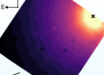
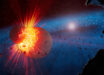
NASA’s Neutron star Interior Composition Explorer (NICER) has detected an extremely energetic explosion called a Type I X-ray burst from SAX J1808.4-3658, a millisecond X-ray pulsar located about 11,000 light-years away in the constellation Sagittarius. The explosion was caused by a massive thermonuclear flash on the surface of the neutron star. It released as much energy in 20 seconds as the Sun does in nearly 10 days and was the brightest X-ray burst among all bursting sources observed with NICER to date.

A thermonuclear blast on a pulsar called SAX J1808.4-3658 resulted in the brightest burst of X-rays seen to date by NASA’s Neutron star Interior Composition Explorer. Image credit: NASA’s Goddard Space Flight Center.
“This burst, detected by the NICER telescope on August 20, 2019, was outstanding,” said Dr. Peter Bult, an astrophysicist at NASA’s Goddard Space Flight Center and the University of Maryland, College Park.
“We see a two-step change in brightness, which we think is caused by the ejection of separate layers from the pulsar surface, and other features that will help us decode the physics of these powerful events.”
SAX J1808.4-3658 has a period of 2.49 milliseconds, meaning it is rotating 401 times per second.
It is in a binary system with a brown dwarf. A steady stream of hydrogen gas flows from the companion toward the neutron star, and it accumulates in a vast storage structure called an accretion disk.
Gas in accretion disks doesn’t move inward easily. But every few years, the disks around neutron stars like SAX J1808.4-3658 become so dense that a large amount of the gas becomes ionized. This makes it more difficult for light to move through the disk.
The trapped energy starts a runaway process of heating and ionization that traps yet more energy. The gas becomes more resistant to flow and starts spiraling inward, ultimately falling onto the neutron star.
Hydrogen raining onto the surface forms a hot, ever-deepening global ‘sea.’ At the base of this layer, temperatures and pressures increase until hydrogen nuclei fuse to form helium nuclei, which produces energy — a process at work in the core of our Sun.
“The helium settles out and builds up a layer of its own. Once the helium layer is a few feet deep, the conditions allow helium nuclei to fuse into carbon. Then the helium erupts explosively and unleashes a thermonuclear fireball across the entire pulsar surface,” said Dr. Zaven Arzoumanian, the deputy principal investigator for NICER and a researcher at NASA’s Goddard Space Flight Center.
Astronomers employ a concept called the Eddington limit — named for English astrophysicist Sir Arthur Eddington — to describe the maximum radiation intensity a star can have before that radiation causes the star to expand. This point depends strongly on the composition of the material lying above the emission source.
“Our study exploits this longstanding concept in a new way. We are apparently seeing the Eddington limit for two different compositions in the same X-ray burst. This is a very powerful and direct way of following the nuclear burning reactions that underlie the event,” said MIT Professor Deepto Chakrabarty.
As the burst started, NICER data show that its X-ray brightness leveled off for almost a second before increasing again at a slower pace.
The scientists interpret this ‘stall’ as the moment when the energy of the blast built up enough to blow the neutron star’s hydrogen layer into space.
The fireball continued to build for another two seconds and then reached its peak, blowing off the more massive helium layer.
The helium expanded faster, overtook the hydrogen layer before it could dissipate, and then slowed, stopped and settled back down onto the neutron star’s surface.
Following this phase, SAX J1808.4-3658 briefly brightened again by roughly 20% for reasons the team does not yet understand.
The findings were published in the Astrophysical Journal Letters.
_____
Peter Bult et al. 2019. A NICER Thermonuclear Burst from the Millisecond X-Ray Pulsar SAX J1808.4-3658. ApJL 885, L1; doi: 10.3847/2041-8213/ab4ae1
This article is based on text provided by the National Aeronautics and Space Administration.