Genetic evidence suggests the familiar seabird is actually four separate species — including one previously unknown to science — with three now facing growing climate threats.
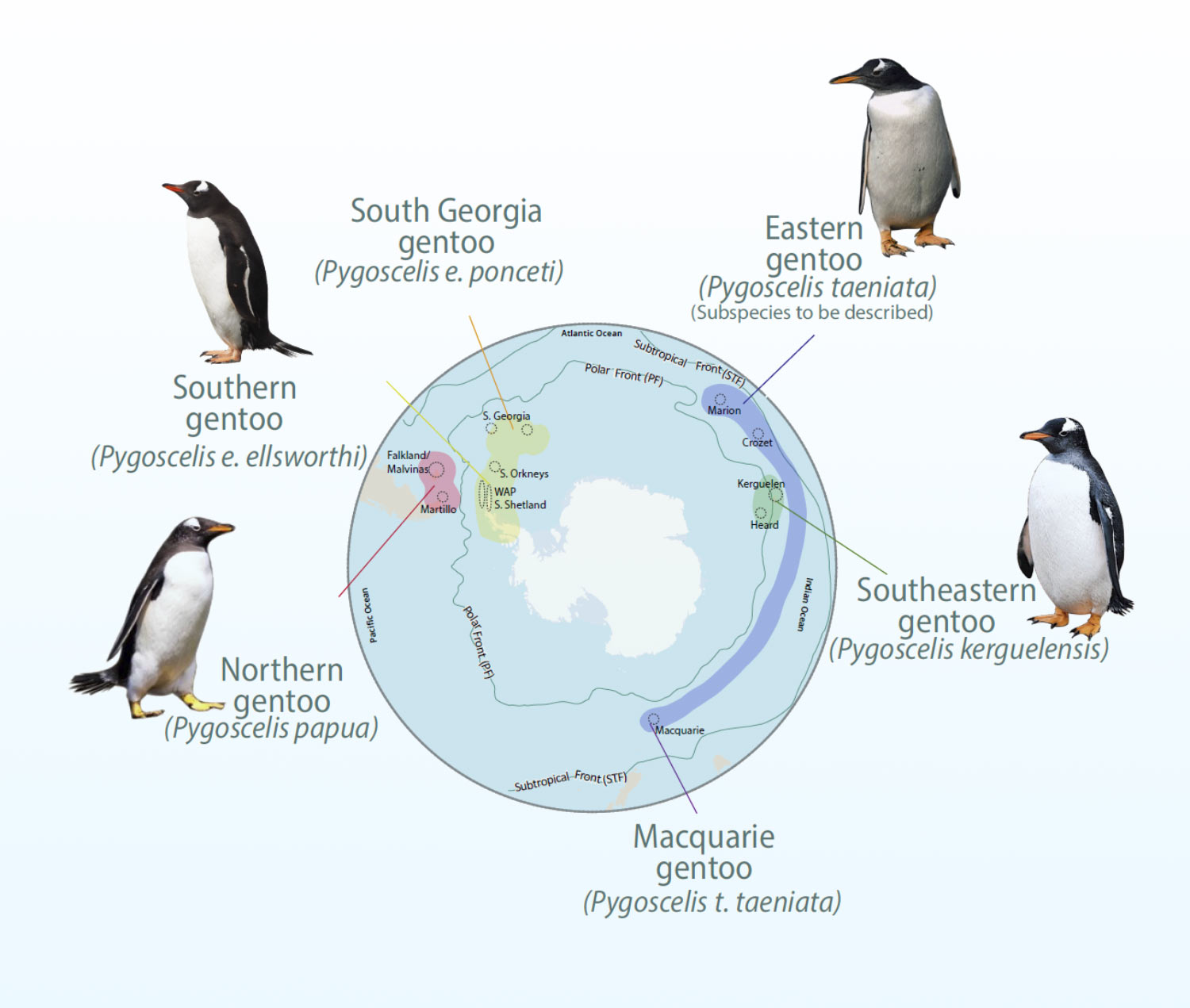
Geographic distribution of the four species of gentoo penguins around the Southern Ocean. Image credit: Noll et al., doi: 10.1038/s42003-026-10081-7.
Among seabirds, the gentoo penguin complex (Pygoscelis papua) represents a potential case of adaptive divergence, with morphological, ecological, and genetic differences observed among lineages across the Southern Ocean.
Recent studies have identified between four and six distinct evolutionary lineages occupying environments with little ecological overlap, suggesting that local conditions may have played a key role in driving their adaptive divergence.
“There’s probably no species of penguin where the taxonomy has been more debated than the gentoo penguin,” said University of California, Berkeley’s Professor Rauri Bowie.
“For over 100 years it’s been controversial as to how many species or how many subspecies there are.”
“What this paper does is try to address that question using cutting-edge integrative approaches.”
Professor Bowie and colleagues provided genetic evidence that what was once thought to be one widely dispersed species is actually four separate species of gentoo penguin.
“North of the Polar Front, where the water is warmer and saltier, there’s now the eastern lineage — Pygoscelis taeniata — on the Crozet, Marion and Macquarie Islands; and the northern lineage — Pygoscelis papua — which is restricted to the Falkland/Malvinas and Martillo Islands in South America,” they said.
“Right on the Polar Front lies the newly described, though low-population, southeastern lineage — Pygoscelis kerguelensis — which evolved on Kerguelen Island and likely nearby Heard Island.”
“Below the Polar Front is found the southern and most populous lineage — Pygoscelis ellsworthi — which thrives on the Antarctic Peninsula, coastal Antarctica and South Georgia Island.”
Pygoscelis kerguelensis was previously unrecognized because, except for slight differences in size and vocalization, it looks like every other gentoo: a white underside and black back, which are optimal for escaping predation while enabling prey capture in an ocean environment.
Yet it is clearly genetically different — what scientists refer to as a cryptic species.
“In Antarctica, of course, other species, not the gentoo, are threatened by climate change,” said Professor Juliana Vianna, a researcher at Andrés Bello National University.
“But the gentoo is of most concern in the sub-Antarctic region, an area of widely separated islands north of Antarctica governed by numerous countries, including Chile, South Africa, France, the Netherlands, Australia and New Zealand.”
“It’s very important that conservation institutions in all the different countries involved recognize and take appropriate action to save these three gentoo penguin species.”
The team’s paper was published in the journal Communications Biology.
_____
D. Noll et al. Integrative evidence reveals adaptive divergence and speciation in gentoo penguins. Commun Biol, published online April 23, 2026; doi: 10.1038/s42003-026-10081-7