Space debris — ranging from defunct satellites and discarded rocket stages to fragments from collisions — poses an ever-increasing threat to active spacecraft and human spaceflight. New research shows that surges in solar activity can accelerate the descent of space debris, reshaping how scientists predict satellite lifetimes and collision risks.
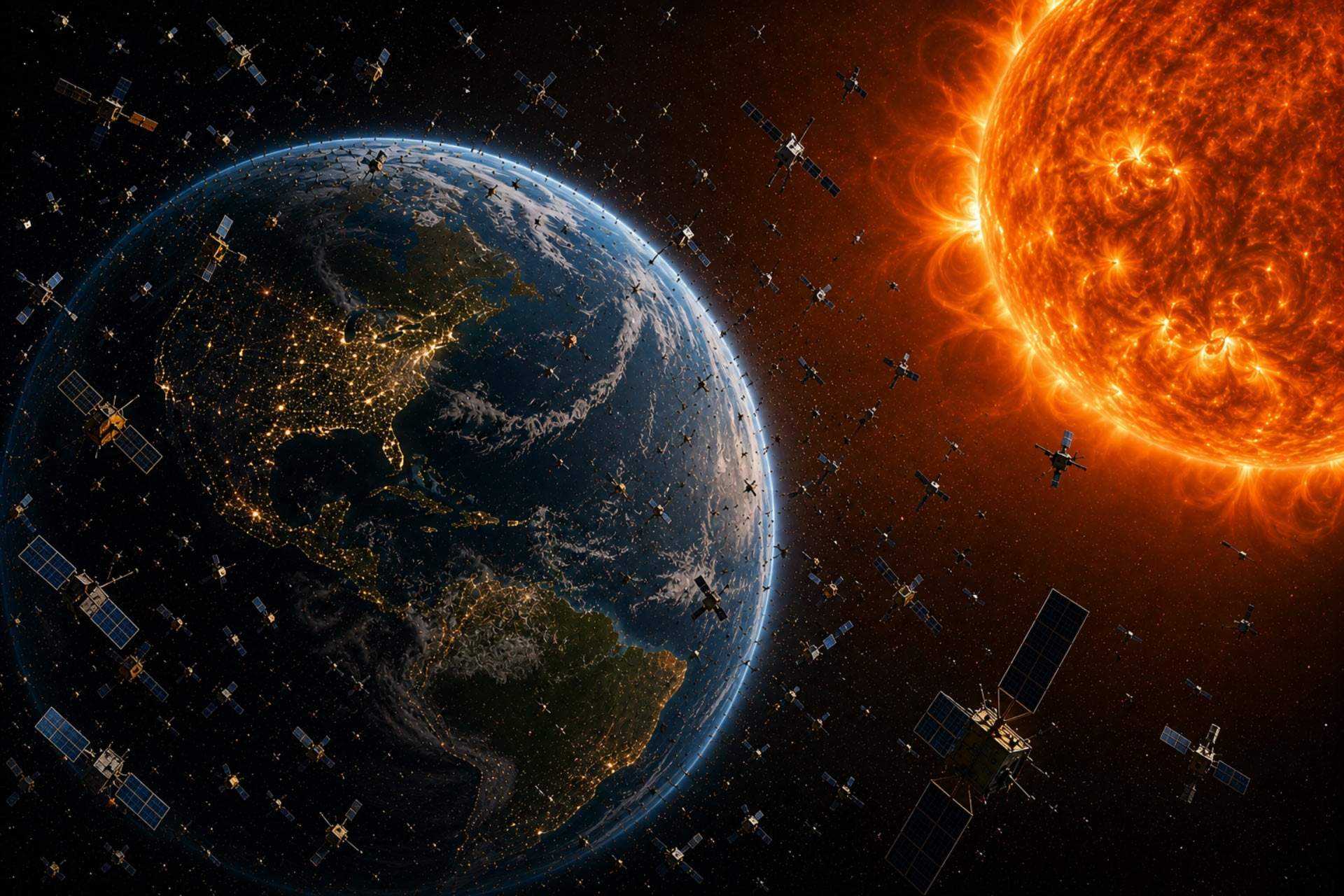
Space junk begins to fall down much faster once the Sun’s activity across the solar cycle reaches approximately 67% of its peak.
A low Earth orbit (LEO) between 400 and 2,000 km altitude is ideal for imaging and surveillance satellites and internet ‘mega-constellations’ such as Starlink.
Unfortunately, these days it’s also chock-full of ‘junk’ like old satellite debris and rocket stages, and these threaten new space launches. For example, even one collision may spread damage through a domino effect.
Because missions to capture space junk with robots are still in their infancy, scientists today focus mainly on tracking debris more accurately to identify the most dangerous objects for future removal.
“Here we show that space debris around Earth loses altitude much faster when the Sun is more active,” said Dr. Ayisha Ashruf, a researcher at the Vikram Sarabhai Space Centre.
“For the first time, we find that once solar activity passes a certain level, this loss of altitude happens noticeably more quickly.”
“This observation is expected to be key for planning sustainable space operations in the future.”
The Sun has an 11-year cycle of active and quiet phases — correlated with the number of sunspots — which results in changes in the intensity at which it emits
UV radiation and charged particles, for example helium nuclei and heavy ions.
When this outward stream peaks, like most recently in 2024, solar emissions heat and expand upwards into the Earth’s thermosphere (located between approximately 100 and 1,000 km, with a temperature between 500 and 2,500 degrees Celsius).
This in turns raises the atmospheric density around orbiting bodies (between 350 and 36,000 km) and increases the resistance or ‘drag’ on them, thus slowing them down and making them fall faster.
In the study, Dr. Ashruf and colleagues followed the historic trajectory of 17 LEO space junk objects over a 36-year period since the 1960s, during the 22nd through 24th solar cycles.
These objects orbit the Earth every 90 to 120 minutes at an altitude between 600 and 800 km, and are yet to reenter the atmosphere, where they will ultimately burn up.
Because space junk doesn’t perform active station-keeping maneuvers like satellites do, changes in the speed of their descent (orbital decay) only depends on fluctuations in thermospheric density.
“This makes space debris an excellent tool for tracing long-term solar-activity effect on atmospheric drag,” the researchers said.
They linked the trajectories to long-term data at the German Research Centre for Geosciences that track the number of sunspots and daily changes in the Sun’s radio and Extreme Ultraviolet (EUV) emissions.
The results show that when the number of sunspots is higher than two-thirds of its maximum, space junk passes through a ‘transition boundary’ — a threshold beyond which it begins to fall much faster.
“This threshold doesn’t seem to be tied to a fixed value of solar radiation, but rather to how close the Sun is to its peak activity,” Dr. Ashruf said.
“Around this point, the Sun produces more intense EUV radiation, which may be driven by changes in solar processes that become stronger near the peak.”
The scientists stress that their results are expected to help space scientists plan the trajectories of satellites better, avoiding collisions with space junk.
“Our results imply that when solar activity passes certain levels, satellites — just like space junk — lose altitude faster so that more orbit corrections are required,” Dr. Ashruf said.
“This directly affects how long satellites stay in orbit and how much fuel they need, especially for missions launched near a solar maximum.”
“What is most interesting is that all of this information comes from objects launched back in the 1960s.”
“They are still contributing to science, serving as valuable tools for studying long-term effects of solar activity on the thermosphere.”
The team’s paper was published today in the journal Frontiers in Astronomy and Space Sciences.
_____
Ayisha M. Ashruf et al. 2026. Characterizing solar cycle influence on long-term orbital deterioration of low-Earth orbiting space debris. Front. Astron. Space Sci 13; doi: 10.3389/fspas.2026.1797886