A new genus and species of massopodan sauropodomorph that lived during the Early Jurassic epoch has been identified from a partial skeleton unearthed in southwestern China. Named Xiangyunloong fengming, this dinosaur bridges a critical gap between early plant-eaters and the colossal four-legged sauropods that would later dominate the Mesozoic world.
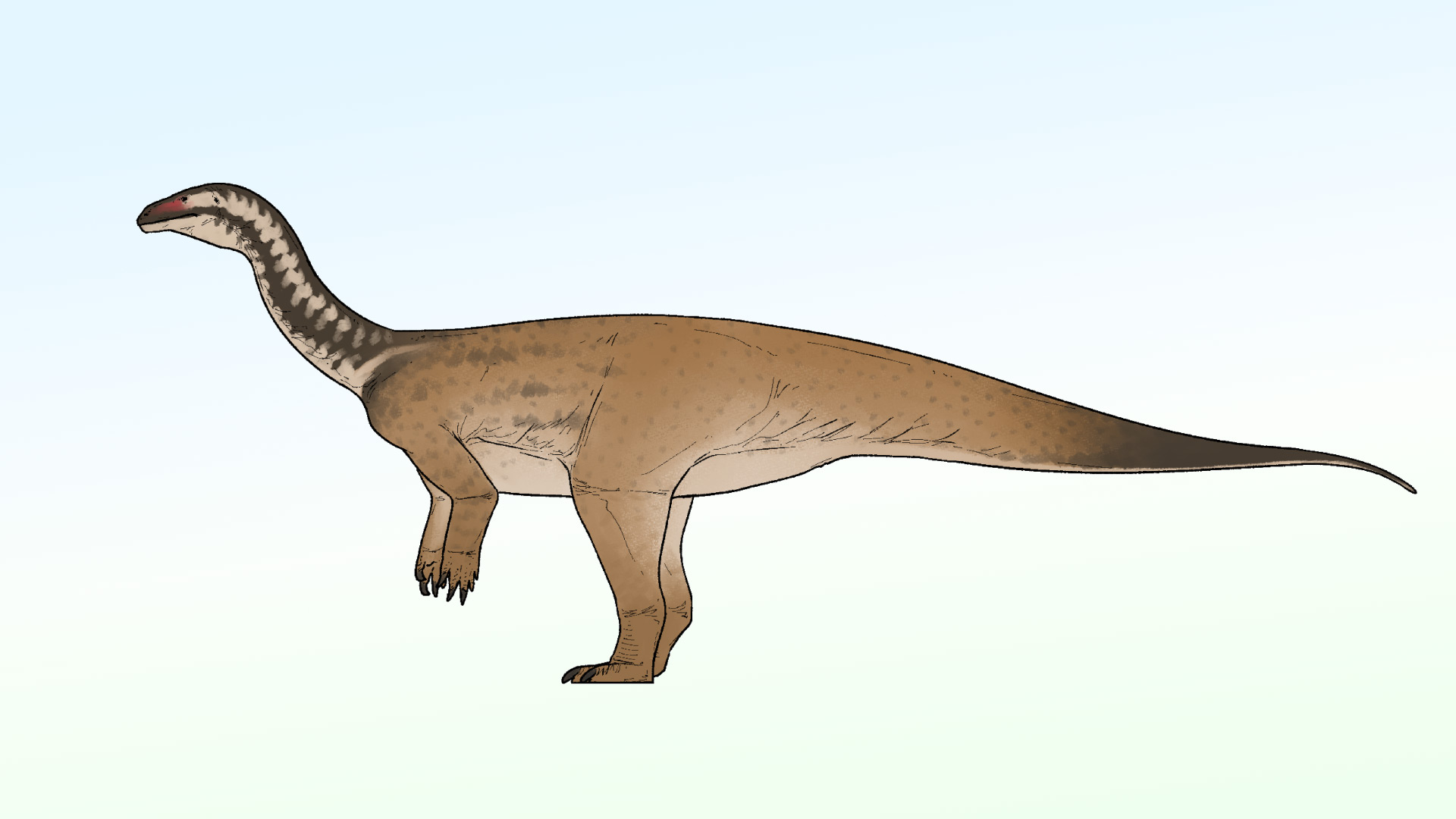
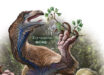
An artist’s impression of Xiangyunloong fengming. Image credit: Connor Ashbridge / CC BY 4.0.
Xiangyunloong fengming lived in what is now China during the Early Jurassic, roughly 190 million years ago.
Based on its preserved bones, the dinosaur stretched approximately 9-10 m (30-33 feet) in length, making it one of the largest known early-diverging sauropodomorph dinosaurs from China.
The species was a type of massopodan, a group of sauropodomorphs that lived during the Late Triassic to Late Cretaceous.
“The Early Jurassic epoch is a pivotal period in dinosaur evolution, witnessing the diversification and rise to dominance of sauropodomorph dinosaurs in the terrestrial ecosystem,” said Dr. Ya-Ming Wang from the Geological Museum of China and colleagues.
“Within this group, non-sauropodan massopodan sauropodomorphs played a crucial role in the evolutionary pathways leading to the gigantic body plans characteristic of sauropods.”
“Understanding the anatomy, diversity and paleobiogeography of these early-diverging sauropodomorphs is therefore fundamental to deciphering the origins of sauropods, which represent one of the most successful dinosaurian clades.”
Xiangyunloong fengming’s partial skeleton was found the Fengjiahe Formation in Luming town, China’s Yunnan province.
The specimen is represented by vertebrae from the neck, back and tail, as well as parts of the hip.
The analysis of the fossil shows that the dinosaur possessed an unusual combination of features that the researchers describe as an alternative evolutionary pathway: not the long neck that most people associate with giant dinosaurs, but an exceptionally robust and elongated tail.
The tail may have served as a counterbalance, allowing the animal to rear up on its hind legs to feed, despite a neck that was relatively short for its body size.
Using a phylogenetic analysis, the scientists found that Xiangyunloong fengming occupies an evolutionary position between earlier sauropodomorphs and more derived forms closer to true sauropods.
“The discovery of this new specimen significantly enriches the known Early Jurassic dinosaur fauna of southwestern China,” the authors said.
“It provides critical new anatomical features that enhance our understanding of morphological disparity and evolutionary patterns among the early-diverging sauropodomorphs.”
The findings were published on March 25 in the journal Royal Society Open Science.
_____
Shao-Bin Hu et al. 2026. A new sauropodomorph dinosaur from the Lower Jurassic Fengjiahe Formation of Dali of Yunnan Province, China. R Soc Open Sci 13 (3): 252219; doi: 10.1098/rsos.252219