Hundreds of camera-trap records from Bolivia and Peru suggest the short-eared dog (Atelocynus microtis), one of the world’s least-known canids and one of Latin America’s least-known carnivores, may be thriving in intact upland forests.
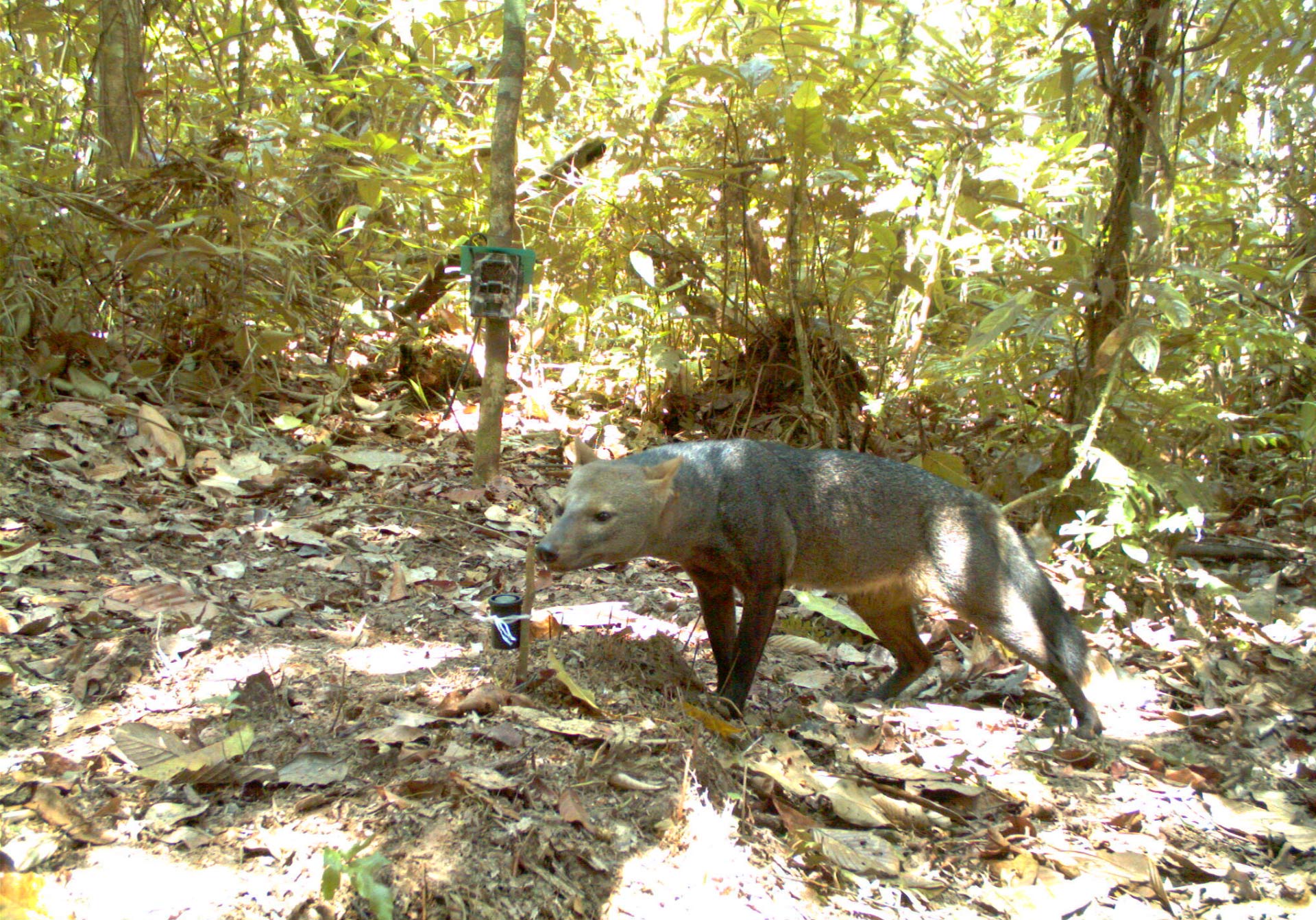
The short-eared dog (Atelocynus microtis) from a trap camera in Bolivia. Image credit: G. Ayala & M.E Viscarra.
“The short-eared dog, or ghost dog, is perhaps the least known medium- to large-sized Neotropical mammal and potentially one of the scarcest canids,” said Dr. Robert Wallace and his colleagues from Wildlife Conservation Society.
“Even the geographical and habitat distribution of this species is unclear, with its ecology virtually unknown.”
“After decades of speculation, more recent continental-scale habitat analyses suggest that short-eared dogs are forest specialists, with occupancy studies in southern Peru suggesting a strong preference for terra firme, or upland forests away from rivers.”
“Until recently, there were only six reported localities in Bolivia, four museum specimens, and two direct observations by experienced field biologists.”
“However, subsequent efforts to systematize national information on mammals and carnivores revealed substantially more confirmed localities for the species.”
For their research, the authors collected published and unpublished records of the short-eared dog’s distribution across Bolivia.
Between 2001 and 2024, they conducted 34 intensive camera-trap surveys across the lowland portions of the Greater Madidi-Tambopata Landscape in northwestern Bolivia and southeastern Peru, and the Llanos de Moxos Biocultural Landscape in northern Bolivia.
In total, they obtained 4,635 photos that represented 594 independent short-eared dog events during 21 (61.8%) of the 34 camera-trap surveys or 11 (47.8%) of 23 survey sites.
“This research is a wonderful example of how conservation technology and remote sensing — in this case the intensive use of camera traps — can provide substantial data on one of the least known species of the Amazonian rainforests,” Dr. Wallace said.
The camera traps revealed a unique physical profile the short-eared dog: a dark, dense coat ranging from blackish gray to reddish-brown, a large head with very small and rounded ears, short legs, and a long, bushy tail.
Intriguingly, the species even boasts partially webbed paws, a trait that is completely unique among Amazonian canids.
“The most surprising aspect of the results was that despite being an almost mythical beast, short-eared dogs are much more abundant than we had imagined,” the researchers said.
While they are by no means a common species, their camera-trap capture rates and an estimated density of 15 individuals per 100 km2 suggest they are not as rare as scientists once feared.
“Short-eared dogs are primarily diurnal, meaning they are most active during the day, with their activity peaking between 6:00 a.m. and 12:00 p.m,” the scientists said.
“So, where are these ghost dogs hiding? The data points to intact forests.”
“The short-eared dog is a true forest specialist, showing a strong preference for terra firme — upland forests away from rivers.”
“This specialized, dense habitat requirement is a primary reason for the species’ reduced visibility to humans.”
Because their survival is intricately tied to continuous, intact forest cover, the conservation of the short-eared dog depends heavily on the creation and effective management of protected areas.
“We found that the relative abundance of short-eared dogs was noticeably higher in national protected areas and Indigenous territories that overlap with these protected zones, compared to unprotected areas,” the authors said.
“The most important management strategy is the protection of Amazonian forest canopy for which the creation and effective management of protected areas is the most important element, in combination with the sustainable management of Indigenous territories.”
“While we now know that this elusive canid is secretly thriving in the deep forests of Bolivia and Peru, its future relies entirely on our ability to protect its home.”
The results were published online on March 27, 2026 in the journal Neotropical Biology and Conservation.
_____
R.B. Wallace et al. 2026. Unveiling the ghost: short-eared dog (Atelocynus microtis) distribution, activity patterns, habitat use, relative abundance, and occupancy in Bolivia. Neotropical Biology and Conservation 21 (1): 49-66; doi: 10.3897/neotropical.21.e183324