Paleontologists have identified a previously unknown species of amphicyonid — the extinct family of carnivorous mammals popularly known as bear-dogs — from two specimens unearthed at a rich fossil site in the Vallès-Penedès Basin near Barcelona, Spain.
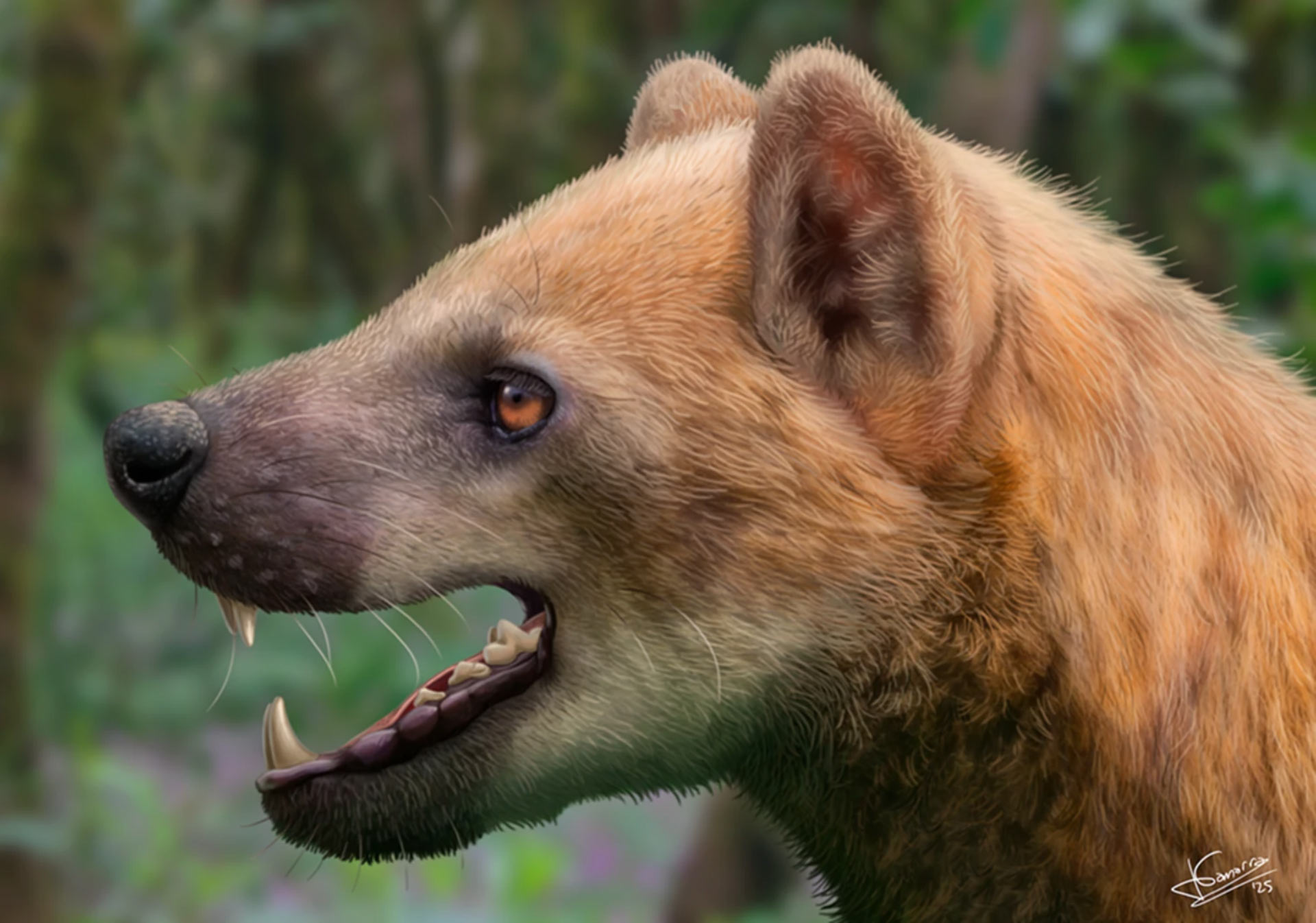
Paludocyon moyasolai. Image credit: Jesús Gamarra.
Dubbed Paludocyon moyasolai, the new species lived during the Middle Miocene epoch, roughly 15.9 million years ago, in what was then a warm, forested landscape dotted with shallow lakes.
The animal belonged to the family Amphicyonidae, an extinct group of predators commonly known as bear-dogs because they combined features seen in both modern bears and dogs, though they were neither.
“The Amphicyonidae were an important component of carnivoran assemblages in North America and Eurasia during much of the Cenozoic Era,” said Dr. Jorge Morales from the Museo Nacional de Ciencias Naturales-CSIC and his colleagues.
“In Africa, the oldest known records of amphicyonids date back to the Early Miocene, and they persisted there until the end of the Late Miocene, constituting the latest known records of this group.”
“Recent work argued for a North American origin of the family. This hypothesis is supported by the more complete and diverse Paleogene record of amphicyonids in North America than in Western Europe and Asia.”
The paleontologists found two specimens of Paludocyon moyasolai at the site of els Casots in the Vallès-Penedès Basin, Spain.
The fossils consist of a compressed but well-preserved partial skull with most of its teeth intact, along with an isolated lower molar recovered separately.
Both specimens are now housed at the Institut Català de Paleontologia Miquel Crusafont in Sabadell, Spain.
According to the researchers, Paludocyon moyasolai can be distinguished from its closest relatives by the unusual proportions of its molar teeth.
In particular, its second upper molar was broader than the first upper molar, while its third upper molar was exceptionally large and highly developed.
These traits have not been observed in other known members of the genus Paludocyon.
To determine where Paludocyon moyasolai fits on the evolutionary tree, Dr. Morales and co-authors compared its teeth with those of related species from Europe and North America.
Their results suggest that the new species represents the earliest branch of Paludocyon, making it one of the most primitive known members of the group.
They also support the idea that the long-recognized genus Cynelos is not a natural grouping — technically, it is paraphyletic, meaning its members do not all share a single common ancestor exclusive to the group.
Three North American species currently assigned to Cynelos present a particular puzzle.
The analysis places them closer to Paludocyon than to the European Cynelos species, yet their exact classification remains unresolved.
The scientists suggest these North American animals may have evolved independently from their European counterparts, possibly descending from Asian ancestors or from endemic North American lineages.
“The phylogenetic analysis indicates that Cynelos is paraphyletic but supports the monophyly of Paludocyon, with the new species being recovered as its basal-most member,” the authors said.
“It supports a distant relationship between the Cynelos species from Europe (Cynelos rugosidens and Cynelos lemanensis) and the Paludocyon clade, justifying their classification as distinct genera.”
The discovery is reported in a paper published in the Journal of Mammalian Evolution.
_____
J. Morales et al. 2026. A new species of Paludocyon (Carnivora: Amphicyonidae) from the early Middle Miocene of els Casots (Vallès-Penedès Basin, Barcelona, Spain). J. Mamm. Evol 33, 29; doi: 10.1007/s10914-026-09814-6