A new study analyzing the walking patterns of predatory mammals suggests that the extinct thylacine (Thylacinus cynocephalus) likely hunted more like an opportunistic pouncer than the wolf-like pursuit predator it is often portrayed as.
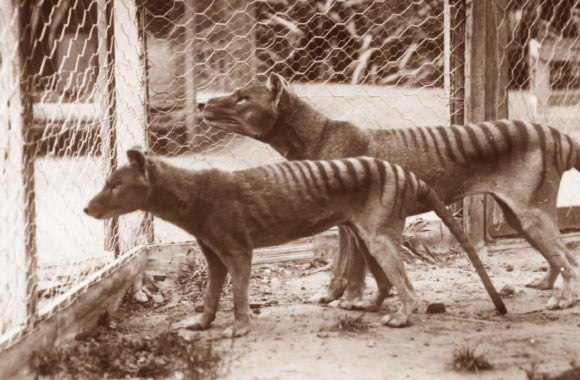
Tasmanian tigers (Thylacinus cynocephalus) in captivity. Image credit: University of Melbourne / Museums Victoria.
“The thylacine was a large (10-28 kg) marsupial carnivore that was native to mainland Australia, Tasmania, and New Guinea before being extirpated from both the mainland and New Guinea approximately 3,500 years ago, and later from Tasmania in the 1930s,” said Dr. Christofer Clemente from the University of the Sunshine Coast and his colleagues.
“The animal belongs to the order Dasyuromorphia, whose members range from mostly insect-eating smaller species (less than 250 g) like Antechinus, Phascogales, and dunnarts (Sminthopsis), to larger species like quolls (Dasyurus) and Tasmanian devils (300 g to 10 kg).”
“The smaller species of this group adopt a similar posture to small rodents, while the larger species have a much more erect posture, following the trend observed in placental mammals.”
“Quolls and Tasmanian devils are identified as solo ambush predators; however, devils are also considered carrion specialists. All are capable of living in scansorial or highly complex environments, and, like most marsupials, opt to utilize bounding gaits instead of galloping during high-speed locomotion.”
“What sort of predator was the thylacine? Previous work based on morphology suggests it functioned as either a dog-like or cat-like predator, leading to the popular terms ‘marsupial wolf’ or ‘Tasmanian tiger,’ respectively.”
In the new research, the authors used geometric morphometrics to compare the locomotion of 48 species of carnivorous mammals, from house cats and hyenas to wolves and Tasmanian devils.
They digitized 115 video-recorded strides, tracking 19 body landmarks frame by frame to build a mathematical ‘shape space’ describing how each animal’s posture shifts during a stride.
The species were sorted into five hunting-strategy groups — anteaters, opportunistic grapplers, large grapplers, opportunistic pouncers, and social hunters — based on traits like pursuit distance, prey size, and sociality.
The researchers then tested how well these ecological categories lined up with locomotor shape, while accounting for body mass, gait type, and evolutionary relatedness.
Using rare archival footage of the last captive thylacine at Beaumaris Zoo in Hobart, they measured its walking posture and compared it against the locomotor signatures of the living species.
Across several statistical approaches, the thylacine’s gait most closely resembled that of opportunistic pouncers, though it also showed some similarity to anteaters in overall posture.
“We used archival footage and modern biomechanical analysis to examine how posture, movement and locomotion affected animals’ hunting styles,” Dr. Clemente said.
“We then grouped the animals into five clusters, ranging from social pursuit hunters to predators that grappled with or pounced on their prey.”
“It was fascinating to find the Tasmanian tiger was more likely an opportunistic pouncer, similar to a fox, jackal or coyote, rather than a grappler like a tiger or a wolf,” he said.
“The results showed that hunting ecology was reflected in the way predators moved, particularly during faster, high-performance gaits associated with acceleration, maneuvring and prey capture.”
“Walking patterns were more strongly influenced by evolutionary history, but still retained information about hunting behavior.”
The study was published in the journal BMC Ecology and Evolution.
_____
J.L. Gaschk et al. 2026. Convergent carnivores or divergent dasyurids? Inferring predation and locomotor strategies of extant and extinct carnivorous marsupials from locomotor shape. BMC Ecol Evo 26, 69; doi: 10.1186/s12862-026-02569-x