A new camera technique in Congo’s Lomami National Park reveals how monkeys, pangolins and civets divide up life between the ground, the understory and the canopy.
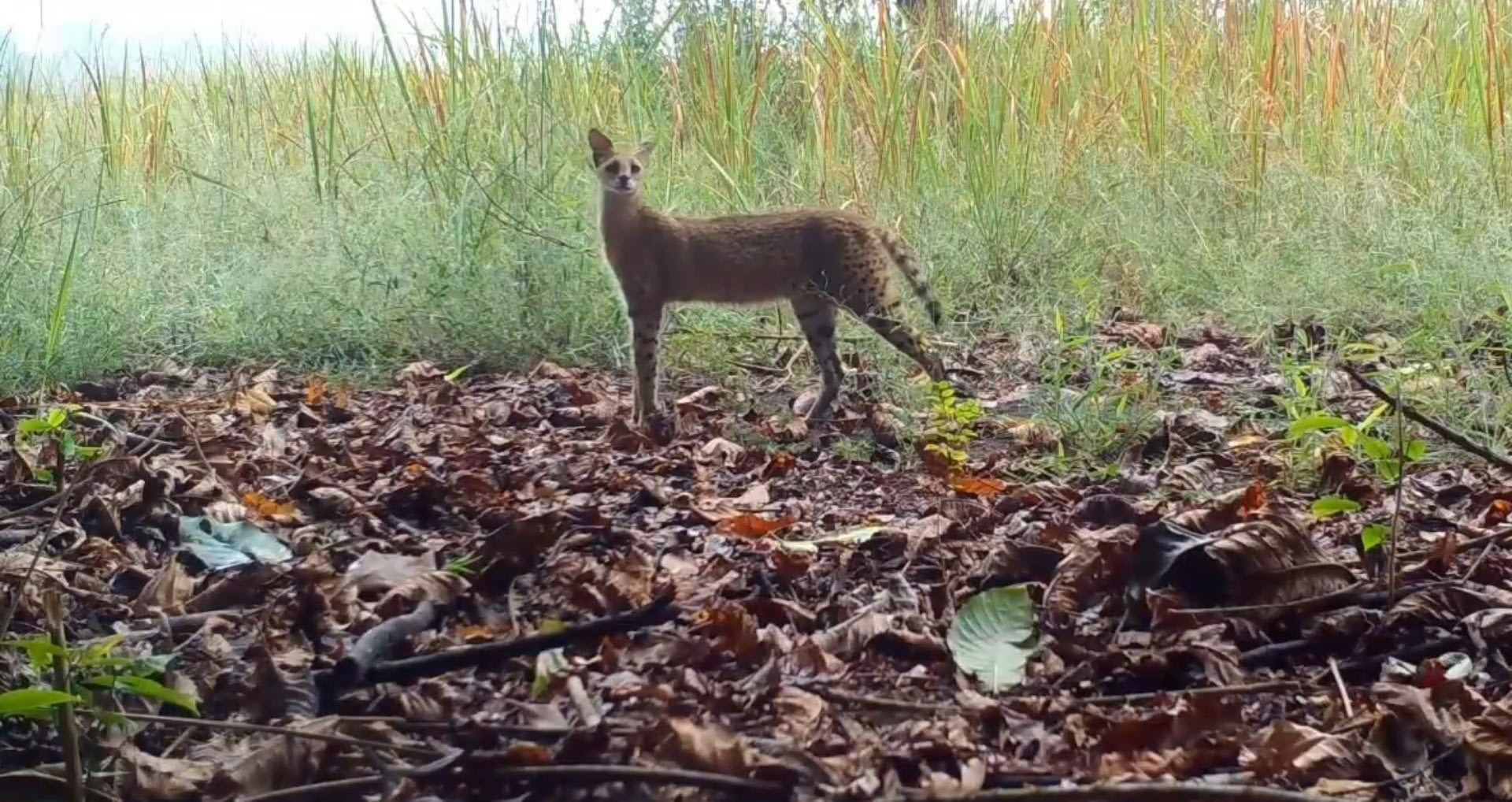
The serval (Leptailurus serval), a medium-sized wild cat native to Africa. Image credit: Florida Atlantic University.
Lomami National Park is located in the Tshopo and Maniema provinces in the Democratic Republic of the Congo.
Established in 2016, the national park covers an area of 8,874 sq.km and is comprised of evergreen rainforests, semievergreen rainforests, swamp forests, and savannas.
The area is home to a rich diversity of flora and fauna, including many rare mammals of high conservation concern, such as bonobo, okapi, dryas monkey, and lesula.
Using infrared cameras from the forest floor to the canopy, Florida Atlantic University researchers created a 3D view of biodiversity in the park.
In one study, published in the Journal of Mammalogy, they developed the method to examine species richness, community composition and vertical habitat use across three survey areas in the park and its buffer zone.
They identified 47 mammal species representing primates, carnivores, rodents, artiodactyls (even-toed hoofed mammals like red river hogs), and pangolins, which are among the world’s most heavily trafficked mammals.
Eight species were detected outside their currently documented geographic ranges, providing records that could help inform future range assessments.
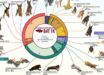
The cameras revealed a remarkably layered community, with 32 species detected on the ground, 23 in the understory and 22 in the canopy.
“The cameras essentially gave us a way to turn a single point in the forest into a vertical column of observation” said lead author Dr. Daniel Alempijevic, a researcher at Florida Atlantic University.
In another study, published in the journal Ecology, the scientists used the data from 25 mammal species that were detected most often to develop a multispecies, multi-scale occupancy model.
The animals included bonobos, red-tailed monkeys, African palm civets, red river hogs, long-nosed mongooses, rope squirrels, among others.
Combining observations from the ground, understory and canopy revealed patterns that would have been missed at any single level.
Most notably, mammal occupancy increased with elevation — a surprising result considering how little elevation gain there is within the swampy central Congo Basin.
Even across such subtle topographic variation, the full camera-column approach revealed an important relationship that would have been missed from the forest floor alone.
“Most biodiversity surveys essentially flatten the forest into a two-dimensional world,” said lead author Dr. Daniel Gorczynski, also of Florida Atlantic University.
“What’s unique is that we were able to look at the same forest from the ground all the way into the canopy and then ask how that additional dimension changes what we think we know about an entire mammal community.”
“We found that it can fundamentally change the ecological story.”
_____
Daniel Alempijevic et al. 2026. Multi-strata ‘camera columns:’ an effective approach to characterize non-volant mammal communities in tropical forests. Journal of Mammalogy 107 (4): 794-809; doi: 10.1093/jmammal/gyag047
Daniel Gorczynski et al. 2026. Ground-to-canopy monitoring reveals hidden ecological patterns in Congo Basin mammals. Ecology 107 (7): e70449; doi: 10.1002/ecy.70449