A 7.2-million-year-old thigh bone unearthed at the fossil site of Azmaka in southern Bulgaria displays a mosaic of features suggesting a unique combination of locomotor capabilities, including aspects of terrestrial quadrupedalism and bipedalism, according to a research team led by Professor Madelaine Böhme from the Senckenberg Centre for Human Evolution and Palaeoenvironment at the University of Tübingen. The paleoanthropologists have tentatively attributed the fossil to Graecopithecus, a fossil ape species known from fragmentary remains in the Balkans and sometimes proposed as the earliest hominin.
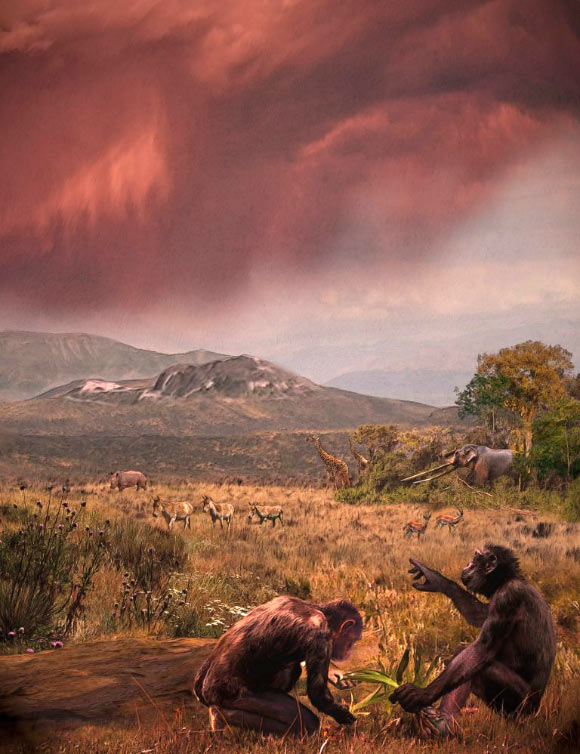
Graecopithecus freybergi lived 7.2 million years ago in the dust-laden savannah of the Athens Basin. This view from Graecopithecus freybergi’s place of discovery, Pyrgos Vassilissis, to the southeast over the plain of Athens and under a reddish cloud of Sahara dust; in the background: Mount Hymettos and Mount Lykabettos. Image credit: Velizar Simeonovski.
Graecopithecus is a controversial fossil ape from the Late Miocene, dated to about 7.2 million years ago.
Some researchers have proposed that it may represent the earliest hominin — possibly even older than fossils traditionally linked to early hominins in Africa.
Until now, Graecopithecus has been known from just two fossils: a partial lower jaw with teeth, discovered in 1944 near Athens, Greece; and an isolated upper premolar from Azmaka, Bulgaria, described in the 2010s.
“At 7.2 million years old, this ancestor, which we classify as belonging to the genus Graecopithecus, could be the oldest known human,” said University of Toronto’s Professor David Begun, co-author of the new study.
In the study, the researchers examined a nearly complete femur (thigh bone) of Graecopithecus from the Azmaka site.
The new fossil was found in 2016 in floodplain deposits dated to about 7.2 million years ago.
The Azmaka bone has a spherical femoral head clearly set off from the neck and an elongated, obliquely ascending medial margin of the neck — a configuration characteristic of hominoids.
However, the specimen does not show the full suite of specializations seen in later bipeds.
The neck-shaft angle falls within the lower range of modern humans and near estimates for early hominins such as Orrorin, but below the higher angles typical of suspensory apes like orangutans.
According to team, the combination of traits points to a transitional form of bipedalism: neither a specialized suspensory climber nor a fully committed terrestrial biped.
Body mass estimates derived from femoral head and shaft dimensions suggest a Graecopithecus individual weighing roughly 23 to 24 kg, comparable to a small chimpanzee.
“A number of external and internal morphological features, such as the elongated, upward-pointing neck between the femur shaft and head, special attachment points for the gluteal muscles, and the thickness of the outer bone layer, have similarities with bipedal fossil human ancestors and humans,” said Professor Nikolai Spassov, a researcher at the Bulgarian National Museum of Natural History.
“This is where they differed from the thighs of tree-dwelling apes.”
“However, Graecopithecus did not quite move the way modern humans do.”
The Azmaka environment, reconstructed as bush and forest savanna near a braided river system, suggests that early terrestrial bipedalism may have emerged outside dense forests.
The authors hypothesize that descendants of this population could have dispersed from Eurasia into Africa amid climatic and environmental shifts in the eastern Mediterranean during the Late Miocene, potentially contributing to the ancestry of later African apes and hominins.
Whether the Azmaka femur ultimately reshapes the geographic narrative of human origins will depend on further discoveries.
But for now, it provides a rare glimpse of how and where upright walking may have first taken hold — in a landscape of seasonal rivers and open woodland, millions of years before the earliest widely accepted members of the human lineage appeared in Africa.
“Graecopithecus represents a stage in human evolution between our arboreal and ground-dwelling ancestors, such as the almost 12-million-year-old Danuvius guggenmosi from the Hammerschmiede site in southern Germany, and more recent finds from East Africa,” Professor Begun said.
“One could certainly describe it as a missing link. Graecopithecus most likely descended from the eight- to nine-million-year-old Balkan-Anatolian apes like Ouranopithecus and Anadoluvius, which in turn evolved from ancestors in western and central Europe.”
“We know that large-scale climate changes in the eastern Mediterranean and western Asia led to the periodic emergence of extensive semi-deserts and deserts eight to six million years ago.”
“This set off several waves of dispersal of Eurasian mammals to Africa and laid the foundation for today’s mammal fauna of African savannas,” Professor Böhme concluded.
The team’s results were published in November 2025 in the journal Palaeobiodiversity and Palaeoenvironments.
_____
N. Spassov et al. An early form of terrestrial hominine bipedalism in the Late Miocene of Bulgaria. Palaeobio Palaeoenv, published online November 13, 2025; doi: 10.1007/s12549-025-00691-0