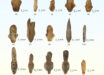
An international team of archaeologists has examined a total of 85 pottery sherds with substantial amounts of foodcrusts from 13 archaeological sites across Northern and Eastern Europe i dating from the 6th to the 3rd millennium BCE, of which 58 have allowed for identification of plant tissues, such as wild grasses and legumes, fruits, and the roots, tubers, leaves and stems of herbaceous plants. The results demonstrate that the choice of plant foods was remarkably selective, with hunter-gatherers favoring certain plant species and even their parts over others and combining these with specific animal ingredients.

Prehistoric Europeans approached plant foods selectively, consciously choosing certain species over others, and combining these with specific animal ingredients; such practices would have created new esthetics, tastes, flavors and textures that would be hard to achieve without pottery technology and may have contributed to the motivation for its invention/adoption.
Foraging for wild plants was an inherent component of prehistoric subsistence strategies, but direct evidence of this practice, details of the types of foraged plants, and their specific uses, is often obscure.
A common technique for interpreting ancient diets involves analyzing fatty residues in ancient pottery. This method is limited, however, as it mostly provides insights only into animal remains.
In the new study, University of York researcher Lara González Carretero and her colleagues combined multiple techniques, including microscopic examination and chemical analysis, to identify the remains of plants that were eaten by ancient European hunter-gatherers.
They examined organic remains found in 58 pieces of pottery uncovered at 13 archaeological sites across Northern and Eastern Europe dating between the 6th and 3rd millennium BCE.
This method recovered tissue samples of a wide variety of plants, including grasses, berries, leaves, and seeds.
In many cases, plant remains were found alongside those of animals, most often fish and other seafood.
The exact mixtures and ingredients varied from region to region, most likely reflecting which resources were locally available as well as local cultural practices.
The findings emphasize the important role of plants and aquatic foods in the diets of early Europeans.
The results also support the idea that these communities regularly used pottery technology for food preparation and that each culture had their own complex culinary traditions.
“Our results demonstrate that the choice of plant foods was remarkably selective, with hunter-gatherers favouring certain plant species and even their parts over others and combining these with specific animal ingredients,” the researchers concluded.
“The results also reveal that our knowledge of plant processing in pottery is likely to be grossly under-represented by relying on lipid residue analysis alone.”
Their paper appears online in the journal PLoS ONE.
_____
L. González Carretero et al. 2026. Selective culinary uses of plant foods by Northern and Eastern European hunter-gatherer-fishers. PLoS One 21 (3): e0342740; doi: 10.1371/journal.pone.0342740